Blog

All General Tips Panama City Toyota Dealer Panama City Toyota Service Car Care Tips Panama City Used Cars
2027 toyota tundra towing capacity
in Panama City Toyota Dealer

Toyota Tundra i-FORCE MAX Towing and Payload: Start With Your Trailer

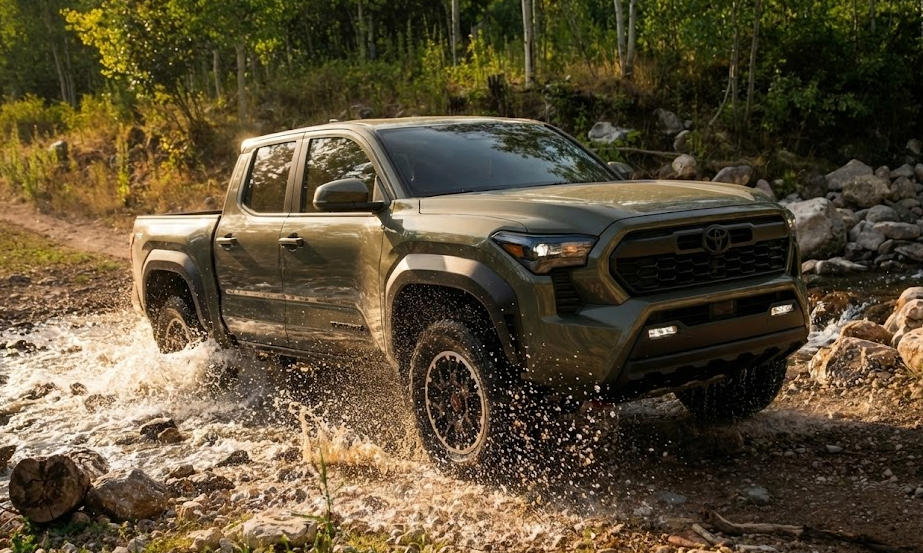
Toyota truck guide Towing Capacity vs. Payload: Understanding the Limits That Matter Most When Hauling Home / Blog / Toyota Tundra i-FORCE MAX Towing and Payload: Start With Your Trailer The Toyota Tundra i-FORCE MAX can give you strong hybrid power for towing, but its engine badge does not tell you how much a particular truck can tow or carry. Start with the loaded trailer weight, then check the truck's towing rating, payload, and hitch limits. Toyota's 12,000-pound Tundra lineup maximum does not apply to every hybrid configuration. That distinction matters if you are choosing a truck for a boat, camper, or work trailer. It is possible to be below a trailer-weight limit and still run out of room for passengers and gear under the truck's load limits. A few numbers checked before you buy can prevent an expensive mismatch later. Tundra i-FORCE MAX Towing Guide: Ratings, Payload, and Truck Choice What Does i-FORCE MAX Add to the Tundra? Towing Capacity vs Payload: Check Both Why Configuration and Model Year Matter Should You Choose Hybrid or Gas for Towing? Build a Towing Worksheet Before You Shop Compare Two Loading Plans for the Same Truck What to Ask When Weighing Your Truck and Trailer Check the Hitch and Trailer Equipment Separately Choose a Grade That Works When the Trailer Is Parked Plan Maintenance and Learn the Assistance Features Bring the Trailer Decision Into the Purchase Conversation Questions to Resolve Before Delivery What to Bring When You Compare Trucks Key Takeaways Frequently Asked Questions What Does i-FORCE MAX Add to the Tundra? The Tundra's i-FORCE MAX is a hybrid powertrain that pairs a twin-turbo V6 with an electric motor and a 10-speed automatic transmission. It uses gasoline and does not plug in. Toyota lists 437 horsepower and 583 lb-ft of torque for the 2026 hybrid and repeats those output figures in its 2027 announcement. Extra output can be appealing when you want a truck that also handles everyday driving. It does not automatically make the hybrid the highest-rated tow configuration. The question is whether the specific truck has the capacity, equipment, and cabin you need for the way you will use it. Towing Capacity vs Payload: Check Both Truck and trailer limits in plain language Number to check What it means Why you need it Towing capacity The manufacturer trailer-weight limit for the exact configuration A model-line headline may belong to a different truck Payload / occupant-and-cargo limit The weight the truck can carry within its applicable limits People, equipment, and hitch load use this capacity Tongue weight The downward load a conventional trailer applies at the hitch It contributes to the load carried by the truck GVWR and axle ratings Maximum loaded vehicle weight and maximum load at each axle Passing one weight check does not mean all the others pass GCWR Maximum combined weight of the loaded truck and trailer The complete combination must remain within its rating Payload and towing capacity describe different loads. Trailer tongue weight uses part of the Tundra's carrying capacity, alongside passengers, cargo, and added equipment. Check the Tire and Loading Information label, certification label, model-specific towing information, and owner's manual together; no single headline number replaces those checks. A simple payload example Suppose a truck has an occupant-and-cargo allowance of 1,600 pounds. If your passengers account for 550 pounds, cargo and added equipment account for 250 pounds, and the trailer applies 700 pounds at the hitch, you have used 1,500 pounds. That leaves 100 pounds under that particular allowance. This is an illustrative calculation, not a Tundra rating or approval of a tow setup. A real combination must also meet its axle, hitch, trailer, vehicle, and combined-weight limits. Use measured weights and follow the vehicle and trailer instructions. For a boat on St. Andrew Bay, do not start with the boat's dry weight alone. The trailer, fuel, batteries, and gear travel with it. The useful number is what the complete rig weighs when you are ready to leave. Why Configuration and Model Year Matter Two Tundras can share an i-FORCE MAX badge while differing in grade, bed length, drivetrain, installed equipment, and load limits. Compare those details on the exact vehicles you are considering. Choosing a more expensive grade is not a reliable way to choose more towing capacity. Toyota's 2027 Tundra announcement lists a maximum towing capacity of up to 12,000 pounds across the lineup, but that release does not provide a hybrid configuration-by-configuration towing and payload table. It also announces new towing assistance features. Neither fact establishes that a 2026 truck's rating carries over to a 2027 truck. If a specific 2027 rating is not yet available in the official information for the configuration you want, contact Panama City Toyota for the latest details. Make the final choice using the correct model-year documentation and the vehicle's own labels. Should You Choose Hybrid or Gas for Towing? Compare the actual trucks alongside the trailer you own or plan to buy. Put their towing and carrying limits next to their prices, equipment, and everyday usefulness. The hybrid's stronger published output is one part of that decision, rather than a substitute for the capacity checks. For a Tundra that will tow and carry a family, payload deserves attention before you settle on a trim. A truck that accommodates the trailer but leaves too little carrying capacity for your passengers and equipment does not fit the trip. Compare complete setups, including hitch load and added accessories, rather than choosing from horsepower or maximum towing alone. Fuel economy also needs context. An unladen MPG estimate is not a towing-MPG promise. If your budget depends on fuel use with a particular camper or boat, leave room for the difference rather than treating the published daily-driving estimate as the cost of every towing mile. Build a Towing Worksheet Before You Shop Start a single worksheet for your trailer and the truck you are considering. Use one row for each number and write where it came from. A measured trailer weight, a manufacturer rating, and an estimate serve different purposes; keeping their sources visible makes it easier to identify what still needs checking. For the trailer, record its identification information, weight rating, actual loaded weight, and the load transferred through the hitch. Include the trailer's equipment and any manufacturer instructions relevant to the connection. For a boat, “loaded” means the trip-ready rig, not just the boat manufacturer's dry hull figure. For the truck, record the model year, grade, cab, bed, drivetrain, and identification number. Then collect the applicable towing, vehicle, axle, combined-weight, and hitch ratings. Some information is on labels, while other information belongs in the model-specific documentation. Ask for help matching the documents to the exact configuration rather than copying the first Tundra chart you find. Keep a final column for your usual passengers and equipment. If you tow alone during the week and take the family on weekends, make two loading plans. A setup that meets the limits in one arrangement may need another review when the cab and bed fill up. The worksheet should describe the trip, not an empty truck parked in the showroom. Compare Two Loading Plans for the Same Truck Consider an illustrative truck with a 1,600-pound occupant-and-cargo allowance. This is an invented number for explaining the method, not a rating assigned to any Tundra configuration. Suppose passengers account for 500 pounds, luggage and equipment for 200 pounds, hitch equipment for 100 pounds, and measured trailer tongue load for 650 pounds. The total is 1,450 pounds. That leaves 150 pounds under this example's allowance, before anything else that must be counted. Add a 180-pound passenger without removing another load, and the total becomes 1,630 pounds. The trailer itself has not changed, yet the carrying allowance is exceeded by 30 pounds. This is why “the trailer is under the tow rating” is only one part of the check. The example also shows why small additions deserve attention. A toolbox, bed cover, extra equipment, or a different hitch setup can change the actual load. Avoid counting a factory item twice if it is already reflected in the vehicle's stated allowance, and account for subsequent additions using the applicable instructions and actual vehicle information. Passing that one arithmetic check still does not approve the combination. Axle loads, the hitch, the trailer, loaded vehicle weight, and combined weight must also meet their applicable limits. If a result is close, replace estimates with measurements. Do not try to solve a rating problem by guessing how much weight a particular driving route will allow. What to Ask When Weighing Your Truck and Trailer A scale visit is most useful when the vehicle is loaded as you intend to travel. Bring the normal occupants, fuel, supplies, and equipment into the planning process. Weighing a lightly loaded weekday setup does not establish the weights of a fully packed holiday trip. Ask the scale operator or a qualified towing professional how to obtain the measurements needed for your configuration. You may need separate information for the truck's axles, the trailer, and the complete combination. Follow the appropriate procedure for your hitch and trailer rather than assuming that one total weight answers every question. Keep the weight tickets with the worksheet and label the loading arrangement. Record changes such as a different trailer, more passengers, additional accessories, or equipment moved between the truck and trailer. Measurements are a snapshot of a setup. Significant changes can make the earlier snapshot less useful. If a limit is exceeded, reassess the configuration and loading plan with qualified help. Moving cargo does not automatically fix the problem: it can change axle loads, trailer balance, and hitch load. Choose a combination that meets all applicable instructions and ratings instead of adjusting one number while overlooking another. Check the Hitch and Trailer Equipment Separately The truck's rating does not establish that every hitch component has the same capacity. Confirm the receiver, connection hardware, trailer coupler, and any other equipment required for your trailer. Match the combination using the vehicle, hitch, and trailer manufacturers' instructions, including any conditions attached to a rating. Trailer braking also deserves its own conversation. Ask what the specific truck is equipped to control, what the trailer requires, and how the system should be checked before travel. A brake controller listed on a window sticker is not proof that a particular trailer is connected, adjusted, or operating correctly. If a weight-distributing hitch is part of the proposed setup, confirm its requirements and installation with qualified help. Do not treat it as an accessory that increases Toyota's published vehicle or axle limits. The purpose of evaluating the complete setup is to make sure the equipment works within those limits, not to replace them. For a used trailer, include its condition and documentation in the review. Lighting, tires, brakes, and the connection all belong to the trailer as well as the truck. A new tow vehicle cannot establish the condition of equipment that comes with a boat or camper purchased elsewhere. Choose a Grade That Works When the Trailer Is Parked A truck may spend much more time commuting than towing. After you identify configurations that meet your towing needs, compare how they work without the trailer. Check parking, rear-seat room, bed access, visibility, and the equipment you handle every day. A capacity calculation cannot tell you whether a particular cab-and-bed arrangement fits your driveway or family. For a work truck, consider which equipment stays aboard permanently. Tools and storage systems should be part of the capacity discussion before they are installed. For a family truck, think about passengers and child restraints as well as bags. Evaluate approved seating positions and installation requirements using the vehicle and restraint instructions. The highest equipment grade is not necessarily the best starting point if the purchase is driven by a defined towing job. Compare the actual allowances and installed options of two trucks at a similar level of usefulness. An option you value may be worth choosing, but its price or appearance does not establish a capability advantage. Likewise, do not select 4x2 or 4x4 solely from a headline towing figure. Consider your intended use and the manufacturer's guidance for the drivetrain, then compare ratings for those exact trucks. The correct choice is the configuration that meets the job and your daily requirements, rather than a drivetrain label treated as universally better. Plan Maintenance and Learn the Assistance Features Tell the service team that the Tundra will tow, how often, and under what conditions. Use the Warranty & Maintenance Guide for the exact model year to establish the relevant schedule. Do not assume that every truck follows the same maintenance plan regardless of use, or invent a shorter interval because towing sounds demanding. Before a trip, review the truck and trailer as a connected setup. Tires, lights, brakes, fluid-related service needs, and the hitch all deserve attention according to the applicable instructions. Ask a technician about unfamiliar checks rather than learning a procedure for the first time with a loaded trailer waiting in the driveway. Toyota's towing assistance features can also differ by model year and equipment. Ask for a demonstration of the systems fitted to the vehicle you are considering, including any setup steps and limitations. Learn what a displayed camera view includes and what remains outside it. A convenient image is still only one source of information about your surroundings. Practice handling the combination in an appropriate location and under suitable conditions before relying on it for a demanding trip. Technology does not increase a weight rating or remove the driver's responsibility to understand the trailer's movement. The useful benefit of a demonstration is knowing what assistance you actually have, rather than assuming all Tundras behave identically. Bring the Trailer Decision Into the Purchase Conversation If you already own the trailer, bring its documentation and measurements. If you plan to buy one later, identify a realistic candidate before committing to the truck. “A camper someday” leaves too much unresolved to confirm whether a specific Tundra will fit. Ask the trailer seller for the information needed to evaluate a loaded setup, not only an attractive empty-weight specification. Compare purchase quotes after you have a viable configuration shortlist. Keep the truck's equipment, any hitch-related work, and added accessories itemized. If you are trading another tow vehicle, establish its payoff and allowance separately so the monthly payment does not obscure what the replacement truck and equipment actually cost. For towing around Bay County, a short trip to a boat ramp still requires the correct setup. A longer drive adds route and stop planning, but distance does not change the manufacturer's limits. Decide with your real trailer and load in front of you, then choose the Tundra that fits both that job and the rest of your week. Questions to Resolve Before Delivery Before accepting the truck, review the configuration one last time against the worksheet. Confirm that any promised equipment is installed and that the vehicle identification matches the documents used for the capacity discussion. If a different truck replaces the original selection, repeat the check rather than assuming an identical badge establishes identical limits. Ask where to find the correct manual and towing guidance, how to identify the load labels, and whom to contact if you change trailers later. Save that information with the trailer records. It is much easier to revisit a clearly documented setup than to reconstruct a conversation months after purchase. If the trailer is not yet ready to connect, keep that step open. A dealership visit can establish information about the truck, but it cannot fully evaluate an absent trailer's condition or a loading arrangement that has not been measured. Finish the setup review before the first towing trip, including the trailer equipment and instructions, instead of treating delivery of the truck as approval of every future combination. What to Bring When You Compare Trucks Your loaded trailer weight: use a scale measurement when possible. Your tongue or hitch load: measure the load transferred to the truck and follow the correct instructions for your trailer type. Your passenger and cargo estimate: include the people, tools, coolers, and equipment that normally travel with you. Your added accessories: account for equipment fitted after the truck was built. Your model-year preference: keep the documentation for 2026 and 2027 trucks separate. Towing cameras and backup assistance can help with visibility and positioning when equipped, but they do not increase the manufacturer's weight ratings. Confirm each truck's equipment and understand its operating limitations before relying on it. You can compare current new Toyota trucks once you have those numbers. For a specific vehicle, ask about its towing configuration before making the trailer part of the purchase plan. Key Takeaways A Tundra lineup maximum is not the rating for every i-FORCE MAX truck. Payload includes the carrying load from passengers, cargo, equipment, and trailer hitch load. A higher trim or more torque does not guarantee a higher towing rating. Use the correct model-year manual and configuration-specific manufacturer information. Compare the complete loaded truck-and-trailer setup before buying. Frequently Asked Questions Can every Tundra i-FORCE MAX tow 12,000 pounds? No. The 12,000-pound figure is a Tundra lineup maximum for a properly equipped configuration, not a rating for every i-FORCE MAX truck. Check the exact truck's model year, configuration, manufacturer towing information, and load limits. Does trailer tongue weight count against payload? Yes. The downward load transferred through the hitch uses part of the truck's carrying capacity. Account for it along with occupants, cargo, accessories, and hitch equipment. Does more torque mean a higher towing rating? No. Torque describes powertrain output. Towing ratings also depend on the vehicle configuration and other manufacturer limits. Choose using the exact truck's ratings, not engine output alone. Can I apply 2026 Tundra towing figures to a 2027 truck? No. Use the towing information and owner's manual for the model year and configuration you are buying. Shared powertrain names or output figures do not establish identical tow or payload ratings. Find a Tundra That Fits Your Trailer Bring your loaded trailer weight, hitch load, and usual passenger-and-gear estimate. Contact Panama City Toyota to review the configuration and manufacturer information for a truck you are considering. Discuss Your Towing Needs Call 850-769-3377 Related Toyota Insights & Updates Three-row SUVs 2026 Toyota Sequoia Capstone vs Platinum Compare two Sequoia trims when a larger SUV is on your shopping list. Read More Safety & technology Toyota Safety Sense: What the Current System Includes Understand the features, model-year differences, and system limitations. Read More Buying & finance How Much Can You Negotiate on a New Toyota? See how selling price, trade-in value, and financing fit into a vehicle quote. Read More

Read More
2027 toyota land cruiser trims

2027 Toyota Land Cruiser Trims: Should You Choose the 1958 or Land Cruiser?

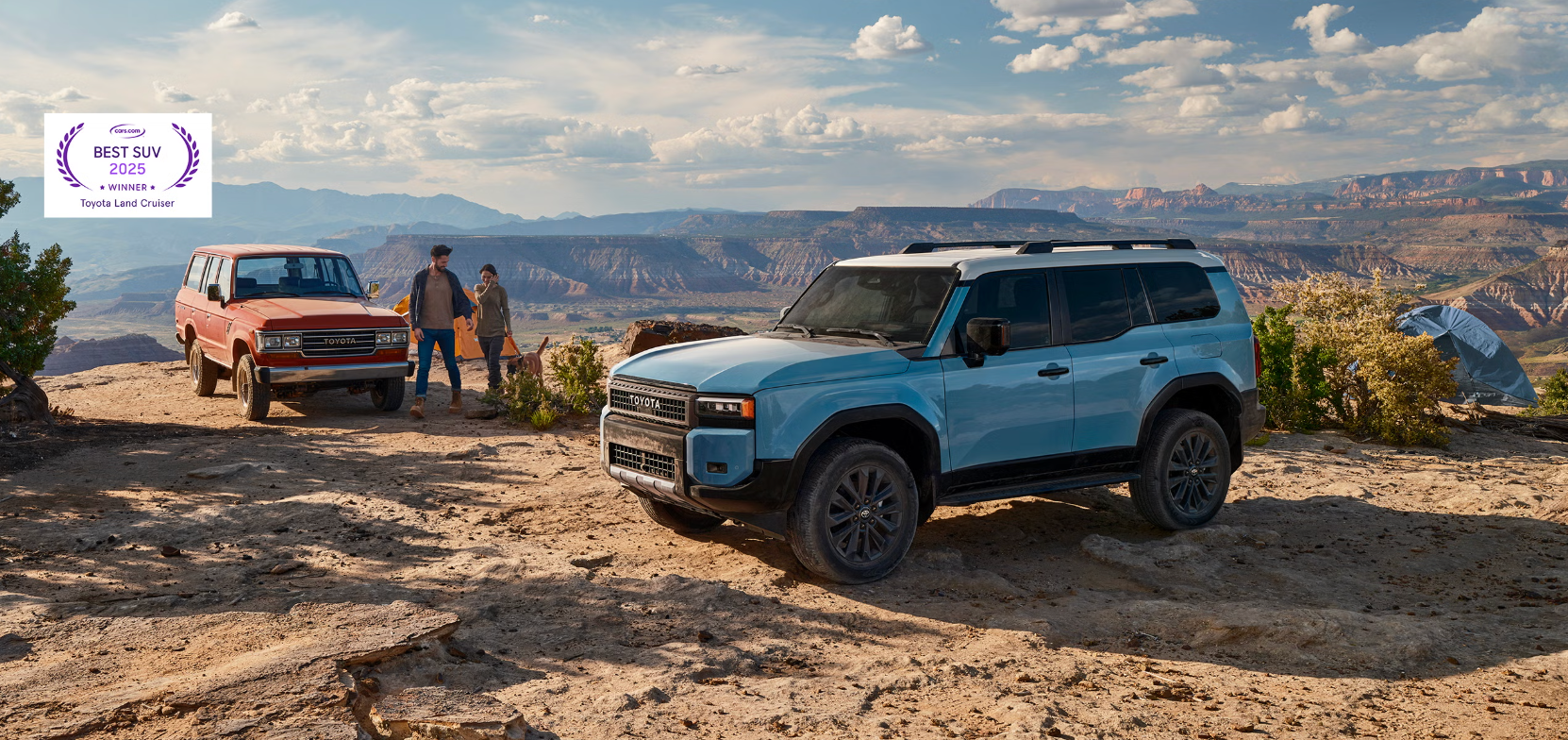
Toyota SUV guide 2027 Toyota Land Cruiser Trim Comparison: Features, Tech, and Off-Road Gear Home / Blog / 2027 Toyota Land Cruiser Trims: Should You Choose the 1958 or Land Cruiser? The 2027 Toyota Land Cruiser gives you two trims to choose from, but you do not need to move up for more engine power. The Land Cruiser 1958 and Land Cruiser share a 326-hp i-FORCE MAX hybrid system, full-time four-wheel drive, and locking center and rear differentials. Choose between them by the comfort features and extra trail technology you will use. If you like the Land Cruiser but are unsure which version makes sense, start inside the cabin. Sit in both seats, try the screens, and consider what you want on a normal drive. The shared mechanical equipment makes that a more useful starting point than assuming the higher trim is necessary. 2027 Land Cruiser Trim Guide: Equipment, Towing, and Buying Advice What Both 2027 Land Cruiser Trims Give You Land Cruiser 1958 vs Land Cruiser: The Differences You Will Notice What the Off-Road Features Actually Do Check Your Boat, Cargo, and Passenger Count Sort Features by How Often You Will Use Them Check Seats, Controls, and Storage in Person Full-Time 4WD and Locking Differentials Answer Different Questions Decide Whether the Added Terrain Systems Matter to You Evaluate Towing With All Five Seats in Use When Another Toyota Belongs on Your Shortlist Plan Ownership Costs Alongside the Equipment Price What to Compare Before Your Test Drive Key Takeaways Frequently Asked Questions What Both 2027 Land Cruiser Trims Give You The Land Cruiser is a two-row, five-passenger SUV with a body-on-frame construction. Its i-FORCE MAX system combines a turbocharged 2.4-liter four-cylinder engine and an electric motor with an eight-speed automatic. It uses gasoline and does not plug in. Both grades include full-time 4WD, a two-speed transfer case, CRAWL Control, and locking center and rear differentials. Toyota rates the hybrid system at 326 net combined horsepower and 465 lb-ft of torque. That shared foundation means the 1958 is more than a styling package without the core off-road equipment. Land Cruiser 1958 vs Land Cruiser: The Differences You Will Notice 2027 Land Cruiser trim equipment Feature Land Cruiser 1958 Land Cruiser Headlights Heritage-inspired round LEDs Rectangular LEDs Front seats Heated fabric-trimmed seats Power heated and ventilated SofTex-trimmed seats Multimedia touchscreen 8-inch 12.3-inch Standard audio 6 speakers 10 speakers Power liftgate Not listed as standard in the release Included Additional trail technology Shared core 4WD, locking differentials, and CRAWL Control Adds Multi-Terrain Select and Multi-Terrain Monitor Premium Package Not offered on this grade in the release Available; review the specific vehicle for included equipment Equipment above follows Toyota's 2027 announcement. Check the vehicle's window sticker for its installed options and package content before making your final comparison. Why choose the 1958? The 1958 makes sense if you want the shared powertrain and 4WD hardware, prefer fabric seating, and do not need the larger screen or added cabin equipment. You may also simply prefer its round headlights. You are choosing a different equipment mix, rather than accepting less engine output. When does the Land Cruiser trim make sense? The Land Cruiser grade is worth a closer look if ventilated front seats, the larger display, a power liftgate, or additional terrain systems are features you would use regularly. For daily driving between Lynn Haven and Panama City, try the seat support and controls during a test drive rather than deciding only from the specification list. If you are considering the Premium Package, compare the exact optioned vehicle. Toyota lists upgrades including leather-trimmed seating, a JBL audio system, a head-up display, and a power moonroof. Those are package features, so do not assume every Land Cruiser-grade vehicle includes them. What the Off-Road Features Actually Do The 2027 Land Cruiser's two grades share their core 4WD and locking-differential hardware. The Land Cruiser grade adds Multi-Terrain Select and Multi-Terrain Monitor to help with terrain settings and visibility on equipped vehicles. Those features can influence your trim choice, but they do not replace correct operation, suitable tires, or judgment about whether a route is passable. CRAWL Control manages throttle and braking at selected low speeds in its intended operating conditions. Multi-Terrain Select adjusts vehicle responses for the selected terrain. The monitor provides camera views that can help you see around the vehicle. Learn the operating instructions and limitations before using any of them off pavement. Toyota also announces an available High Mounted Air Intake for 2027. That equipment should not be treated as permission to enter flooded roads. Four-wheel drive, extra ground clearance, and a raised intake do not establish a safe water-crossing depth. Check Your Boat, Cargo, and Passenger Count Toyota lists a maximum towing capacity of 6,000 pounds for a properly equipped Land Cruiser. For a boat, include the trailer, fuel, batteries, and gear in the weight you compare with the rating. The people and equipment carried in the SUV also matter to its load limits. If you regularly fill all five seats, check your towing setup with those passengers and their bags included. A tow rating by itself does not establish that every combination of trailer and cargo fits. Use the exact vehicle's labels and manual rather than relying on the model-line maximum. Before choosing a Land Cruiser trim, decide whether a five-seat SUV fits your household at all. If you need a third row or a different towing capability, compare another Toyota before spending time on Land Cruiser packages. If five seats and its rated capacity fit, the 1958-versus-Land Cruiser decision becomes a focused comparison of comfort, convenience, and trail equipment. The 4Runner and Sequoia may belong on your list, but compare their exact model years and configurations. Seating layouts, drivetrain equipment, and towing ratings vary. Do not assume a shared Toyota badge or hybrid name makes the vehicles interchangeable. Sort Features by How Often You Will Use Them A useful way to compare the two Land Cruiser grades is to place features in three groups: everyday use, regular recreation, and occasional interest. Seat comfort and controls may matter on every drive. Terrain systems may matter on certain weekends. A particular accessory may simply be something you like. None is an invalid reason to buy, but separating them makes the price difference easier to judge. For each feature on your list, describe a situation where you would use it. “A larger screen” becomes “I want to read the camera view comfortably while parking.” “More trail equipment” becomes “I use permitted unpaved access roads and want to understand which systems help there.” Specific situations reveal whether equipment addresses a need or only sounds appealing in a brochure. Then sit in both grades without letting one vehicle's optional package stand in for all examples of that trim. If the Land Cruiser you try has the Premium Package, identify which features are package additions. Otherwise, you might attribute an upgrade to the grade itself and be disappointed when a differently equipped vehicle lacks it. This method can also support choosing the 1958 confidently. If the shared powertrain and hardware meet your needs, and the extra equipment does not solve a recurring problem for you, the simpler configuration remains a legitimate choice. If you will appreciate the comfort upgrades daily, the higher grade may justify closer consideration without requiring an off-road story to explain it. Check Seats, Controls, and Storage in Person Start by setting the driver's seat and steering wheel for your normal posture. Check whether you can reach frequently used controls without stretching and whether the screen and instrument display are easy to read. A good fit for a taller passenger may not be a good fit for you, so evaluate the position personally. Move to the second row with the front seat still in that position. Check the room available to the people who would ride there and how easy it is to get in and out. If child restraints are part of your household, bring them and follow both the vehicle and restraint instructions when evaluating approved installations. Seat count alone does not establish how a particular combination will fit. For cargo, bring dimensions rather than relying on a photograph of an empty compartment. A dog crate, cooler, work case, or piece of camping equipment may depend on opening width and usable shape as much as a volume figure. Check loading access with the rear seats positioned the way you intend to use them. Look at smaller storage needs too. Where will phones, charging cables, drinks, and frequently used items go? Can a passenger reach what they need without unpacking the cargo area? These details do not create a specification-sheet winner, but they can determine which interior feels easier to live with over a normal week. Full-Time 4WD and Locking Differentials Answer Different Questions Full-time four-wheel drive and locking differentials are related parts of the Land Cruiser's capability, but the terms do not mean the same thing. The drivetrain describes how power is delivered, while the locking features address particular traction conditions. Knowing that both grades share the hardware does not remove the need to learn when and how each function should be used. Ask for an explanation using the owner's manual for the exact vehicle. Identify the controls, their operating conditions, and any restrictions. Do not experiment with differential locks or other off-road settings on a normal road simply to see whether the SUV feels more capable. These systems have intended uses and instructions. Think about the surfaces you actually encounter. Paved commuting, a maintained gravel road, and a demanding trail are different situations. You should be able to describe your use before deciding that a particular feature is necessary. More controls on the console do not automatically make a route suitable or remove the importance of driver preparation. The same distinction matters in rain around Panama City. A capable drivetrain does not make floodwater safe, establish braking performance on every surface, or replace suitable tires. Treat the Land Cruiser's equipment as tools with defined purposes. A clear demonstration and time with the manual are more useful than a broad promise that four-wheel drive can handle anything. Decide Whether the Added Terrain Systems Matter to You The Land Cruiser grade's Multi-Terrain Select and Multi-Terrain Monitor can be relevant if off-pavement use is a regular part of your plans. Before assigning them a value, ask what settings and camera views the specific vehicle provides, how the systems are operated, and what their limitations are. For the monitor, look at the view from the driver's seat rather than judging it from a demonstration image. Ask what is visible, what remains outside the view, and how the display changes with the selected function. A camera can assist awareness, but it does not make every obstacle or person visible in every situation. For terrain settings, focus on understanding the manufacturer's instructions. A mode name is not a guarantee of access to every road with that surface. Road permission, route condition, weather, equipment, and driving experience remain separate considerations. If beach access is your interest, check the rules for the location; vehicle capability does not grant permission to drive there. If your recreation mostly involves paved access and organized parking, you may give more weight to cabin comfort or cargo fit. If your plans involve more demanding permitted routes, consider training and suitable preparation alongside equipment. That provides a stronger basis for choosing a grade than adding every available feature on the assumption that you might need it someday. Evaluate Towing With All Five Seats in Use A trailer decision should include the people who will ride in the Land Cruiser. If the whole family goes to the boat ramp, the relevant setup is the loaded SUV with everyone aboard, not an empty vehicle paired with a trailer's dry weight. Make a simple list of passengers, luggage, equipment, and the trailer load transferred to the hitch. Compare the applicable carrying allowance and other limits with that arrangement. Separately, establish the trailer's complete loaded weight and required equipment. A maximum trailer rating is only one of the limits you must satisfy. If you are buying the boat or trailer later, ask the seller for the information needed to plan a realistic loaded combination. Fuel, equipment, and trailer hardware can make an empty specification less useful for your actual trip. Measurements and manufacturer instructions should guide the final review rather than estimates designed to make a preferred SUV fit. Consider cargo access while the trailer is connected as well. Where will the gear you need at a stop be stored, and can you reach it without creating an awkward loading routine? This is a convenience question rather than a rating calculation, but both matter when choosing a vehicle you expect to use repeatedly for recreation. When Another Toyota Belongs on Your Shortlist Start any comparison with the requirement that brought you to the Land Cruiser. If it is a five-seat SUV with the shared hybrid powertrain and standard drivetrain hardware, compare those attributes directly. If it is family transportation with occasional recreation, seating, cargo, parking, and daily comfort may deserve greater weight. The 4Runner and Sequoia can be worth considering for different needs, but compare specific configurations instead of treating either model name as a single specification. A third-row requirement, for example, should be checked against a vehicle that actually has the appropriate seating layout. Do not assume every grade offers the same arrangement. Keep model years visible on your worksheet. An update can change equipment or program terms even when a familiar powertrain name remains. If one vehicle is available now and another is being discussed from an announcement, distinguish confirmed configuration details from information still pending. A balanced comparison can conclude that the Land Cruiser is not the best fit for your household. That is a useful outcome if it saves you from choosing an SUV that lacks a necessary seat or cannot accommodate your loaded trailer. Capability is valuable when it matches the job, and a better match is more important than winning a comparison on paper. Plan Ownership Costs Alongside the Equipment Price Ask for an insurance quote for the configuration you are considering and include expected fuel, maintenance, registration, and financing in the budget. Use the vehicle's applicable efficiency information as a planning input rather than a guarantee of your results. A payment that seems manageable can feel different once the rest of ownership is included. Separate factory warranty coverage, scheduled maintenance, roadside assistance, and any additional protection product. Ask which documents establish each benefit and what time, mileage, eligibility, or service conditions apply. A feature on the vehicle and coverage for that feature are different questions; one does not establish the other. For accessories, ask whether they are already included in the quote or proposed for later installation. Identify what each item does, why you want it, and whether it affects the loading or operating instructions relevant to your use. A roof setup or additional equipment should be part of the planning conversation before it is fitted. Finally, compare a specific 1958 and Land Cruiser using the same price basis. Keep selling price, options, accessories, taxes, fees, trade information, and financing separate enough to understand. Once the vehicle fits your needs, a clear quote lets you decide whether the equipment difference is worth its actual cost to you. What to Compare Before Your Test Drive Ask for a current, itemized quote on the Land Cruiser you are considering. Compare the same model year and include options, accessories, delivery or processing charges, taxes, and other fees. A launch-announcement MSRP is not the final price of the vehicle in front of you. Seats: compare fabric with the available upgraded upholstery and ventilation. Screens: try the navigation and camera views on each display. Cargo: bring measurements for equipment you carry regularly. Towing: bring your fully loaded trailer weight and hitch-load information. Options: match the window sticker to the quote so package features are clear. You can browse current new Toyota inventory before visiting, then ask about the Land Cruiser configurations available. Toyota Safety Sense 3.0 is listed for both 2027 trims; it provides driver assistance and requires an attentive driver, rather than making the SUV self-driving. Key Takeaways The 2027 Land Cruiser has two trims: 1958 and Land Cruiser. Both share the 326-hp hybrid powertrain, full-time 4WD, and locking center and rear differentials. The Land Cruiser grade adds comfort equipment and terrain technology. It seats up to five and is rated for up to 6,000 pounds of towing when properly equipped. Choose from the exact vehicle equipment and a current itemized quote. Frequently Asked Questions What are the 2027 Toyota Land Cruiser trims? Toyota offers the 2027 Land Cruiser in two grades: Land Cruiser 1958 and Land Cruiser. Both share the i-FORCE MAX hybrid powertrain and full-time four-wheel drive. Is the Land Cruiser 1958 less powerful than the Land Cruiser trim? No. Both 2027 grades use the same hybrid system rated at 326 net combined horsepower and 465 lb-ft of torque. The trim differences are primarily equipment, comfort, and additional trail technology. Does the 2027 Land Cruiser have a third row? No. It is a two-row SUV with seating for up to five. If you regularly carry more than five people, compare a Toyota with the seating configuration your household needs. Can the 2027 Land Cruiser tow a boat? Toyota lists a maximum towing capacity of 6,000 pounds when properly equipped. Your complete loaded boat and trailer must fit the vehicle's towing, payload, hitch, and other applicable limits. Check the exact vehicle and its owner's manual before towing. Compare the Two Land Cruiser Trims Tell Panama City Toyota what you carry, whether you tow, and which cabin features matter most. Ask about the equipment and current price of the Land Cruiser you want to compare. Ask About a Land Cruiser Call 850-769-3377 Related Toyota Insights & Updates Three-row SUVs 2026 Toyota Sequoia Capstone vs Platinum Compare two Sequoia trims when a larger SUV is on your shopping list. Read More Safety & technology Toyota Safety Sense: What the Current System Includes Understand the features, model-year differences, and system limitations. Read More
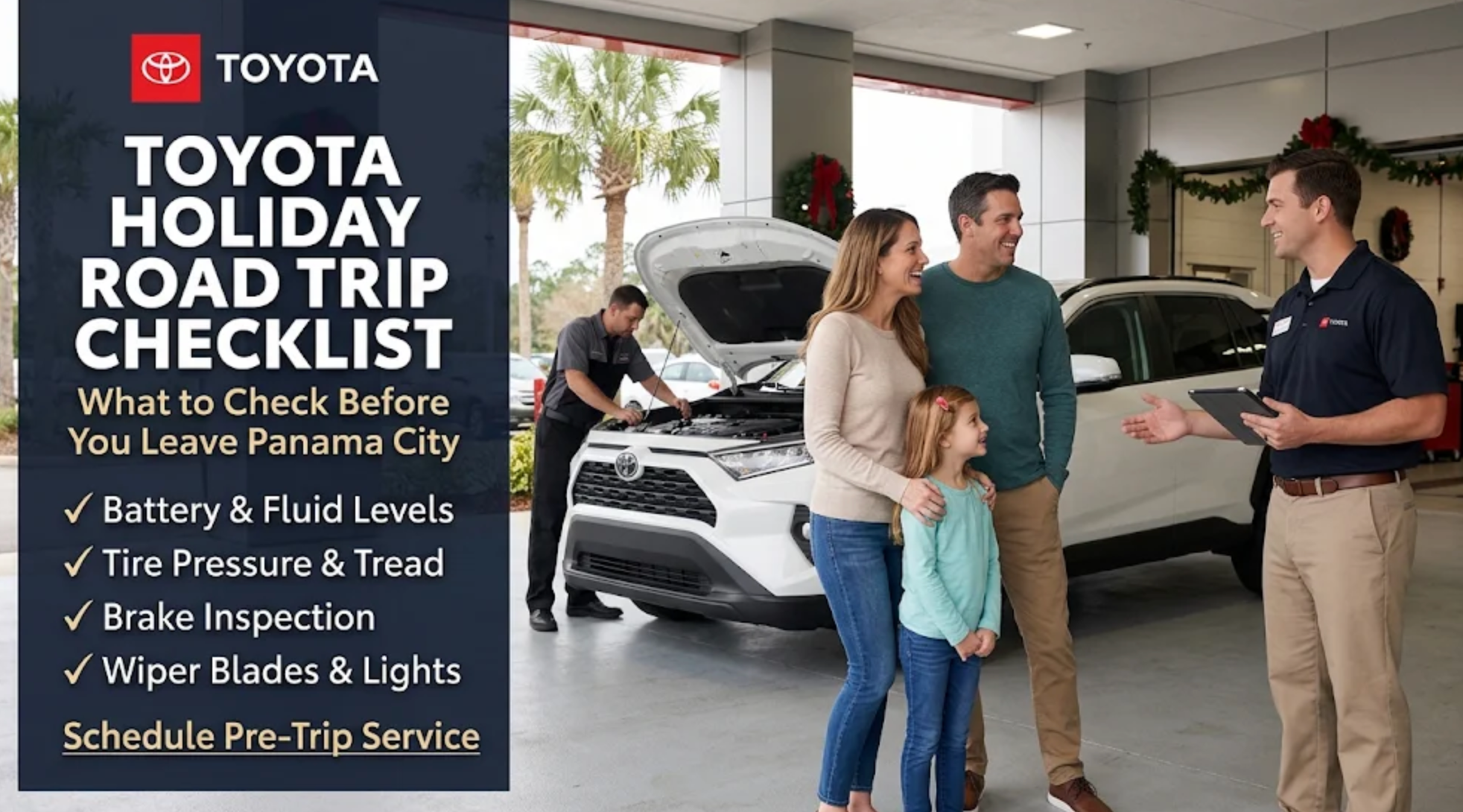
Toyota Holiday Road Trip Checklist: What to Check Before You Leave Panama City

Toyota Holiday Road Trip Checklist: What to Check Before You Leave Panama City

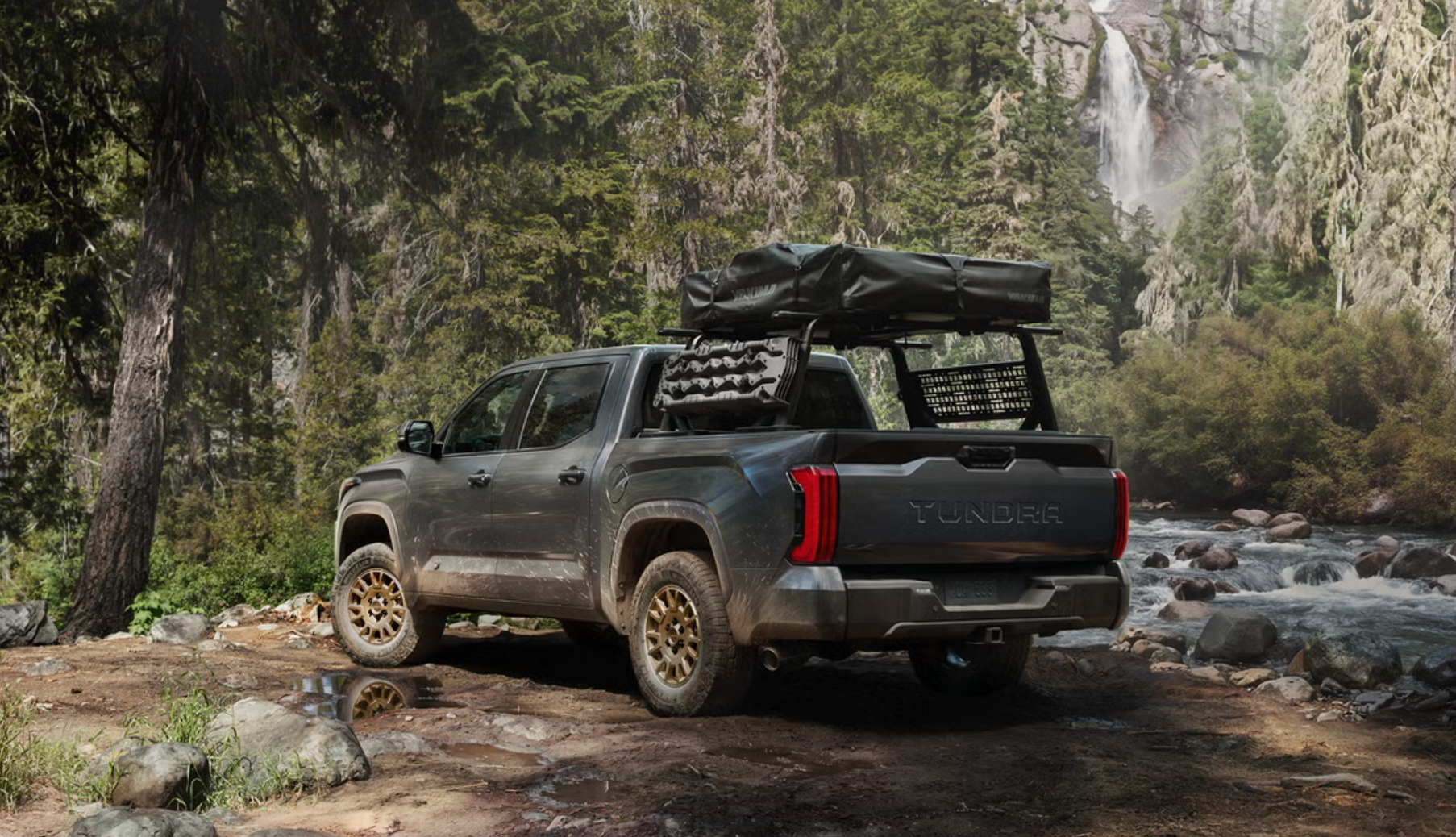
Toyota service & travel Preparing Your Toyota for Holiday Traffic and Changing Road Conditions Home / Blog / Toyota Holiday Road Trip Checklist: What to Check Before You Leave Panama City Before a holiday road trip, start with your Toyota's tires, visibility, maintenance needs, and the load you plan to carry. Check cold tire pressure against the vehicle's label, look for tire damage, and make sure the lights and wipers work. If you have a warning light, a starting problem, or a change in how the vehicle drives, arrange an inspection before departure. The best time to deal with a streaking wiper or a tire that keeps losing air is before the luggage goes in. Give yourself room to handle anything that needs attention, whether you are leaving Panama City for a long interstate drive or spending a holiday weekend along the coast. A pre-trip check is a review of your vehicle's condition for the drive ahead. It complements the maintenance schedule in your owner's manual; it does not replace scheduled service or guarantee that nothing will go wrong. Toyota Holiday Travel Guide: Vehicle Checks, Packing, and Route Planning Your Toyota Holiday Road Trip Checklist Start With Tire Pressure and Condition Check Visibility, Starting, and Upcoming Service Count the People Along With the Holiday Gear Plan the Route Around the Trip You Are Taking Keep Roadside Essentials Within Reach Give Each Check a Place in Your Travel Schedule Write Down Symptoms So the Service Visit Is Useful Make the Passenger Area Work for the Whole Trip Prepare for the Destination, Not Just Panama City Build Breaks Into the Arrival Time Know How You Would Request Roadside Help Leave Room for the Return Journey When Is a Service Visit the Better Choice? Key Takeaways Frequently Asked Questions Your Toyota Holiday Road Trip Checklist What to review before you leave Check What you can do When to ask for help Tires Check cold pressure against the vehicle label; look for wear or damage A tire loses pressure repeatedly, looks damaged, or has uneven or worn tread Wipers and lights Test the wipers, washer spray, headlights, brake lights, and turn signals Wipers streak, a light fails, or visibility is poor Maintenance and fluids Review service history and the checks in your owner's manual Service is due, a leak appears, or you are unsure what needs checking 12-volt battery Pay attention to starting trouble or electrical symptoms Starting is slow, unreliable, or different from normal Passengers and cargo Check the load allowance and secure what you carry You are near a limit or adding a trailer or roof carrier Route and supplies Check traffic and weather; pack essentials where you can reach them The route forecast requires different equipment or a change of plans You do not have to diagnose a problem yourself. A useful description is enough: which light came on, when the noise happens, or whether the vibration appears at a particular speed. Share those details when you request service. Start With Tire Pressure and Condition NHTSA recommends checking tire pressure when the tires are cold, meaning the vehicle has not been driven for at least three hours. Use the pressure specified on your Toyota's Tire and Loading Information label or in its owner's manual, rather than the number on the tire sidewall. Include the spare if your vehicle has one. Check tread and look for cuts, bulges, or uneven wear as well. NHTSA says tires should be replaced when tread is worn to 2/32 of an inch. If you are unsure about the tread or condition, have it measured and inspected before a long drive. A tire-pressure warning light is a reason to check, not a substitute for a gauge. If a tire keeps losing pressure after adjustment, have the cause evaluated rather than repeatedly topping it up and leaving the problem for the trip. For ongoing care, review the Toyota tire rotation guide alongside your model's maintenance schedule. A rotation and an inspection serve different purposes; rotating tires does not correct existing damage. Check Visibility, Starting, and Upcoming Service Try the wipers before the forecast turns wet Test the washer spray and watch how the blades clear the glass. If they leave streaks or missed areas, address that before the trip. Check exterior lights too, especially if part of your drive will be after dark. Bring up starting problems and overdue maintenance If starting has become slow or unreliable, request a battery and starting-system check. Describe what happens instead of assuming the battery is the only possible cause. An inspection can help establish the next step. Review the service history before adding a long drive to the odometer. Follow the fluid-checking instructions for your exact Toyota and leave unfamiliar checks to a technician. A reservoir that needs attention or a visible leak deserves an explanation, rather than an automatic top-up and a guess. Panama City Toyota lists tire service, battery service, and multi-point inspections among its Toyota service options. When you request an appointment, explain that you are preparing for a trip and ask what the visit will include. Timing depends on the work and appointment availability. Count the People Along With the Holiday Gear A vehicle can have room for another suitcase while being close to its weight limit. Check the occupant-and-cargo allowance on its label, then account for passengers, bags, gifts, coolers, and equipment. Secure cargo so it cannot shift during the drive. A roof carrier has its own limits, and a trailer introduces additional checks. Follow your vehicle and accessory instructions. If you tow, use the complete loaded trailer weight and account for the load it transfers to the hitch; do not choose the setup from an empty-trailer figure or a model-line towing maximum. Picture the vehicle as it will actually leave your driveway. The full family, the cooler, and the last few bags all belong in the calculation. If you are close to a limit, revise the packing plan before departure. Plan the Route Around the Trip You Are Taking For an interstate trip, think through the full route, including the roads connecting Panama City to I-10 and the stops you will need along the way. For a shorter drive on US-98 or toward 30A, leave room in your schedule for changing conditions instead of relying only on distance. Check Florida’s official FL511 traffic information before you leave and review updates while safely parked. Check the forecast for your destination as well as home. If you are heading north, prepare for the conditions expected there, even when the weather in Bay County feels mild. Plan fuel or charging stops, breaks, and an arrival time that does not depend on driving while tired. For an electric Toyota or plug-in hybrid, confirm the charging arrangements relevant to your route and vehicle. Set navigation before driving, or let a passenger manage updates. Keep Roadside Essentials Within Reach A phone charger or charged power bank. A flashlight and first-aid supplies. Drinking water, snacks, and a blanket appropriate to your route. Reflective warning equipment and your roadside-assistance contact information. The spare or tire-repair equipment supplied with your vehicle, plus the instructions for using it. Pack these where you can get to them without unloading every bag. Know what tire equipment your Toyota actually carries and what its limitations are. Having a kit does not mean you should attempt a repair in an unsafe roadside location. Give Each Check a Place in Your Travel Schedule Spread preparation across the days before departure instead of trying to do everything while the family is waiting to leave. Start with work that may require an appointment, then finish with checks that depend on the final packing plan and current road conditions. When you first settle the travel dates, review upcoming maintenance and write down any symptoms. Request service if something needs evaluation, explaining when you plan to leave. An appointment request is not a guarantee that every possible repair can be completed before that date, so ask the team to confirm the arrangements. Once you know what you will carry, review the passenger and cargo plan. Locate the spare or repair kit, check the instructions, and decide where roadside supplies will go. If you are adding a roof carrier or trailer, resolve the equipment and loading questions before the final evening of packing. On departure day, confirm the cold tire-pressure check, check current traffic and destination weather, and make sure essentials are accessible. This final review is meant to catch changes, not replace the earlier inspection. A concern discovered at that point may require delaying the trip rather than assuming that leaving on schedule is the only option. Write Down Symptoms So the Service Visit Is Useful A clear description can help the service team understand what needs evaluation. Record what happens, when it happens, and whether it has changed. “The vehicle vibrates at highway speed” gives more context than “please check everything,” especially if the symptom is intermittent. For a warning light, identify the symbol using the owner's manual and note whether it stays on or appears under particular conditions. Follow the manual's instructions about what to do. Do not keep driving simply because a service appointment is scheduled; some warnings require a more immediate response. For a noise or starting concern, note whether it happens after the vehicle sits, during startup, while braking, or on a particular type of road. Share recent work and any change in use, such as towing or a longer commute. These observations do not diagnose the cause, but they give the technician a better starting point. Ask what the inspection found and which recommendations affect the travel plan. If work is needed, discuss timing and the next step before assuming the vehicle is ready. A completed inspection and a completed repair are different things. Keep the service record so you know what was checked and what remains to be addressed. Make the Passenger Area Work for the Whole Trip Pack with the occupied seats in their travel positions. If the third row will carry people, leave it upright while you evaluate luggage space. Folding a seat to make everything fit is not a solution if a passenger needs that seating position. Keep seat belts and approved child-restraint installations usable. Follow the vehicle and restraint instructions rather than placing bags where they interfere with the setup. If you are uncertain about an installation, resolve it with qualified assistance before departure instead of making changes under time pressure at the first stop. Decide where frequently needed items will go: water, a phone charger, medications, and the information you would use to request assistance. Keep appropriate items accessible without allowing loose objects to interfere with driving. If the driver needs something from the cargo area, plan to stop rather than reaching for it on the road. For a full family vehicle, try the packing arrangement before travel morning. An awkward cooler, stroller, or oversized gift may be easier to repack while you still have time to choose another container or leave an item behind. A practical arrangement protects seating and visibility as well as staying within the vehicle's load limits. Prepare for the Destination, Not Just Panama City Check the forecast across the route, including the return trip. A mild afternoon at home does not describe the weather where you will spend the night or the conditions expected after a front passes. If the trip extends beyond Florida, use the relevant state transportation information as well as local forecasts. Ask whether your vehicle, tires, washer fluid, and travel supplies are appropriate for the conditions you may encounter. Follow model-specific instructions and qualified service guidance rather than assuming a Florida routine covers every destination. If conditions exceed your preparation or experience, consider changing the timing or route. For fuel planning, choose stops with enough flexibility that a closure or detour does not leave you depending on one location. For an electric vehicle, confirm compatible charging access, current station information, and an alternative. If you are staying with relatives or at a hotel, ask about actual charging arrangements instead of assuming an outlet or listing guarantees suitable access. Keep weather decisions separate from the vehicle's drivetrain or assistance features. AWD, 4WD, and driver-assistance systems do not make every road condition manageable. The useful question is whether the trip, equipment, and conditions fit together, not whether a familiar badge sounds reassuring. Build Breaks Into the Arrival Time Choose an arrival plan that includes normal stops rather than treating every break as a delay to recover. Food, restrooms, fuel or charging, and time away from the driver's seat are part of the trip. A schedule that works only with uninterrupted driving is fragile before traffic or weather enters the picture. Discuss driving responsibilities before you leave. If more than one person will drive, make sure each person is comfortable with the vehicle's controls and the conditions ahead. If there is only one driver, do not build the schedule around having someone else take over later. Use traffic updates while safely parked, or have a passenger manage information without distracting the driver. If a closure changes your route, review the alternative and needed stops before continuing. A shorter estimated route is not automatically preferable if it creates an unsuitable driving or charging plan. If you are too tired to drive attentively, stop and change the plan. Cruise control and other assistance features do not replace alertness. Protecting the departure time is less important than arriving with a vehicle and driver ready for the remaining distance. Know How You Would Request Roadside Help Find the contact information for any roadside assistance available through your vehicle coverage, insurance, membership, or other plan. Check eligibility, coverage dates, exclusions, and how to request help. Do not assume that every new or used Toyota has identical benefits or that all towing destinations and distances are covered. Save the information somewhere you can reach without searching through packed luggage. Know which vehicle details the service may ask for and how you would describe your location. A charged phone is helpful, but the number and plan details should also be available if an app is not working. Review your Toyota's instructions for a flat tire, loss of power, or other roadside concern before travel. Different vehicles may have different spare-tire, repair-kit, jump-starting, or towing procedures. Do not improvise work on unfamiliar equipment or assume instructions for another model apply. If a problem develops, prioritize your surroundings and follow the appropriate emergency and vehicle guidance. A shoulder can expose you to moving traffic, and having tools does not make it an appropriate place to use them. Request qualified help when needed rather than treating a packed emergency kit as a reason to attempt every repair yourself. Leave Room for the Return Journey The drive home can differ from the drive out. You may have additional luggage, different passengers, or a changed forecast. Recheck the packing and route plan instead of assuming the outbound arrangements still describe the vehicle. Pay attention to anything that changed during the trip. A new vibration, a repeated pressure warning, a fluid-related concern, or a starting problem deserves evaluation. Being close to home or eager to finish the holiday does not establish that a symptom can wait until afterward. Keep receipts and service information together if the vehicle needs attention away from Panama City. Describe what happened and what work was completed when following up with the service team. A good record helps you continue the vehicle's maintenance plan after the holiday, rather than starting the next visit from memory. When Is a Service Visit the Better Choice? A home checklist helps you notice concerns, but it cannot determine the cause of every warning light, noise, or vibration. If your Toyota starts poorly, loses tire pressure repeatedly, or feels different under braking or steering, have the concern assessed before the trip. Arrange the visit early enough to allow for recommended work rather than assuming an inspection will be the only step. When you request a Toyota service appointment, include your departure date, mileage, and what you have noticed. Mention a trailer, heavy cargo, or a colder destination. That gives the team a clearer picture of the drive you are preparing for. Key Takeaways Check cold tire pressure using the vehicle label or manual, and inspect tire condition. Test wipers and lights before you need them on the road. Address symptoms and upcoming maintenance before departure. Count passengers, cargo, accessories, and applicable hitch load against the correct limits. Review traffic and destination weather, plan breaks, and keep essentials accessible. Frequently Asked Questions How far ahead of a holiday trip should I have my Toyota checked? Arrange service early enough to leave time for any recommended work before departure. When you request the appointment, share your travel date, mileage, and any symptoms. Confirm the appointment and expected timing with the service team. Should I use the tire pressure printed on the tire sidewall? Use the vehicle manufacturer's recommended cold tire pressure on the Tire and Loading Information label or in your owner's manual. The number on the tire sidewall is not the vehicle's recommended inflation setting. Does a pre-trip inspection replace regular Toyota maintenance? No. A pre-trip inspection focuses on current condition and travel concerns. Continue following the maintenance schedule for your exact model, year, mileage, and driving conditions. What should I tell Panama City Toyota when requesting service? Share your departure date, vehicle year and model, current mileage, recent service history, and any warning lights, noises, vibration, leaks, or starting problems. Mention towing, heavy cargo, or colder destinations so the team understands how you plan to use the vehicle. Get Your Toyota Ready for the Drive Preparing for holiday travel? Request service at Panama City Toyota and tell us your departure date and any concerns. The team can confirm the appointment, discuss the checks you need, and explain recommended work before you travel. Request a Service Appointment Call 850-769-3377 Related Toyota Insights & Updates Tire care Toyota Tire Rotation Schedule for Panama City Drivers Understand how to plan tire rotations and when uneven wear deserves attention. Read More Cabin comfort Toyota Cabin and Engine Air Filter Service Learn the difference between the two filters and what to ask about airflow concerns. Read More Safety & technology Toyota Safety Sense: What the Current System Includes Get familiar with driver-assistance features and their operating limitations. Read More

Toyota Cabin and Engine Air Filter Service in Panama City, FL

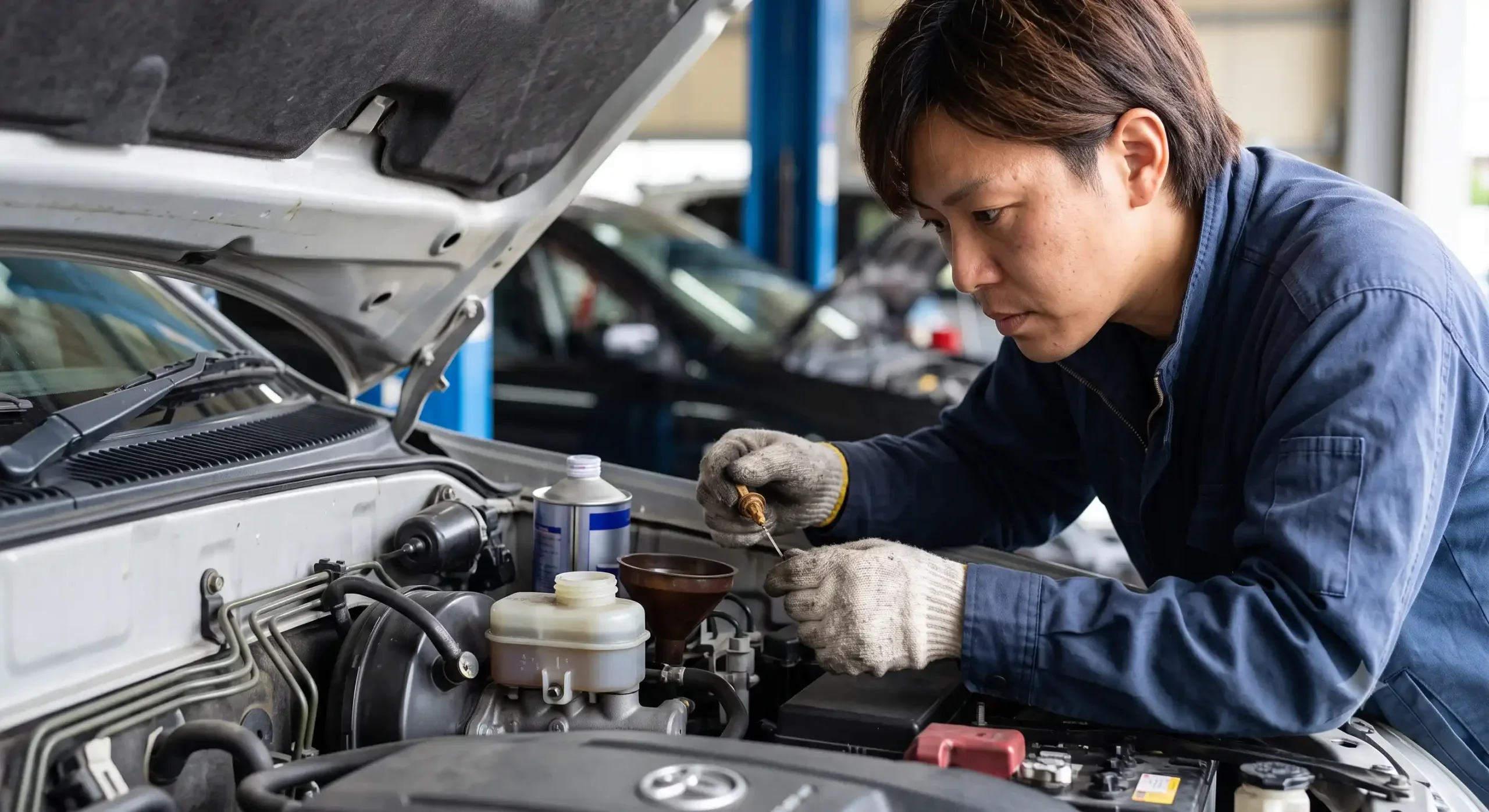
In this article, our team at Panama City Toyota breaks down what each filter does, the signs that indicate it needs attention, how local heat, dust, and pollen affect replacement timing, and whether this service falls under ToyotaCare. We will also cover genuine Toyota filters versus aftermarket options so you can make an informed decision the next time either filter comes up during a service visit. Toyota Air Filter Service Guide: Differences, Replacement Timing, and Coverage Introduction What is a cabin air filter? Cabin Air Filter vs. Engine Air Filter: What Each One Does How Often to Check Each Filter, Genuine Parts vs. Aftermarket, and ToyotaCare Coverage Why the Florida Panhandle Climate Affects Filter Life Real-World Use Cases for Panama City-Area Drivers Schedule Your Filter Service Key Takeaways FAQ Introduction Your Toyota actually uses two separate air filters, and they do different jobs. The cabin air filter cleans the air that flows through your vents and into the passenger compartment, while the engine air filter cleans the air your engine draws in for combustion. Most manufacturer guidance points to replacing a cabin air filter roughly every 12,000 to 15,000 miles, or about once a year, and an engine air filter roughly every 15,000 to 30,000 miles depending on the model and driving conditions. Your exact interval varies by model year and trim, so always confirm the specific mileage in your Toyota owner's manual. Both filters are easy to overlook because neither one is part of a visible, moving system you interact with daily. Yet both affect how your Toyota feels to drive and how comfortable it is to sit in. A clogged cabin filter can leave your air conditioning working harder than it should for less airflow, which matters in a Florida Panhandle summer. A neglected engine filter can quietly restrict the airflow your engine relies on for efficient combustion. Schedule an Air Filter Inspection Explore Our Toyota Service Center What is a cabin air filter? A cabin air filter is a filtration element inside a vehicle's HVAC system that removes dust, pollen, and other airborne particles from the air entering the passenger compartment. An engine air filter is a separate filtration element that cleans the air drawn into the engine for combustion, protecting internal components from debris. Both are wear items that require periodic replacement, and the correct interval for each depends on the specific Toyota model, model year, and driving conditions. Cabin Air Filter vs. Engine Air Filter: What Each One Does Although they share a name and a basic function (trapping particles before air reaches somewhere important), the cabin air filter and the engine air filter serve completely different systems, sit in different locations, and show different symptoms when they need replacing. What the Cabin Air Filter Does The cabin air filter is part of your Toyota's heating, ventilation, and air conditioning (HVAC) system. Air pulled in from outside, or recirculated from inside the cabin, passes through this filter before it reaches your vents. The filter is designed to capture dust, pollen, mold spores, road debris, and other particulates so they do not circulate through the interior of the vehicle. Most Toyota models locate the cabin air filter behind the glovebox, which makes it one of the more accessible filters on the vehicle. Because it sits directly in the path of your HVAC airflow, a clogged cabin filter has an immediate and noticeable effect on how the system performs. Common signs that a cabin air filter needs replacing include: Noticeably weaker airflow from the vents, even at the highest fan setting A musty, stale, or dusty odor when the air conditioning or heat first kicks on Increased sneezing, congestion, or other allergy symptoms while driving, particularly during pollen season Visible dust or debris around the vents Fogging on the windshield that takes longer than usual to clear What the Engine Air Filter Does The engine air filter is a separate component housed in the engine bay. It filters the air the engine pulls in before that air mixes with fuel for combustion. A clean engine air filter allows the engine to draw in the correct volume of air for efficient combustion, while a severely clogged filter can restrict airflow enough to affect performance and, in some cases, fuel economy. Toyota generally recommends inspecting or replacing the engine air filter more frequently in dusty or unpaved driving conditions than in typical paved-road commuting. Unlike the cabin filter, the engine air filter does not affect your comfort directly. Its condition shows up instead in how the vehicle runs. Signs that an engine air filter may need attention include: Reduced acceleration or a feeling that the engine is not responding as quickly as usual Unusual engine sounds, particularly a rougher idle A visibly dark, dirty, or clogged filter when inspected (a clean filter is typically light-colored and free of heavy debris) In more severe cases, reduced fuel economy, since a badly restricted air supply forces the engine's fuel system to compensate Because the engine air filter sits inside a sealed housing in the engine compartment, checking it is a bit more involved than a cabin filter check, though our service technicians can inspect both during a routine visit. Why the Difference Matters Cabin Air Filter vs. Engine Air Filter Category Cabin Air Filter Engine Air Filter Protects Passenger compartment air quality Engine combustion Typical location Behind the glovebox Engine bay, sealed housing Typical replacement interval Roughly 12,000 to 15,000 miles (about 1 year) Roughly 15,000 to 30,000 miles Key symptoms when dirty Weak vent airflow, musty odor, allergy symptoms Sluggish acceleration, rough idle, reduced fuel economy Covered by ToyotaCare No No The core distinction is simple: the cabin air filter protects the people inside the vehicle, and the engine air filter protects the engine itself. Confusing the two, or assuming that replacing one accomplishes the same thing as replacing the other, is a common mistake. A driver who complains about weak air conditioning airflow needs a cabin filter check, not necessarily an engine air filter replacement, and vice versa for a driver noticing sluggish acceleration. Because the two filters wear at different rates and respond to different conditions, they should be evaluated independently rather than assumed to need service on the same schedule. Have Both Toyota Air Filters Checked How Often to Check Each Filter, Genuine Parts vs. Aftermarket, and ToyotaCare Coverage General Replacement Intervals As a general guideline, cabin air filters commonly need replacement roughly every 12,000 to 15,000 miles, or approximately once a year for an average driver. Engine air filters commonly last longer, with a typical range of roughly 15,000 to 30,000 miles, though that range narrows considerably for drivers who spend meaningful time on dusty, sandy, or unpaved roads. These figures are general maintenance guidance, not a fixed rule for every Toyota. The exact interval for your vehicle depends on the model, model year, and powertrain, and it is published in your Toyota owner's manual maintenance schedule. If you are unsure which interval applies to your Toyota, our service advisors can pull the manufacturer-recommended schedule for your exact model and mileage. Genuine Toyota Filters vs. Aftermarket Filters Genuine Toyota cabin and engine air filters are engineered to the exact fit and filtration specifications of your vehicle, which supports consistent airflow and a proper seal within the filter housing. Aftermarket filters vary in quality, materials, and fit from one brand to another, and some are built to a lower price point rather than to Toyota's original specifications. The tradeoff for most owners comes down to fit consistency and manufacturer specification with a genuine filter versus a lower upfront cost with an aftermarket option, and either can be a reasonable choice depending on what you prioritize. Genuine Toyota Filters vs. Aftermarket Filters Category Genuine Toyota Filter Aftermarket Filter Fit Engineered to exact vehicle housing dimensions Varies by brand; may require researching correct part number Filtration specification Matches Toyota's original specification Varies by brand and price point Upfront cost Typically higher Typically lower Consistency across brands Consistent (single source) Varies Availability Panama City Toyota parts department and online parts ordering Varies by retailer This is not a case where every aftermarket filter performs poorly. Reputable aftermarket brands can offer adequate filtration for the price. The practical difference is consistency: because a genuine Toyota filter is manufactured to match your vehicle's exact housing dimensions and airflow requirements, you generally do not need to research which aftermarket part number actually fits your specific trim and model year. Our parts department stocks genuine Toyota filters for current models, and you can also order parts directly through our online parts ordering tool if you prefer to handle a filter swap yourself. Order Genuine Toyota Air Filters Is This Covered by ToyotaCare? This is a question we hear often, and the honest answer is that cabin and engine air filter replacement is typically not included under ToyotaCare. ToyotaCare's no-cost maintenance coverage is generally built around scheduled services such as oil changes, tire rotations, fluid level checks, and multi-point vehicle inspections for a defined period after purchase. Air filters are considered a wear item that falls outside that included coverage, which means filter replacement is typically billed as a separate service rather than something ToyotaCare covers automatically. If you are unsure whether a specific service on your Toyota is included under your current ToyotaCare terms, our team can confirm exactly what applies to your vehicle and mileage before any work begins. Symptom-to-Likely-Cause Quick Reference Symptom You Notice Likely Filter Weak airflow from vents at highest fan setting Cabin air filter Musty or dusty odor when A/C or heat starts Cabin air filter Worsening allergy symptoms while driving Cabin air filter Windshield fogging that clears slowly Cabin air filter Sluggish acceleration Engine air filter Rougher engine idle Engine air filter Visibly dark or clogged filter on inspection Engine air filter Reduced fuel economy (severe cases) Engine air filter Review ToyotaCare Coverage Ask About Your Maintenance Coverage Why the Florida Panhandle Climate Affects Filter Life Panama City and the surrounding Bay County area put both filters through conditions that differ meaningfully from a cooler, drier climate. Three local factors in particular tend to shorten the practical life of both the cabin and engine air filters: heat, pollen, and dust. Florida Panhandle summers mean near-constant air conditioning use for most drivers, often for months at a time. Every hour the HVAC system runs, air continues to pass through the cabin air filter. More running time means more particulate accumulation over the same mileage compared to a vehicle that uses air conditioning only occasionally. Drivers who commute daily between Panama City, Lynn Haven, Callaway, or Panama City Beach and keep the air conditioning running for most of the year may notice reduced airflow sooner than the general mileage guideline would suggest, which is a reasonable signal to have the filter checked rather than waiting strictly for a mileage milestone. Pollen season across the Panhandle, particularly in spring, adds another layer of particulate load. Pine pollen and other seasonal allergens are heavy in this region, and a cabin air filter that is already due for replacement can become saturated more quickly during peak pollen weeks. Drivers who deal with seasonal allergies often notice the connection directly: symptoms that seem to worsen specifically while driving can point to a cabin filter that needs attention. Dust plays a larger role in engine air filter wear than most drivers expect. While most Bay County commuting happens on paved roads, drivers who regularly travel unpaved or rural routes, whether for work, hunting or timber-land access, or trips toward more rural parts of Washington or Jackson County, expose the engine air filter to a higher volume of airborne particulate than a typical paved commute. In those conditions, checking the filter closer to the shorter end of the recommended range, or having it inspected at each service visit, is a sensible approach rather than assuming the longer mileage interval automatically applies. None of these factors change the manufacturer-recommended interval itself. What they change is how quickly a given vehicle may reach the point where the filter is doing less than it should, which is why we recommend having both filters checked at routine service visits rather than waiting for a symptom to appear. Real-World Use Cases for Panama City-Area Drivers The following scenarios are hypothetical examples meant to illustrate how these factors typically play out. They do not describe actual customers or specific vehicles. The allergy-sensitive commuter. Picture a driver commuting daily from Lynn Haven into Panama City during peak spring pollen season. Around the one-year mark, they notice the air conditioning seems to blow noticeably softer than it used to, and they start sneezing more during the drive than they do once they arrive. That combination, weaker airflow paired with worsening symptoms specifically in the vehicle, is a fairly clear indicator that a cabin air filter check is worth scheduling, even if the vehicle has not yet hit the upper end of the typical mileage range. The rural commuter near Fountain or Youngstown. Consider a driver whose daily route includes several miles of unpaved or heavily graveled road on the way to and from more rural parts of Bay County. Because that kind of driving exposes the engine air filter to more airborne dust than a purely paved commute, this driver may find it worthwhile to have the engine air filter inspected at every service visit rather than relying on the longer end of the standard mileage interval. The near-daily A/C user. Imagine a Panama City Beach resident who runs the air conditioning almost every time they drive, given how much of the year stays warm in this part of Florida. Even with modest annual mileage, the cumulative hours of HVAC operation can outpace what the mileage-based interval alone would suggest, making it reasonable to have the cabin filter checked based on time elapsed rather than mileage alone. Schedule Your Filter Service If it has been a while since either filter was checked on your Toyota, or you are noticing any of the symptoms described above, our service team can inspect both the cabin and engine air filters and let you know whether replacement makes sense based on their actual condition rather than mileage alone. We carry genuine Toyota filters for current models and can typically handle this as a quick service alongside routine maintenance you already have scheduled. You can book an appointment through our online scheduling tool, or call our service department directly if you would rather set up a time over the phone. Schedule Toyota Air Filter Service Call 850-769-3377 Key Takeaways The cabin air filter cleans air entering the passenger compartment through the HVAC system, while the engine air filter cleans air entering the engine for combustion; they are separate components with separate replacement schedules. General guidance suggests cabin air filter replacement roughly every 12,000 to 15,000 miles (about once a year) and engine air filter replacement roughly every 15,000 to 30,000 miles, but the exact interval for your Toyota is listed in your owner's manual. Weak vent airflow, musty odors, and worsening allergy symptoms while driving point to the cabin filter; sluggish acceleration, rough idle, or a visibly dirty filter point to the engine filter. Florida Panhandle heat, pollen, and dust can shorten practical filter life compared to the general mileage guideline, particularly for drivers with heavy A/C use or unpaved-road commutes. Genuine Toyota filters are built to your vehicle's exact specifications; aftermarket filters vary in quality and fit, so the choice comes down to fit consistency versus upfront cost. Cabin and engine air filter replacement is typically not included under ToyotaCare and is generally billed as a separate maintenance service. FAQ Can a dirty air filter hurt my fuel economy? A severely clogged engine air filter can restrict the airflow your engine needs for efficient combustion, which in more extreme cases can reduce fuel economy. A moderately dirty filter is less likely to produce a noticeable change on its own, but it is still worth replacing on schedule since airflow restriction tends to get worse gradually rather than all at once. Is cabin or engine air filter replacement covered under ToyotaCare? Typically, no. ToyotaCare's no-cost coverage generally centers on services like oil changes, tire rotations, fluid checks, and multi-point inspections. Air filters are considered a wear item and are usually billed as a separate service. Our team can confirm exactly what your current ToyotaCare terms include for your specific vehicle. Can I replace either filter myself? On many Toyota models, the cabin air filter is relatively accessible behind the glovebox and can be a manageable DIY task for owners comfortable with basic maintenance, provided you use the correct filter for your exact model and follow your owner's manual instructions. The engine air filter is also accessible on many models, though its housing and clip locations vary more by vehicle. If you would rather not handle it yourself, our service team can complete either replacement, and our parts department can also order the correct genuine filter if you want to do the work on your own. How do I know which filter is causing a problem I'm noticing? Airflow, odor, and allergy-related symptoms almost always point to the cabin air filter, since that filter sits directly in your HVAC system's path. Performance-related symptoms, such as sluggish acceleration or a rougher idle, point to the engine air filter, since that filter affects combustion rather than cabin comfort. If you are not sure which one applies to what you are noticing, our service advisors can inspect both during your visit. Cabin and engine air filters rarely get much attention because neither one is something you see or touch during normal driving, but both affect how your Toyota feels and performs day to day. The cabin filter shapes your air conditioning airflow and interior air quality, while the engine filter supports efficient combustion. General guidance points to roughly 12,000 to 15,000 miles for the cabin filter and roughly 15,000 to 30,000 miles for the engine filter, though your owner's manual has the exact interval for your model. If you are due for a check, noticing weaker airflow, an odd odor, or a change in how your Toyota accelerates, our service team at Panama City Toyota can inspect both filters and recommend genuine Toyota replacements when needed. Stop by our service center at 959 West 15th Street in Panama City, or schedule an appointment online, and we will take it from there. Book Your Filter Inspection Get Directions Related Articles Oil Change Service Oil Changes: DIY Or Professional? Read More Routine Maintenance Toyota Tire Rotation Schedule for Panama City Drivers Read More Brake Maintenance Toyota Brake Fluid Change Schedule in Panama City, FL Read More

Toyota Safety Sense: What the Current System Includes

If you have shopped for a new Toyota recently, you have probably seen "TSS" or "Toyota Safety Sense" listed as standard equipment and wondered exactly what that means for your day-to-day driving. Our sales team fields this question often, because the answer changes depending on the model, the model year, and sometimes the trim. This article breaks down what Toyota Safety Sense 3.0 actually includes, what it is designed to do, and where its limits are, so you know what to expect before you get behind the wheel. We will also cover how the system generation can vary across the Toyota lineup and how to confirm exactly what is equipped on a specific vehicle, along with what these features mean for the kind of driving common around Panama City, Panama City Beach, and the rest of Bay County. Toyota Safety Sense Features, Limitations, and Driving Guide What Is Toyota Safety Sense? Definition What Toyota Safety Sense 3.0 Includes What Toyota Safety Sense Does Not Do Why These Features Matter for Florida Panhandle Driving Real-World Use Cases for Panama City-Area Drivers Experience Toyota Safety Sense for Yourself Key Takeaways FAQ What Is Toyota Safety Sense? Toyota Safety Sense is a suite of driver-assistance technologies that Toyota builds into its vehicles to help drivers notice hazards, keep their lane, and manage following distance. Toyota Safety Sense 3.0 includes Pre-Collision System, Lane Departure Alert, Dynamic Radar Cruise Control, Lane Tracing Assist, Road Sign Assist, Automatic High Beams, and Proactive Driving Assist, according to Toyota's official Safety Sense 3.0 brochure. These are driver-assist features, not self-driving or autonomous systems, and they work alongside an attentive driver rather than in place of one. Ask About Toyota Safety Sense Visit Panama City Toyota Definition Definition: Toyota Safety Sense is Toyota's name for a bundled set of active safety and driver-assistance technologies that use cameras, radar, and other sensors to help detect road hazards, monitor lane position, and manage following distance. It is a driver-assist system, not an autonomous driving system, and it is intended to support an attentive driver rather than operate the vehicle independently. For Panama City-area drivers, the practical implication is that these features can add an extra layer of awareness on highways like US-98 and I-10, but they do not remove the driver's responsibility to watch the road. What Toyota Safety Sense 3.0 Includes Toyota Safety Sense 3.0 is one generation of the system, and according to Toyota's official Safety Sense 3.0 brochure, it includes seven core features. Here is what each one does and the conditions under which it operates. Pre-Collision System (PCS). This feature is designed to detect vehicles, pedestrians, bicyclists, or motorcyclists ahead of the vehicle and provide an audio and/or visual forward collision warning along with brake assist if the driver responds to the warning. In TSS 3.0, PCS has been enhanced to identify potential threats coming from multiple lanes and from lateral directions, not just straight ahead. This makes it more capable of flagging a vehicle merging from an adjacent lane or crossing into the vehicle's path, in addition to a vehicle stopped directly ahead. Lane Departure Alert (LDA). LDA detects when the vehicle drifts out of its lane without a turn signal at speeds above 30 mph and issues an audio and visual warning to the driver. If the driver does not respond, the system can apply gentle steering corrections to help guide the vehicle back toward its lane. TSS 3.0 includes improved 3D object recognition that helps the system better distinguish lane markings from roadside features like guardrails. Toyota Safety Sense 3.0 combines seven features with specific operating thresholds: Pre-Collision System with pedestrian, bicyclist, and motorcyclist detection; Lane Departure Alert with steering assist above 30 mph; Dynamic Radar Cruise Control active above 20 mph with four selectable following-distance settings; Lane Tracing Assist, which centers the vehicle in its lane while DRCC is engaged; Road Sign Assist, which reads speed limit, stop, yield, do-not-enter, and pedestrian-crossing signs; Automatic High Beams, which operate above 25 mph; and Proactive Driving Assist, which provides gentle braking in curves and steering support to help maintain lane position. These specifications come from Toyota's official Safety Sense 3.0 brochure. Dynamic Radar Cruise Control (DRCC). DRCC is an adaptive cruise control system that maintains a preset distance from the vehicle ahead at speeds over 20 mph. Drivers can choose from four distance settings depending on preference and traffic conditions, and TSS 3.0's enhanced vehicle detection allows for smoother speed adjustments as traffic ahead speeds up or slows down. Lane Tracing Assist (LTA). LTA works together with DRCC to help center the vehicle within its lane by reading lane markings and tracking the vehicle ahead. It can also offset the vehicle's path slightly within the lane to provide extra clearance when passing an adjacent vehicle, cyclist, or other object close to the lane line. Road Sign Assist (RSA). RSA recognizes speed limit signs, stop signs, do-not-enter signs, and yield signs, along with warning signs such as pedestrian crossings. It displays the relevant icon on the instrument cluster and can alert the driver if the vehicle's speed does not match a posted speed limit sign the system has read. Automatic High Beams (AHB). AHB operates above 25 mph and is designed to help the driver see farther down the road at night by keeping the high beams on when appropriate, while switching to low beams to reduce glare for oncoming or leading traffic. Proactive Driving Assist (PDA). PDA provides gentle braking support when approaching curves, works to detect obstacles such as parked vehicles and pedestrians, and offers steering support to help the driver maintain a centered position in the lane. Safety Sense 3.0 Features and Operating Thresholds Feature Function Operating Threshold Pre-Collision System (PCS) Forward collision warning with brake assist; detects vehicles, pedestrians, bicyclists, motorcyclists Active at applicable driving speeds Lane Departure Alert (LDA) Warns of unintended lane drift; can apply gentle steering correction Above 30 mph Dynamic Radar Cruise Control (DRCC) Adaptive cruise control with 4 selectable following-distance settings Above 20 mph Lane Tracing Assist (LTA) Centers vehicle in lane while DRCC is engaged Works with DRCC Road Sign Assist (RSA) Reads and displays speed limit, stop, yield, do-not-enter, pedestrian-crossing signs When operating and detection conditions are met Automatic High Beams (AHB) Switches between high and low beams automatically at night Above 25 mph Proactive Driving Assist (PDA) Gentle braking in curves; steering support to help maintain lane position When operating and detection conditions are met Every one of these features is designed to work with the driver, prompting a warning or offering light assistance rather than taking control of the vehicle on its own. Compare Toyota Safety Features What Toyota Safety Sense Does Not Do This is the part of the conversation we think matters most, because it is easy to see a long feature list and assume more than the system actually delivers. Toyota Safety Sense, including TSS 3.0, is a driver-assistance suite. It is not a self-driving system, and Toyota does not market it as one. None of the seven features described above are designed to replace an attentive driver who is watching the road, checking mirrors, and staying ready to brake or steer. Toyota Safety Sense features are driver-assistance technologies designed to support, not replace, an attentive driver, and no combination of these features makes a Toyota vehicle self-driving or capable of avoiding every collision. Because the exact TSS generation and feature set can vary by model and model year, the most reliable way to confirm what is equipped on a specific vehicle is to check that vehicle's window sticker or ask our sales team directly. This matters most for shoppers cross-shopping different Toyota models or comparing a current vehicle to a newer one, since assuming identical safety equipment across the lineup can lead to a mistaken understanding of what a specific car actually includes. A second point worth being direct about: Toyota Safety Sense 3.0 is confirmed as standard equipment on the 2027 Toyota Crown. Beyond that, the generation of Toyota Safety Sense equipped on a given model, whether that is TSS 4.0, TSS 3.0, or an earlier generation such as TSS 2.5 or 2.5+, varies by model and by model year. Toyota already offers TSS 4.0 on the 2026 RAV4. A Camry, a RAV4, a Tacoma, and a Highlander do not necessarily carry the same generation of the system, and the same model can carry a different generation from one model year to the next as Toyota updates its lineup. Contact Panama City Toyota for the exact Toyota Safety Sense generation and features equipped on the vehicle you are considering. That is why the most reliable way to know what is equipped on a specific vehicle is to check that vehicle's window sticker, which lists the standard safety equipment for that exact car, or to ask our sales team to confirm it before you buy. If you already own a Toyota and are unsure which generation of Toyota Safety Sense your vehicle has, your owner's manual and window sticker (or the original build sheet) are the most accurate sources, rather than assuming your vehicle matches a newer model you may have seen advertised. It is also worth understanding the practical limits of what these systems can do even when they are working as designed. A forward collision warning depends on the system's sensors detecting a hazard, and no system is described as working in every weather or visibility condition or as guaranteed to prevent a collision. Lane Tracing Assist provides steering support, not hands-free driving, and Toyota requires the driver to keep hands on the wheel and stay engaged. Treat every Toyota Safety Sense feature as a layer of support for a driver who is already paying attention, not a substitute for that attention. Toyota Safety Sense Does vs. Does Not Do Toyota Safety Sense Does Toyota Safety Sense Does Not Do Warns of a potential forward collision and can apply brake assist Guarantee collision avoidance in every situation Alerts the driver to unintended lane drift and can nudge steering Drive the vehicle hands-free or autonomously Maintains a preset following distance above 20 mph Replace the need for an attentive, engaged driver Reads and displays posted road signs Guarantee accurate detection in all weather or visibility conditions Helps manage high-beam use at night above 25 mph Adjust for every road or weather condition on its own Ask About a Specific Toyota Model Get Help With Your Toyota's Settings Why These Features Matter for Florida Panhandle Driving Driving conditions around Bay County give some practical context for why these features can be useful day to day, without needing to overstate what they do. US-98 and I-10 both see heavy seasonal traffic as visitors head toward Panama City Beach, and stop-and-go conditions on these corridors are exactly the kind of scenario where Dynamic Radar Cruise Control's ability to maintain a preset following distance can reduce some of the manual speed adjustments a driver would otherwise make constantly. Florida Panhandle summers also bring frequent heavy rain and afternoon thunderstorms. Pre-Collision System and Lane Departure Alert are designed to help flag hazards and lane drift, but sensor-based systems like these can be affected by heavy rain, fog, or road spray, so they should never be treated as a substitute for slowing down and increasing following distance in poor visibility. The same caution applies to glare, whether from a low afternoon sun over St. Andrews Bay or headlights on a dark stretch of US-231. Automatic High Beams is built to help with nighttime visibility above 25 mph, but the driver should still adjust speed and following distance for actual road and weather conditions rather than relying on the system to compensate. Local road sign variety is another place where Road Sign Assist can be a genuine convenience, particularly on routes through Lynn Haven, Callaway, and Springfield where speed limits change frequently near schools, intersections, and commercial corridors. Reading the posted sign and displaying it on the instrument cluster gives drivers one more reference point, though drivers should still watch for posted signage themselves rather than depending on the system alone. Florida Panhandle Driving Conditions and Relevant TSS Features Local Condition Relevant TSS 3.0 Feature What to Keep in Mind Heavy seasonal traffic on US-98/I-10 Dynamic Radar Cruise Control Still requires driver attention in stop-and-go conditions Summer thunderstorms and heavy rain Pre-Collision System, Lane Departure Alert Sensor performance can be affected by rain, fog, or road spray Low sun glare over St. Andrews Bay or night driving on US-231 Automatic High Beams Driver should still adjust speed and following distance for conditions Frequent speed-limit changes near schools/intersections in Lynn Haven, Callaway, Springfield Road Sign Assist Drivers should still watch posted signage directly Real-World Use Cases for Panama City-Area Drivers The following scenarios are hypothetical examples meant to illustrate how these features could be used in everyday driving around Bay County. They are not based on specific customer experiences. The daily I-10 commuter. Imagine a driver commuting from Marianna or Chipley into Panama City several days a week. With Dynamic Radar Cruise Control and Lane Tracing Assist active on the open highway stretches, that driver could let the system help maintain following distance and lane position during long, monotonous stretches, while still staying alert and ready to take full control in heavier traffic near the Panama City interchanges. A parent with a new teen driver. Consider a parent about to hand their teenager the keys for the first time. Understanding that Pre-Collision System is designed to warn of a potential forward collision and can apply brake assist if the driver responds to the alert might be one factor, among many, in choosing a particular Toyota for a new driver, alongside actual driver training and supervised practice. A tourist-season grocery run. Picture a Panama City Beach resident driving Front Beach Road during peak tourist season, where pedestrian traffic and sudden stops are common. Pre-Collision System's pedestrian detection and Automatic High Beams for nighttime visibility could both be relevant in that kind of congested, mixed-use corridor, alongside the driver's own attention to crosswalks and slowing traffic. Experience Toyota Safety Sense for Yourself Reading about these features only tells part of the story. If you want to see how Pre-Collision System, Lane Tracing Assist, Dynamic Radar Cruise Control, and the rest actually feel on the road, we invite you to schedule a test drive at our dealership at 959 West 15th Street in Panama City. Our sales team can walk you through exactly which Toyota Safety Sense generation is equipped on the specific vehicle you are considering, show you where to find that information on the window sticker, and answer any questions about how the system operates before you decide. Request a Toyota Test Drive Call 850-769-3377 Key Takeaways Toyota Safety Sense 3.0 includes seven features: Pre-Collision System, Lane Departure Alert, Dynamic Radar Cruise Control, Lane Tracing Assist, Road Sign Assist, Automatic High Beams, and Proactive Driving Assist. Toyota Safety Sense 3.0 is confirmed standard equipment on the 2027 Toyota Crown; the generation equipped on other models and model years varies, so confirm the exact system on any specific vehicle before assuming it matches another model. Several features have specific speed thresholds: Lane Departure Alert's steering assist activates above 30 mph, Dynamic Radar Cruise Control above 20 mph, and Automatic High Beams above 25 mph. Toyota Safety Sense is a driver-assistance suite, not a self-driving system, and it does not remove the driver's responsibility to stay attentive. Weather, glare, and road spray common in the Florida Panhandle can affect sensor-based systems, so drivers should not rely on these features as a substitute for slowing down in poor conditions. The most reliable way to confirm what is equipped on a specific vehicle is the window sticker or a conversation with our sales team. FAQ Can Toyota Safety Sense features be turned off? Some individual Toyota Safety Sense features can be adjusted or temporarily disabled through vehicle settings, and specific steps vary by model and model year. If you want to know how to adjust a specific feature on your vehicle, your owner's manual or our service team can walk you through the exact process for that model. Is Toyota Safety Sense the same on every current Toyota model? No. The generation of Toyota Safety Sense equipped on a vehicle, along with the exact feature set, varies by model and model year. Toyota Safety Sense 3.0 is confirmed standard on the 2027 Toyota Crown, while the 2026 RAV4 has TSS 4.0. Other models may carry TSS 3.0 or an earlier generation. Check the window sticker on a specific vehicle or ask our sales team to confirm. Does Toyota Safety Sense replace the need for safe driving habits? No. Every feature in the Toyota Safety Sense suite is designed to assist an attentive driver, not to operate the vehicle independently or guarantee collision avoidance. Drivers should keep their hands on the wheel, stay focused on the road, and treat these features as an added layer of support rather than a replacement for careful driving. Do Toyota Safety Sense features work in all weather conditions? Sensor-based systems like Pre-Collision System, Lane Departure Alert, and Automatic High Beams can be affected by heavy rain, fog, glare, or road spray, all of which are common in the Florida Panhandle. Drivers should reduce speed and increase following distance in poor visibility rather than relying on these systems to compensate for weather conditions. Toyota Safety Sense 3.0 brings together seven driver-assistance features, from Pre-Collision System and Lane Departure Alert to Dynamic Radar Cruise Control, Lane Tracing Assist, Road Sign Assist, Automatic High Beams, and Proactive Driving Assist. Each one is built to support an attentive driver rather than take over the driving task, and the exact generation equipped on a given Toyota depends on the model and model year, so the window sticker remains the most reliable place to confirm what a specific vehicle includes. If you are weighing which current Toyota fits your daily drive around Panama City, Lynn Haven, or the wider Bay County area, our team at 959 West 15th Street can show you exactly which safety features come standard on the vehicles you are considering. Call us at 850-769-3377 or stop by to schedule a test drive and see Toyota Safety Sense in action for yourself. Talk With Our Toyota Team Get Directions Related Articles Family SUV Safety Safest 2026 Toyota SUVs for Families With Kids in Panama City, FL Read More Crown & Crown Signia 2026 Toyota Crown and Crown Signia: Hybrid Luxury at Panama City Toyota Read More Toyota Hybrid Lineup Your Complete Guide to the 2026 Toyota Hybrid Lineup in Panama City Read More

ToyotaCare for 2027 Toyota Models: What Is Actually Covered?

If you're shopping a 2027 Toyota or you already own one, you're likely asking how long the included maintenance coverage lasts and exactly what it pays for. ToyotaCare is Toyota's no-cost factory-scheduled maintenance plan, and the coverage window changed with the 2027 model year. ToyotaCare Guide: Quick Navigation What ToyotaCare Covers (and Doesn't) by Model Year Roadside Assistance and What It Means for Ownership Planning Maintenance Timing for Panama City-Area Driving Real-World Use Cases for Panama City-Area Drivers Key Takeaways FAQ On 2027 Toyota models, ToyotaCare covers factory-scheduled maintenance, including engine oil and filter changes, tire rotation, fluid level inspection and adjustment, and a multi-point inspection, for 1 year or 10,000 miles, whichever comes first. On 2026 and earlier model years, that same coverage runs for 2 years or 25,000 miles, whichever comes first, and Toyota Mirai models carry 3 years or 35,000 miles regardless of model year. ToyotaCare does not cover wear items such as brake pads, rotors, replacement tires, wheel alignment, tire balancing, or wiper blades. Below, we walk through what's actually included in that maintenance coverage, why the shorter 2027 window matters for your ownership budget, what the separate roadside assistance benefit adds, and how this fits into a realistic maintenance plan if you drive around Panama City, Panama City Beach, Lynn Haven, Callaway, or the rest of Bay County. If you're comparing a 2027 model to a 2026 vehicle still in our inventory, the coverage difference is worth understanding before you sign. Definition: ToyotaCare is Toyota's complimentary factory-scheduled maintenance program included with the purchase or lease of a new Toyota. It pays for specific routine maintenance items performed according to Toyota's factory schedule, using genuine Toyota parts, for a set period of time or mileage that depends on the vehicle's model year. It is separate from Toyota's factory warranties and from any dealership-specific warranty program. Explore ToyotaCare Coverage Schedule Toyota Service What ToyotaCare Covers (and Doesn't) by Model Year ToyotaCare pays for the maintenance visits your Toyota needs to stay on Toyota's recommended schedule, not for repairs. Understanding exactly what falls into each category matters because assuming too much coverage can leave you with an unexpected bill, and assuming too little can mean skipping service you've actually already paid for. What's included. ToyotaCare covers factory-scheduled maintenance performed by Toyota-trained technicians using genuine Toyota parts. That specifically means: Engine oil and filter changes Tire rotation Fluid level inspection and adjustment Multi-point inspection These are the same core items Toyota's maintenance schedule calls for at each visit, and they're the foundation of keeping a vehicle's warranty coverage and resale condition intact over time. How often those visits happen depends on the vehicle and the oil it requires. Models that call for 0W-20 synthetic oil generally follow a 10,000-mile service interval, while other models generally follow something closer to a 5,000-mile interval. The exact interval varies by model and engine, so the owner's manual for your specific vehicle is the final word on when a service visit is due. ToyotaCare duration depends on model year, not on the vehicle type. For the 2027 model year, ToyotaCare runs 1 year or 10,000 miles, whichever comes first. For 2026 and earlier model years, ToyotaCare runs 2 years or 25,000 miles, whichever comes first. The Toyota Mirai is an exception across all model years, with ToyotaCare coverage of 3 years or 35,000 miles, whichever comes first. Model Year ToyotaCare Duration Mileage Limit 2027 model year 1 year 10,000 miles 2026 and earlier model years 2 years 25,000 miles Toyota Mirai (all model years) 3 years 35,000 miles What's not included. ToyotaCare is a maintenance program, not a repair or wear-item warranty. It does not cover brake pads, brake rotors, replacement tires, wheel alignment, tire balancing, or wiper blades. Those are considered normal wear items that get used up through everyday driving rather than items that fail from a manufacturing defect, so they fall outside a maintenance plan built around scheduled service visits. ToyotaCare Covers vs. What It Doesn't Covered by ToyotaCare Not Covered by ToyotaCare Engine oil and filter changes Brake pads and rotors Tire rotation Replacement tires Fluid level inspection and adjustment Wheel alignment Multi-point inspection Tire balancing Wiper blades Repairs of any kind It's also worth being clear about what ToyotaCare is not. ToyotaCare is not the same program as our Panama City Toyota Lifetime Warranty, and it's not the same as Toyota's factory powertrain or basic warranty, or any hybrid-system warranty that applies to your specific vehicle. Each of those is a distinct coverage with its own terms, and we'd rather point you to our service team for the exact details on any of them than guess at terms that vary by vehicle and program. ToyotaCare is generally honored at participating Toyota dealerships, and our service advisors can confirm specifics for your exact vehicle when you're ready to schedule. Contact Our Toyota Service Team Roadside Assistance and What It Means for Ownership Planning Separate from scheduled maintenance, ToyotaCare also includes roadside assistance, and this benefit runs on its own timeline that doesn't always match the maintenance coverage window. For most Toyota models, roadside assistance lasts 2 years with unlimited miles, starting from the vehicle's date of first use. Mirai, Prius, Toyota plug-in hybrid models, and Toyota battery-electric models get an extended 3 years of roadside assistance, also with unlimited miles. That's a longer window than the maintenance portion of ToyotaCare provides on a 2027 vehicle, so it's easy to assume both benefits expire together when they don't. Roadside assistance covers battery jump-starts, emergency fuel delivery, lockout protection, winching, tire service using your spare tire, and towing up to 25 miles to the nearest Toyota dealership. It's valid in the continental United States, Hawaii, and Canada, which matters if you're planning to drive out of state for a hurricane evacuation or a longer road trip. ToyotaCare Roadside Assistance Terms Detail Most Models Mirai, Prius, Toyota PHEV and BEV Models Duration 2 years 3 years Mileage limit Unlimited miles Unlimited miles Covered services Jump-starts, fuel delivery, lockout, winching, spare-tire service, towing up to 25 miles Jump-starts, fuel delivery, lockout, winching, spare-tire service, towing up to 25 miles Valid territory Continental US, Hawaii, Canada Continental US, Hawaii, Canada For Bay County shoppers weighing a 2027 model against a 2026 vehicle still in inventory, the practical difference comes down to how much scheduled maintenance is actually paid for before you start covering it yourself. A 2027 vehicle's 10,000-mile ToyotaCare allowance typically covers one to two maintenance visits depending on your vehicle's service interval, while a 2026-or-earlier vehicle's 25,000-mile allowance can stretch across three to five visits for the same driving pattern. That gap is worth factoring into your total ownership budget, particularly if you drive more than a typical commuter mileage. Mirai, Prius, Toyota plug-in hybrid, and Toyota battery-electric buyers get one benefit that doesn't change with the 2027 shift: their roadside assistance window stays at 3 years regardless of the shorter maintenance coverage. What this means in practical terms: if you're buying a 2027 model, plan on budgeting for out-of-pocket oil changes and tire rotations sooner than you might with a 2026 vehicle, since the maintenance coverage runs out after roughly a year or 10,000 miles rather than two years or 25,000 miles. It doesn't change how often your vehicle actually needs service. Toyota's recommended maintenance schedule for your specific model and engine stays the same either way; only the amount of it that ToyotaCare pays for changes. If you're cross-shopping model years, ask our sales team which model year a specific vehicle carries before you compare pricing or payments, since the ToyotaCare terms follow the vehicle's actual model year rather than the calendar year you buy it in. Review ToyotaCare Benefits Ask About Your Vehicle's Coverage Maintenance Timing for Panama City-Area Driving Where you drive affects how much your maintenance schedule matters, and Bay County's climate puts real demands on a vehicle that a mild, dry climate doesn't. Heat and humidity accelerate the breakdown of engine oil and other fluids, which is part of why Toyota's maintenance schedule specifies fluid checks at every visit rather than leaving them to guesswork. Salt air along the coast near Panama City Beach and St. Andrews Bay can also affect components over time, and a multi-point inspection is one of the more useful tools for catching early signs of that kind of wear before it becomes a bigger repair. Stop-and-go traffic on US-98 through Panama City and Panama City Beach, especially during tourist season, puts more wear on a vehicle than steady highway miles do. Frequent starting and stopping works the engine, transmission, and brakes harder per mile driven, which is one more reason to keep to the maintenance schedule rather than stretching intervals based on how the vehicle feels. None of that changes the ToyotaCare terms themselves, but it does make the maintenance schedule worth following closely rather than treating as optional. A 2027 buyer whose ToyotaCare coverage runs out at 10,000 miles or one year should expect that Panama City's driving conditions won't reduce how often service is actually needed. If anything, coastal humidity and heavy local traffic are reasons to stay current on the schedule Toyota built for your vehicle rather than falling behind after ToyotaCare coverage ends. Our service team can walk through your specific model's maintenance schedule and help you plan out what comes due and when, whether your ToyotaCare coverage is still active or has already run its course. Schedule Your Next Maintenance Visit Real-World Use Cases for Panama City-Area Drivers These scenarios are hypothetical examples meant to illustrate how the coverage differences play out, not descriptions of actual customers. A hypothetical 2027 RAV4 buyer. Say a Lynn Haven commuter buys a 2027 RAV4 and drives a typical mix of local roads and US-98. Their ToyotaCare coverage would run out at whichever comes first: their first vehicle anniversary or 10,000 miles. Depending on their exact mileage pace, that could mean one covered maintenance visit, or possibly two if their oil-change interval and driving pace line up well within that window. After that point, scheduled maintenance becomes an out-of-pocket cost following Toyota's recommended schedule for their specific RAV4 trim and powertrain. A hypothetical 2026 Camry buyer. Compare that to a Callaway driver who buys a 2026 Camry from current inventory instead. Their ToyotaCare coverage runs 2 years or 25,000 miles, whichever comes first, giving them roughly two to three times the coverage window of the 2027 buyer above in both time and mileage. For a similar annual driving pattern, this buyer could see several more covered maintenance visits before their ToyotaCare coverage expires. A hypothetical Prius Plug-in Hybrid buyer. A Niceville driver who buys a Prius Plug-in Hybrid, regardless of whether it's a 2027 or 2026 model, gets the extended 3-year roadside assistance benefit that applies to Mirai, Prius, Toyota plug-in hybrid, and Toyota battery-electric models. That roadside coverage would outlast their maintenance coverage window either way, which is worth remembering if a flat tire or dead battery happens well after their oil-change coverage has already run out. Have Questions About Your Specific Vehicle's Coverage? We know ToyotaCare terms can feel like a lot to track, especially when you're comparing model years or cross-shopping a hybrid against a gas model. If you'd like to confirm exactly what your 2027 or 2026 Toyota's ToyotaCare coverage includes, or you're ready to schedule your next maintenance visit, our service team can look up your specific vehicle and walk you through what's covered, what's due, and what comes next. Call us at 850-769-3377, or stop by our service department at 959 West 15th Street in Panama City, and we'll get you the exact answer for your vehicle rather than a general one. Visit Our Toyota Service Center Call 850-769-3377 Key Takeaways ToyotaCare duration depends on model year: 2027 models get 1 year or 10,000 miles, 2026-and-earlier models get 2 years or 25,000 miles, and Mirai gets 3 years or 35,000 miles regardless of model year. ToyotaCare covers factory-scheduled maintenance only: oil and filter changes, tire rotation, fluid inspection, and multi-point inspection. Wear items like brake pads, rotors, tires, alignment, and wiper blades are never covered under ToyotaCare. Roadside assistance runs on its own timeline: 2 years unlimited miles for most models, 3 years unlimited miles for Mirai, Prius, Toyota plug-in hybrid, and Toyota battery-electric models. ToyotaCare is a separate program from the Lifetime Warranty and from Toyota's factory powertrain or hybrid-system warranties, each with its own terms. A 2027 vehicle's shorter maintenance window means budgeting for out-of-pocket service sooner than a 2026-or-earlier vehicle would require. FAQ Does ToyotaCare cover repairs? No. ToyotaCare covers scheduled maintenance items only, including oil and filter changes, tire rotation, fluid inspection and adjustment, and multi-point inspection. Repairs, including anything related to a mechanical failure or wear-item replacement like brakes or tires, fall outside ToyotaCare and would be handled under whatever warranty coverage applies to your vehicle, or as a paid repair. Is ToyotaCare the same as the Panama City Toyota Lifetime Warranty? No, they're separate programs. ToyotaCare is a Toyota factory maintenance plan covering scheduled service visits for a set time or mileage. Our Lifetime Warranty is a distinct Panama City Toyota program with its own eligibility and terms. Ask our team for the exact current terms of either program, since they cover different things and shouldn't be assumed to overlap. What happens once my ToyotaCare coverage expires? Once your ToyotaCare period ends, whether by time or mileage, you're responsible for the cost of future scheduled maintenance visits. Your vehicle's maintenance schedule doesn't change: Toyota still recommends the same intervals for oil changes, tire rotations, and inspections. Our service department can continue performing that maintenance on a pay basis, and can help you plan ahead for what's coming due. Do I have to get my Toyota serviced at Panama City Toyota to keep ToyotaCare valid? ToyotaCare is generally honored at participating Toyota dealerships. Contact our service team for the current terms that apply to your vehicle and to confirm coverage at the participating Toyota dealership where you plan to schedule service. Knowing exactly what ToyotaCare covers, and for how long, makes it easier to plan your Toyota's maintenance budget rather than get surprised by it. The short version: 2027 models get 1 year or 10,000 miles of scheduled maintenance coverage, 2026-and-earlier models get 2 years or 25,000 miles, and roadside assistance runs separately at 2 years for most models or 3 years for Mirai, Prius, Toyota PHEVs, and Toyota BEVs. None of that tells you exactly what your specific vehicle qualifies for once trim, purchase date, and mileage come into play. If you're deciding between a 2027 model and a 2026 vehicle in our current inventory, or you just want to know where your existing Toyota stands on its ToyotaCare coverage, call our service department at 850-769-3377 or stop by 959 West 15th Street in Panama City. We'll pull up your vehicle's exact coverage and help you plan your next visit accordingly. Schedule Toyota Service Contact Panama City Toyota Related Articles Oil Change Service Oil Changes: DIY Or Professional? Read More Toyota Maintenance Toyota Brake Fluid Change Schedule in Panama City, FL Read More Toyota Hybrid Lineup Your Complete Guide to the 2026 Toyota Hybrid Lineup in Panama City Read More

2027 Toyota Crown: What's New for Panama City-Area Drivers

For Panama City-area drivers cross-shopping a Camry, an Avalon-replacement sedan, or a three-row Highlander alternative, the Crown sits in its own lane: a full-size sedan with standard AWD, hybrid efficiency, and a more upscale interior treatment than Toyota's mainstream sedans. This article walks through what changed for the 2027 model year, what each grade costs and includes, and where the Crown fits for drivers commuting along US-98, Highway 231, or I-10 in Bay County and the surrounding Florida Panhandle. Table of Contents What's New on the 2027 Toyota Crown Definition: What Is the Toyota Crown Powertrain and Pricing by Grade Technology, Safety, and Styling by Grade Fuel Economy and Commute Fit for Panama City and Bay County Real-World Use Cases for Panama City-Area Drivers Confirm Your 2027 Crown Options with Our Team Key Takeaways FAQ What's New on the 2027 Toyota Crown The 2027 Toyota Crown carries over its four-grade lineup (XLE, Nightshade, Limited, and Platinum) but updates the powertrain, styling, and technology across the range. XLE, Nightshade, and Limited now use the fifth-generation Toyota Hybrid System (THS 5) paired with a 2.5-liter engine, rated at an EPA-estimated 40 mpg combined, while the Platinum grade keeps its Hybrid MAX powertrain producing 340 horsepower and 400 lb-ft of torque. Every 2027 Crown grade includes standard all-wheel drive. Toyota also refreshed the rear bumper design, added a new "Inked" black paint option, and expanded standard driver-assistance and multimedia technology across the lineup. We'll cover confirmed pricing by grade, the powertrain differences between the standard hybrid grades and the Platinum's Hybrid MAX system, the technology and safety equipment that comes standard versus what's reserved for higher trims, and how the Crown's AWD and fuel economy figures apply to real Gulf Coast driving and weather conditions. Explore the 2027 Toyota Crown Ask About Crown Availability Definition Definition: The Toyota Crown is a full-size hybrid sedan built on Toyota's TNGA-K platform, positioned above the Camry as a more premium option with standard all-wheel drive on every grade. For the 2027 model year, it is offered in four grades: XLE, Nightshade, Limited, and Platinum, with the first three using a standard hybrid system and the Platinum grade exclusively offering a higher-output Hybrid MAX powertrain. Powertrain and Pricing by Grade The 2027 Toyota Crown lineup splits into two powertrain tiers, and understanding that split is the first step in choosing a grade. XLE, Nightshade, and Limited grades share the fifth-generation Toyota Hybrid System, known as THS 5, built around a 2.5-liter engine. Toyota rates this combination at an EPA-estimated 40 mpg combined, a figure that reflects the standard hybrid setup shared across three of the four grades rather than a Platinum-specific number. Because all three of these grades use the same core powertrain, the differences between XLE, Nightshade, and Limited come down to styling, technology, and standard features rather than how the car drives day to day. The Platinum grade breaks from that pattern entirely. It is the only 2027 Crown grade equipped with Toyota's Hybrid MAX powertrain, which trades some of the standard system's efficiency focus for stronger output: 340 horsepower and 400 lb-ft of torque. That torque figure changes how Platinum feels from a stop and when merging onto I-10, since torque determines how quickly the car responds to throttle input at low speeds. Toyota has not published a separate EPA combined mpg figure for Hybrid MAX in the confirmed 2027 Crown materials referenced here, so buyers weighing Platinum against the standard hybrid grades should contact Panama City Toyota for the latest fuel economy information before deciding between the two powertrain tiers. The 2027 Toyota Crown starts at $41,640 for the XLE grade, followed by $48,965 for Nightshade, $49,720 for Limited, and $55,190 for the range-topping Platinum grade. These figures are manufacturer's suggested retail prices (MSRP) and exclude a $1,295 dealer and destination fee, so the out-the-door starting price for each grade will run higher once that fee and any applicable taxes or dealer-installed accessories are added. Every 2027 Crown grade includes all-wheel drive as standard equipment, which is not the case on most competing full-size sedans, where AWD is often an optional add-on limited to certain trims. A few pricing patterns are worth noting. The jump from XLE to Nightshade is the largest single step in the lineup, roughly $7,300, reflecting added styling and equipment rather than a powertrain change, since Nightshade still uses the standard THS 5 hybrid system. Limited adds a comparatively modest amount over Nightshade, about $755, while Platinum's jump to $55,190 reflects both the Hybrid MAX powertrain and the additional technology and styling unique to that grade. Because these are MSRP figures subject to change, we recommend confirming current pricing with our team, and remember that dealer fees, taxes, tags, and registration costs apply on top of the vehicle price. 2027 Toyota Crown Pricing and Powertrain by Grade Grade Starting MSRP* Powertrain Output AWD XLE $41,640 THS 5 hybrid, 2.5L EPA-estimated 40 mpg combined Standard Nightshade $48,965 THS 5 hybrid, 2.5L EPA-estimated 40 mpg combined Standard Limited $49,720 THS 5 hybrid, 2.5L EPA-estimated 40 mpg combined Standard Platinum $55,190 Hybrid MAX 340 hp / 400 lb-ft torque Standard *MSRP excludes the $1,295 dealer and destination fee. Confirm current pricing with our team before purchase. For Panama City-area shoppers who are comparing the Crown against a loaded Camry XLE or Camry XSE, the price gap at the entry point is real but not enormous, and the standard AWD is often the deciding factor once a buyer starts pricing out AWD as an add-on elsewhere. Buyers focused purely on efficiency and lower upfront cost may find the XLE grade's 40 mpg combined rating and $41,640 starting MSRP the more straightforward value proposition, while buyers who want the strongest available powertrain will look toward Platinum, understanding that grade carries the highest price and a different power delivery than the other three grades. Request Current Crown Pricing Compare Grades With Our Team Technology, Safety, and Styling by Grade Standard technology on the 2027 Crown starts at a meaningfully high bar across every grade. All four grades come with a 12.3-inch touchscreen, Toyota Safety Sense 3.0 as standard equipment, and wireless Apple CarPlay and Android Auto, so buyers are not required to step up to a higher grade just to get a modern multimedia setup or current-generation driver-assistance technology. That matters for shoppers cross-referencing the Crown against the Camry or other Toyota sedans, since Toyota Safety Sense 3.0 being standard on every Crown grade removes one of the more common trim-level tradeoffs buyers run into on other vehicles. Limited and Platinum grades add capability beyond that baseline. Both include a Panoramic View Monitor, which gives a wider camera perspective around the vehicle useful for tighter parking situations, and Digital Key capability, which allows phone-based vehicle access and starting without a physical key fob present. Platinum goes a step further with a 10-inch Head-Up Display, projecting key driving information (such as speed) into the driver's line of sight on the windshield, a feature not offered on the other three grades according to the confirmed feature list for this model year. Styling changes for 2027 apply across the lineup in some cases and are grade-specific in others. Every Crown gets a newly sculpted rear bumper design for the model year, along with the option of a new "Inked" black paint color across the range. Grade-specific styling cues separate Platinum and Nightshade from the other two grades visually. Platinum adds red brake calipers and black window surrounds, giving it a more visually distinct stance than XLE or Limited. Nightshade, true to its name across the broader Toyota lineup, adds black badge overlays rather than the brighter chrome-style badging found elsewhere in the range. Standard vs. Grade-Exclusive Technology on the 2027 Crown Feature XLE Nightshade Limited Platinum 12.3-inch touchscreen Standard Standard Standard Standard Toyota Safety Sense 3.0 Standard Standard Standard Standard Wireless Apple CarPlay/Android Auto Standard Standard Standard Standard Panoramic View Monitor Not included Not included Standard Standard Digital Key Not included Not included Standard Standard 10-inch Head-Up Display Not included Not included Not included Standard Within Toyota's current sedan and crossover lineup, the Crown occupies a distinct position: it sits above the Camry with standard all-wheel drive, a more formal three-box sedan shape, and a Platinum grade that outputs more horsepower and torque than any Camry configuration, while the related Crown Signia is a separate model built as a crossover-styled hatchback rather than a traditional sedan. A Panama City-area buyer deciding between these should treat the Camry as the value-focused, front-wheel-drive-standard choice, the Crown sedan as the AWD-standard, more premium option with the Hybrid MAX power ceiling at Platinum, and the Crown Signia as the answer for buyers who want Crown-level styling and standard AWD but prefer a crossover's higher seating position and cargo flexibility over a traditional sedan trunk. That distinction is useful because these three models often get cross-shopped by the same buyer without a clear sense of how they differ. A shopper who assumes "Crown" and "Camry Hybrid" are simply different trim levels of the same car will miss that AWD is standard on every Crown grade but not on the Camry Hybrid lineup, and that the Crown's Platinum grade offers a torque figure the Camry lineup does not match. Similarly, a shopper set on a traditional sedan trunk rather than a hatchback profile should know the Crown Signia's body style before assuming it drives or loads like the Crown sedan. Sedan vs. Camry vs. Crown Signia Positioning Category Crown (sedan) Camry Crown Signia Body style Traditional three-box sedan Traditional sedan Crossover-styled hatchback AWD availability Standard on every grade Not standard across the lineup Standard on every grade Top output 340 hp / 400 lb-ft (Platinum, Hybrid MAX) Lower than Crown Platinum's Hybrid MAX figures Not equipped with Hybrid MAX Price position Above Camry Value-focused entry point Positioned near/above Crown sedan Best fit for Buyers wanting a sedan trunk and standard AWD Buyers prioritizing value and efficiency Buyers wanting Crown styling with crossover cargo flexibility Compare Crown, Camry, and Crown Signia Fuel Economy and Commute Fit for Panama City and Bay County The 40 mpg combined EPA-estimated rating on XLE, Nightshade, and Limited grades is relevant to the mixed driving common around Bay County. A commute combining stop-and-go traffic through Panama City with sustained highway stretches on US-98 toward Panama City Beach is close to the mixed-cycle conditions that figure represents. Drivers whose routine leans toward lower-speed in-town driving, such as within Lynn Haven or Callaway, may see results closer to the city-cycle side of that number, while drivers spending more time on I-10 or US-98 toward Destin may trend toward the highway side. Standard AWD on every 2027 Crown grade is worth understanding in the context of Gulf Coast weather rather than as a snow-and-ice feature, since the Panhandle rarely sees winter driving conditions requiring AWD for that reason. Where standard AWD is more relevant locally is wet-weather traction during the region's heavy rain events, including the fast-moving downpours common during hurricane season and summer thunderstorms. AWD distributes power to all four wheels, which can improve traction on a wet roadway, though it does not replace tire condition, following distance, or reduced speed as the primary factors in wet-weather safety, and it does not make a vehicle safe to drive through standing water. Drivers anywhere in Bay County should avoid driving through flooded areas regardless of drivetrain. For a household cross-shopping the Crown against other Toyota sedans and crossovers for a primarily Bay County commute, the practical takeaway is that the standard hybrid grades deliver an EPA-estimated 40 mpg combined figure well suited to a mixed local and highway routine, while the Platinum grade's Hybrid MAX powertrain prioritizes stronger torque and horsepower over a published efficiency figure matching that number. Neither choice is wrong; it depends on whether the higher priority for a given driver is fuel economy or power. Explore Toyota Hybrid Ownership Real-World Use Cases for Panama City-Area Drivers The scenarios below are illustrative examples meant to show how the 2027 Crown's confirmed specifications might apply to different driving situations. They are not real customer accounts or dealership sales data; they are hypothetical only. Consider a Panama City Beach commuter cross-shopping a Camry XLE against a Crown XLE. Both use a version of Toyota's hybrid technology and both include Toyota Safety Sense 3.0 as standard equipment, but the Crown XLE adds standard AWD and the 12.3-inch touchscreen at that entry grade, along with the more formal Crown styling. If that commuter regularly drives through heavy rain on US-98 during summer storm season, the standard AWD on the Crown XLE may be the deciding factor even though the Camry XLE carries a lower starting price. Consider a Lynn Haven household deciding between a Crown Limited and a Crown Platinum. The Limited grade includes the Panoramic View Monitor and Digital Key capability at a $49,720 starting MSRP with the standard THS 5 hybrid system's 40 mpg combined rating, while the Platinum grade adds the 10-inch Head-Up Display, unique styling cues like the red brake calipers, and the Hybrid MAX powertrain's 340 horsepower and 400 lb-ft of torque for a $55,190 starting MSRP. A household prioritizing stronger acceleration for merging onto I-10 or passing on Highway 77 might lean toward Platinum, while a household prioritizing the lower price and the standard hybrid's published efficiency figure might find Limited the better fit. Consider a buyer near Tyndall Air Force Base comparing the Crown sedan against the Crown Signia. Both share Crown styling cues and standard AWD, but the buyer who regularly hauls gear, equipment, or family cargo may prefer the Crown Signia's crossover-style body for its cargo flexibility, while a buyer who wants a traditional sedan trunk and the option of the Platinum grade's Hybrid MAX powertrain, which is exclusive to the Crown sedan lineup based on the confirmed grade structure, would stay with the Crown sedan. Confirm Your 2027 Crown Options with Our Team If the 2027 Crown's standard AWD, updated hybrid technology, or Platinum grade's Hybrid MAX powertrain fits what you're looking for, our team can walk through current grade availability, confirm final pricing including the dealer and destination fee, and set up a test drive. Because MSRP figures and inventory can change, we recommend reaching out before assuming any price or configuration listed here is locked in. You can reach us at 850-769-3377 or visit our showroom at 959 West 15th Street in Panama City to see the Crown lineup and current offers in person. Request a Toyota Crown Test Drive Call 850-769-3377 Key Takeaways The 2027 Toyota Crown keeps its four-grade lineup: XLE ($41,640), Nightshade ($48,965), Limited ($49,720), and Platinum ($55,190), all MSRP figures excluding a $1,295 dealer/destination fee. XLE, Nightshade, and Limited use the fifth-generation Toyota Hybrid System (THS 5) with a 2.5-liter engine, rated at an EPA-estimated 40 mpg combined. Platinum is the only grade with the Hybrid MAX powertrain, producing 340 horsepower and 400 lb-ft of torque. All-wheel drive is standard across every 2027 Crown grade, which is relevant to wet-weather traction during Bay County's heavy rain and storm season. Every grade includes a 12.3-inch touchscreen, Toyota Safety Sense 3.0, and wireless Apple CarPlay/Android Auto standard; Limited and Platinum add a Panoramic View Monitor and Digital Key, with Platinum alone adding a 10-inch Head-Up Display. Pricing and availability should be confirmed directly with our team, since MSRP figures can change and inventory varies by trim and configuration. FAQ Is the 2027 Toyota Crown available with front-wheel drive only, or is AWD required? Every 2027 Crown grade, from XLE through Platinum, includes all-wheel drive as standard equipment. There is no front-wheel-drive-only configuration in the confirmed 2027 grade lineup. What is the difference between the Crown's standard hybrid system and the Platinum grade's Hybrid MAX system? XLE, Nightshade, and Limited use the fifth-generation Toyota Hybrid System (THS 5) with a 2.5-liter engine, rated at an EPA-estimated 40 mpg combined. Platinum exclusively uses the Hybrid MAX powertrain, which produces 340 horsepower and 400 lb-ft of torque, prioritizing output over the published efficiency figure used for the other three grades. Does the 2027 Crown MSRP include the dealer and destination fee? No. The MSRP figures for each grade (XLE at $41,640, Nightshade at $48,965, Limited at $49,720, and Platinum at $55,190) exclude a $1,295 dealer and destination fee. Confirm the total out-the-door price with our team before finalizing a purchase. How is the Crown different from the Camry and the Crown Signia? The Crown sedan sits above the Camry with standard AWD on every grade and a more formal sedan body style, while the Camry does not include standard AWD across its lineup. The Crown Signia is a separate model built as a crossover-styled hatchback rather than a traditional sedan, sharing Crown styling cues but offering a different body style and cargo layout than the Crown sedan. The 2027 Toyota Crown updates its hybrid technology, adds standard AWD-friendly styling touches, and expands driver-assistance and multimedia technology across all four grades, while keeping the Platinum grade's Hybrid MAX powertrain as the lineup's performance option. For Panama City-area drivers weighing the Crown against a Camry, a Crown Signia, or another full-size sedan, the decision generally comes down to whether standard AWD, the THS 5 hybrid system's 40 mpg combined rating, or the Platinum grade's 340 horsepower and 400 lb-ft of torque matters most for your daily driving on US-98, I-10, or around Bay County. Our team can confirm current 2027 Crown availability, walk through the differences between grades in person, and help you schedule a test drive. Call us at 850-769-3377 or stop by our showroom at 959 West 15th Street in Panama City to see the current lineup and get final pricing on the grade that fits your needs. Contact Panama City Toyota Get Directions Related Articles Crown & Crown Signia 2026 Toyota Crown and Crown Signia: Hybrid Luxury at Panama City Toyota Read More Toyota Hybrid Lineup Your Complete Guide to the 2026 Toyota Hybrid Lineup in Panama City Read More Hybrid Ownership Is A Hybrid Car From Panama City Toyota Right For Me? Read More

2027 Toyota Highlander First Look: Toyota's First Three-Row BEV

This is a genuinely new chapter for the Highlander nameplate rather than an update to the gas or hybrid version Panama City-area families already know. We want local shoppers to understand exactly what has been confirmed so far, what is still pending from Toyota, and how this new model fits into real driving patterns around Bay County. Below, we walk through the confirmed specifications, how the 2027 Highlander relates to the outgoing gas/hybrid Highlander and the separate Grand Highlander Hybrid, and what charging looks like for drivers along US-98 and I-10. 2027 Toyota Highlander: Quick Navigation What Is the 2027 Toyota Highlander? Confirmed Grades, Battery Options, and EPA-Estimated Range How the 2027 Highlander Compares to the Outgoing Highlander and the Grand Highlander Hybrid Charging and Ownership Basics for Panama City-Area Drivers Real-World Use Cases for Panama City-Area Drivers Checking Availability with Our Team Key Takeaways FAQ What Is the 2027 Toyota Highlander? The 2027 Toyota Highlander is an all-new, three-row battery-electric SUV, marking Toyota's first three-row BEV for the U.S. market. Toyota has confirmed two grades, XLE and Limited, with both front-wheel drive and all-wheel drive available and a choice of two battery packs (77.0 kWh or 95.8 kWh). EPA-estimated range runs from 270 to 320 miles depending on the specific grade, battery, and drivetrain combination. Toyota has not announced pricing yet, and sales are expected to begin in late 2026, continuing into early 2027. Definition: The 2027 Toyota Highlander is a three-row battery-electric SUV built on a dedicated BEV platform, replacing the gas and hybrid Highlander's role in Toyota's three-row electric lineup. It uses a battery-electric powertrain rather than a gasoline engine or hybrid system, with EPA-estimated range figures that vary by grade, battery size, and drivetrain. For Panama City-area drivers, the practical implication is a three-row SUV option with a meaningfully different ownership profile than the outgoing gas/hybrid Highlander, one built around home or public charging instead of gas station fill-ups. Ask About the All-Electric Highlander Explore Our Toyota EV & Hybrid Center Confirmed Grades, Battery Options, and EPA-Estimated Range Toyota has released a specific, if still incomplete, set of details for the 2027 Highlander. Here is what our team can confirm right now, based on Toyota's official announcement. 2027 Toyota Highlander Confirmed Specifications at a Glance Category Confirmed Detail Grades XLE, Limited Drivetrain options FWD, AWD Battery pack options 77.0 kWh, 95.8 kWh EPA-estimated range 270 to 320 miles (varies by configuration) MSRP Not yet announced Expected on-sale window Late 2026 into early 2027 Cargo volume, charging speed, full trim features Not yet announced Grades. Two grades are confirmed at launch: XLE and Limited. Toyota has not yet published a full trim-by-trim feature breakdown, so we cannot say which specific technology, interior, or convenience features come standard on each grade until Toyota releases that information closer to the on-sale date. Drivetrain. Both front-wheel drive (FWD) and all-wheel drive (AWD) configurations are available on the 2027 Highlander. This gives shoppers a choice similar to what many current Toyota SUVs offer, though the exact grade-and-drivetrain pairings (which grades get which drivetrain options) have not been detailed yet. Battery options. Two battery packs are confirmed: a 77.0 kWh pack and a larger 95.8 kWh pack. A larger battery generally supports longer range, though the exact range for each specific battery-and-drivetrain pairing depends on Toyota's final EPA testing and certification. EPA-estimated range. Toyota states EPA-estimated range for the 2027 Highlander spans 270 to 320 miles, depending on the exact configuration. This is an EPA-estimated figure, not a guarantee of real-world range for every driver. Actual range varies with driving speed, climate control use, terrain, cargo and passenger load, and outside temperature, the same variables that affect any EV's real-world range. Toyota has confirmed the 2027 Highlander will offer two grades (XLE and Limited), FWD or AWD drivetrain options, and a choice between a 77.0 kWh or 95.8 kWh battery pack. EPA-estimated range spans 270 to 320 miles depending on how those options are combined. Toyota has not announced MSRP for any 2027 Highlander configuration, stating that pricing will be released closer to the vehicle's on-sale date. Pricing and availability. Toyota has not announced MSRP for the 2027 Highlander. Toyota's own statement indicates pricing will come closer to the on-sale date, which is expected in late 2026 and continuing into early 2027. We are not able to quote a price range, a payment estimate, or a specific on-sale date beyond that window, and any source claiming firmer figures at this point is getting ahead of what Toyota has officially released. Battery warranty. Toyota's EV battery coverage is a separate program from ToyotaCare, which covers scheduled maintenance rather than battery components. Contact Panama City Toyota for the official EV battery warranty terms that apply to the Highlander and the latest model-specific coverage information. What remains unannounced. As of this writing, Toyota has not released cargo volume, exact seating configuration details beyond the confirmed three-row layout, charging speed or maximum charge rate, full interior technology specifications, or a complete trim-level feature list for the 2027 Highlander. Contact Panama City Toyota for the latest available specifications and model information. What's Confirmed vs. What's Still Pending from Toyota Confirmed Still Pending Two grades: XLE, Limited Trim-by-trim feature breakdown FWD and AWD available Which grades pair with which drivetrain 77.0 kWh and 95.8 kWh battery packs Range for each specific battery/drivetrain pairing EPA-estimated range of 270 to 320 miles Cargo volume and exact seating configuration details Three-row seating layout Charging speed and maximum charge rate Expected on-sale window (late 2026 into early 2027) MSRP and exact on-sale date Grand Highlander Hybrid continues as a separate model EV battery warranty terms specific to this model Request the Latest Highlander Details How the 2027 Highlander Compares to the Outgoing Highlander and the Grand Highlander Hybrid Families cross-shopping Toyota's three-row lineup should understand that the 2027 Highlander is not simply a new version of the Highlander you may already know. It is a different kind of vehicle built around a different kind of powertrain, and comparing it fairly means comparing categories, not just specs. Versus the outgoing gas/hybrid Highlander. The current gas and hybrid Highlander uses a traditional internal combustion engine or a hybrid gas-electric system, refueled at a gas station in a few minutes. The 2027 Highlander is a battery-electric vehicle with no gasoline engine at all, so ownership shifts toward charging at home or at public stations rather than fuel stops. This is not a case of one version being strictly "better" than the other. A gas or hybrid Highlander may fit a household that regularly drives long distances without reliable charging access, tows frequently, or prefers the familiarity of refueling at a pump. A BEV Highlander may fit a household with home charging access whose daily driving comfortably fits within the EPA-estimated range window, and who wants to reduce or eliminate regular gas station stops. The 2027 Highlander should not be cross-shopped as a direct spec-for-spec replacement for the outgoing gas/hybrid Highlander, since it runs on a battery-electric powertrain instead of gasoline or hybrid propulsion. Families who tow heavily, drive long distances without reliable charging access, or want a familiar gas fill-up routine may find the gas/hybrid Highlander or the separate Grand Highlander Hybrid a better fit, while households with home charging access and daily driving inside the EPA-estimated range window may find the BEV Highlander lines up well with how they actually drive. Both the Grand Highlander Hybrid and the new BEV Highlander continue as separate models in Toyota's current lineup, giving three-row shoppers a genuine choice between powertrain types rather than one replacing the other. Versus the Grand Highlander Hybrid. It is worth being clear here: the Grand Highlander Hybrid is a separate, continuing model in Toyota's lineup, not a discontinued nameplate being replaced by the BEV Highlander. The Grand Highlander Hybrid uses a gas-electric hybrid powertrain and offers its own seating, cargo, and towing capabilities as a larger three-row SUV. The 2027 Highlander, by contrast, is purpose-built as a battery-electric SUV. For a family deciding between the two, the more useful question is not which one Toyota considers more important, but which powertrain type and ownership pattern actually fits daily driving, charging access, and road-trip habits. A household that regularly drives to destinations well beyond the EPA-estimated range of the BEV Highlander, without confirmed charging along the way, may find the Grand Highlander Hybrid's gas-station refueling more practical. A household whose daily and weekly driving stays within range, with charging access at home or work, may find the new BEV Highlander a genuinely different and simpler ownership experience. 2027 Highlander (BEV) vs. Outgoing Gas/Hybrid Highlander vs. Grand Highlander Hybrid Category 2027 Highlander (BEV) Gas/Hybrid Highlander (outgoing) Grand Highlander Hybrid Powertrain type Battery-electric Gasoline or gas-electric hybrid Gas-electric hybrid Refueling method Home or public charging Gas station fill-up Gas station fill-up Range basis EPA-estimated 270 to 320 miles per charge Tank-based, varies by trim/engine Tank-based, varies by trim/engine Model status New for 2027, first three-row BEV Being succeeded by the new BEV Highlander Continuing, separate model Best fit for Home/work charging access, daily driving within range Familiar gas fill-ups, no reliable charging access Frequent towing, longer trips without charging planning Neither comparison is about declaring a winner. Toyota now offers three-row shoppers a real choice between a hybrid three-row SUV and a battery-electric one, and the right answer depends on how a specific family actually drives, not on which vehicle has more headline features. Explore the Toyota Grand Highlander Explore the Current Toyota Highlander Charging and Ownership Basics for Panama City-Area Drivers Charging is the biggest practical shift for anyone moving from a gas or hybrid Highlander into the new BEV Highlander, so it is worth walking through the basics before the vehicle arrives. Home charging. Most BEV owners do the bulk of their charging at home, typically overnight using a Level 2 home charging setup. This generally means slower, steady charging that tops off the battery while the vehicle is parked rather than a quick stop the way refueling with gasoline works. Homeowners in Panama City, Lynn Haven, Callaway, and surrounding areas considering a 2027 Highlander should plan to look into home charging equipment and installation requirements as part of the ownership decision, since Toyota has not published Highlander-specific charging speed figures yet. Public charging access. Public charging infrastructure along the Gulf Coast has continued to expand, though availability, charger types, and charging speeds vary by location and network. Charging networks add, remove, and upgrade stations over time. Drivers considering a 2027 Highlander for regular travel beyond home charging range should plan routes with current, verified charging-network information rather than relying on general assumptions. Range versus regional commute patterns. For many Bay County commuters, daily driving on routes like US-98 along the coast or connections to I-10 falls well within the EPA-estimated 270 to 320 mile range window the 2027 Highlander offers, even accounting for real-world range variation from air conditioning use, humidity, and stop-and-go traffic. Longer trips out toward Tallahassee, Pensacola, or further along I-10 are more dependent on charging availability and planning, since range on any BEV changes with speed, terrain, and climate control demands. Families who mostly drive locally around Bay County, with occasional longer trips, are in a good position to evaluate whether the 2027 Highlander's range and charging pattern fit their actual routine once full specifications and charging details are available. Learn About Toyota EV Ownership Real-World Use Cases for Panama City-Area Drivers The following scenarios are hypothetical, illustrative examples meant to show how the 2027 Highlander's confirmed specifications might apply to typical Bay County driving patterns. They are not real customer stories or dealership experience claims. Consider a Lynn Haven family currently driving a gas Highlander for school runs, sports practices, and weekend errands around Panama City and Panama City Beach. If their combined daily driving stays well under 100 miles and they have access to home charging, the EPA-estimated 270 to 320 mile range on the 2027 Highlander could comfortably cover several days of local driving between charges, though the family would want to confirm exact charging equipment needs and installation costs before deciding. Picture a Niceville household that commutes toward Eglin Air Force Base or Destin several days a week along US-98, with occasional weekend trips further along the Gulf Coast. Their regular commute would likely fall within range for most 2027 Highlander configurations, but longer weekend trips would require checking public charging availability along the route in advance, since charging stops take longer than a gas fill-up. Imagine a Callaway family cross-shopping the 2027 Highlander against the Grand Highlander Hybrid because they occasionally tow a small trailer or need maximum cargo flexibility for extended family trips. Since Toyota has not published towing capacity or cargo volume figures for the BEV Highlander yet, this family would reasonably want to wait for those details, or consider the Grand Highlander Hybrid if towing is a confirmed, regular need today. Checking Availability with Our Team We are following Toyota's 2027 Highlander rollout closely, and our team can help you understand what has been confirmed so far and what is still pending as Toyota releases additional details. Since sales are expected to begin in late 2026 and continue into early 2027, and MSRP has not been announced, we are not able to promise specific configurations, pricing, or delivery timing today. What we can do is keep you updated as Toyota confirms trim features, pricing, and charging specifications, and our team can help you check current availability as the 2027 Highlander nears its on-sale date. If you have questions about how the BEV Highlander might fit your driving pattern compared to the gas/hybrid Highlander or the Grand Highlander Hybrid, reach out and we will walk through what is actually known right now. Contact Panama City Toyota Call 850-769-3377 Key Takeaways The 2027 Toyota Highlander is Toyota's first three-row battery-electric SUV for the U.S. market, confirmed in two grades: XLE and Limited. Both FWD and AWD drivetrain options are available, paired with a choice of 77.0 kWh or 95.8 kWh battery packs. EPA-estimated range spans 270 to 320 miles depending on the specific grade, battery, and drivetrain combination. Toyota has not announced MSRP; pricing will be released closer to the on-sale date, expected in late 2026 into early 2027. The Grand Highlander Hybrid continues as a separate model and is not being discontinued or replaced by the new BEV Highlander. Cargo volume, exact charging speed, full interior technology, and complete trim feature lists have not yet been published by Toyota. FAQ Is the 2027 Toyota Highlander replacing the gas or hybrid Highlander entirely? Toyota has confirmed the 2027 Highlander as a new, all-electric three-row SUV. Toyota's announcement does not state that gas or hybrid Highlander production continues alongside it, so shoppers who specifically want a gas or hybrid three-row Toyota should ask our team about current availability of those powertrains as Toyota's 2027 lineup details become clearer. Will the 2027 Highlander qualify for any federal EV tax credits? Toyota has not published tax credit eligibility details for the 2027 Highlander as part of its initial announcement. Federal EV incentive rules can change and depend on factors like vehicle assembly location, battery sourcing, and buyer income, so this is a question our team can help you research through official sources once more information is available closer to launch. How does the 2027 Highlander's range compare to a typical gas Highlander's driving range? Toyota has not published a side-by-side range comparison, but the two vehicles use fundamentally different fuel sources. The 2027 Highlander's EPA-estimated range of 270 to 320 miles applies to a full battery charge, while a gas or hybrid Highlander's range depends on tank size and fuel economy. The more useful comparison for most drivers is not the number itself, but how refueling (gas stops versus charging) fits daily routines. When can I actually order or see a 2027 Highlander in person? Toyota expects sales to begin in late 2026, continuing into early 2027, though an exact on-sale date has not been announced. Our team can help you check current availability and keep you updated as Toyota releases ordering details, so reaching out closer to that window is the best way to get current information. The 2027 Toyota Highlander represents a real shift for one of Toyota's most familiar three-row nameplates, moving to a battery-electric platform with confirmed XLE and Limited grades, FWD or AWD options, two battery choices, and an EPA-estimated range of 270 to 320 miles. Pricing and several key specifications, including cargo volume and charging speed, are still pending from Toyota, and sales are expected to begin in late 2026 into early 2027. If you are weighing the new BEV Highlander against the outgoing gas/hybrid Highlander or the Grand Highlander Hybrid, the right next step is talking through your actual driving pattern, charging access, and timeline with our team. Reach out to Panama City Toyota at 959 West 15th Street, Panama City, FL 32401, or call 850-769-3377, and we will help you sort through what is confirmed today and what to watch for as Toyota releases more details. Talk With Our Toyota Team Get Directions Related Articles Toyota Hybrid Lineup Your Complete Guide to the 2026 Toyota Hybrid Lineup in Panama City Read More Family SUVs Safest 2026 Toyota SUVs for Families With Kids in Panama City, FL Read More Hybrid Ownership Is A Hybrid Car From Panama City Toyota Right For Me? Read More

Toyota Trade-In Value Guide for Panama City Drivers

Toyota trade-in value depends on mileage, condition, age, trim, options, service history, accident history, local demand, payoff amount, and reconditioning needs. Panama City Toyota helps drivers estimate trade-in value, compare appraisal factors, and apply that value toward a new, used, or certified used vehicle. For a Lynn Haven driver trading a RAV4 toward a new Toyota, we recommend starting with an online estimate, payoff details, service records, and a realistic condition review so the payment conversation is clearer before visiting us. A trade-in is not only a vehicle value question. It can affect monthly payment, down payment strategy, loan payoff, equity, negative equity, finance approval, and the timing of an upgrade. A clean vehicle with complete keys, accurate mileage, strong tires, organized service records, and honest condition information usually creates a smoother appraisal conversation than a vehicle with missing details or last-minute surprises. This guide explains what affects trade-in value, why online estimates and in-person appraisals can differ, how to prepare before bringing your vehicle to us, how a trade can apply toward new, used, or Certified Used Toyota options, and what to know if your current vehicle still has a loan balance. Toyota trade-in value is the estimated amount a dealer may offer for a Toyota or another vehicle when it is applied toward another purchase or lease. It is based on condition, mileage, age, equipment, history, demand, and appraisal results. For Panama City-area drivers, it helps plan an upgrade. Table of Contents What Affects Your Toyota Trade-In Value? Mileage, Condition, Service History, Trim, Options, and Local Demand Vehicle Age, Accident History, Tires, and Reconditioning Needs Why Online Estimates and In-Person Appraisals May Differ How to Prepare for a Trade-In Appraisal Documents, Keys, Payoff Details, Cleaning, and Maintenance Records When to Trade Before Buying, Leasing, or Ordering a Toyota Trade-In Options at Panama City Toyota Apply Value Toward a New, Used, or Certified Used Vehicle How to Start an Appraisal and Compare Next-Step Options Loan Balance, Equity, and Negative Equity: What to Know Before Trading Trade-In Timing: When It Makes Sense to Act Before Q4 Shopping Key Takeaways FAQ: Toyota Trade-In Value in Panama City What Affects Your Toyota Trade-In Value? Key Takeaway: Trade-in value is shaped by vehicle condition, mileage, age, trim, options, service history, accident history, local demand, payoff details, and reconditioning needs. Mileage, Condition, Service History, Trim, Options, and Local Demand The biggest trade-in factors are the ones that help us understand what the vehicle is, how it has been used, and what it may need before resale. Mileage gives context for age and use. Condition shows how the vehicle has been cared for. Service history supports buyer confidence. Trim and options can affect demand because shoppers may search for specific features, drivetrains, colors, packages, and safety technology. Based on what our team sees with Panama City-area trade-ins, a vehicle with accurate mileage, clean condition, good tires, service records, and complete keys usually creates a clearer appraisal conversation. A Tacoma used for work in Youngstown may need a different review than a RAV4 used for Lynn Haven commuting or a Sienna used for Callaway family errands. The appraisal should reflect the actual vehicle, not a guess based on model name alone. Kelley Blue Book defines Trade-In Value as an estimate of what a consumer can expect to receive from a dealer for a trade-in vehicle, assuming an accurate appraisal of condition. We recommend using online value tools as a starting point, then letting our team inspect the vehicle so mileage, options, condition, and local market factors can be reviewed together. Trade-In Factor Why It Matters What We Recommend Checking Ideal Use Case Mileage Shows how much the vehicle has been used relative to age. Verify the odometer reading before starting an estimate. Lynn Haven commuter trading a RAV4. Condition Exterior, interior, tires, glass, lights, and odors can affect appraisal. Review damage, wear, stains, warning lights, and unusual noises. Panama City Beach SUV owner with sand and cargo wear. Service history Maintenance records help tell a stronger ownership story. Bring receipts or service records when available. Long-term Toyota owner planning an upgrade. Trim and options Features, packages, drivetrain, and technology can influence demand. Confirm trim, packages, keys, accessories, and manuals. RAV4, Tacoma, Camry, Tundra, or Highlander shopper. Local demand Market interest can affect how useful a vehicle is for resale. Ask our team how similar vehicles are performing locally. Bay County driver deciding whether to trade now. Best For Drivers who want a realistic trade-in conversation before upgrading. Combine online estimate with in-person appraisal. Payment-conscious buyer comparing next steps. Based on Toyota official website. Write down the exact mileage before starting the online estimate. Gather service records, tire receipts, and repair documentation when available. Bring all keys, manuals, accessories, and title or registration documents. Be realistic about dents, tire wear, stains, warning lights, and accident history. Value Your Trade Online Vehicle Age, Accident History, Tires, and Reconditioning Needs Vehicle age and accident history matter because they help us understand how the vehicle may be positioned for the next owner. Tires, brakes, battery condition, body damage, windshield chips, odors, missing trim pieces, dashboard warning lights, and fluid leaks can also affect final value because they may create reconditioning needs. For a Panama City Beach SUV owner, coastal use can show up through sand, cargo-area wear, salty air exposure, tire wear, and interior cleanup needs. For a Youngstown truck owner who uses a Tacoma or Tundra for tools and work routes, we recommend checking bed condition, tires, brakes, service records, and any accessory wear before appraisal. A strong truck can still need reconditioning if it has been used hard. We do not recommend hiding concerns before an appraisal. Accurate condition information helps create a better conversation and reduces surprises. If your current vehicle has a check engine light, brake noise, tire pressure warning, windshield damage, or a missing key, tell us early so we can review the real situation. Why Online Estimates and In-Person Appraisals May Differ Online estimates and in-person appraisals may differ because online tools depend on the information entered, while our appraisal can review the actual vehicle. Mileage, options, trim, condition, accident history, warning lights, tire wear, odors, cosmetic damage, mechanical concerns, market demand, and reconditioning needs can all affect the final offer. What most buyers do not realize is that an online estimate is a starting point, not a promise. We recommend using it to prepare, then bringing the vehicle in for a final review. For a Callaway family trying to estimate a bigger SUV upgrade, the online value can help with planning, but the in-person appraisal is what helps us connect trade value to the next vehicle payment. How to Prepare for a Trade-In Appraisal Key Takeaway: The best trade-in preparation includes accurate mileage, payoff details, keys, documents, service records, a clean vehicle, and honest condition notes before the appraisal begins. Documents, Keys, Payoff Details, Cleaning, and Maintenance Records Trade-in preparation can make the appraisal faster and more useful. We recommend bringing your driver’s license, registration, title if available, loan payoff information if the vehicle is financed, lender account details, all keys, owner’s manuals, accessories, and service records. If you still owe money on the vehicle, the payoff amount is especially important because it helps us understand equity or negative equity before discussing the next Toyota. Cleaning the vehicle helps too, but it does not need to become a restoration project. Remove personal items, clear the cargo area, check under seats, gather charging cables that belong with the vehicle, and make sure all keys are available. For a Panama City Beach family vehicle, we recommend cleaning sand from the cargo area and checking for beach gear left behind. For a Youngstown truck, we recommend removing tools, checking the bed, and gathering accessory information. Preparation Step Why It Helps What to Bring or Do Ideal Use Case Online estimate Gives a planning range before the visit. Enter accurate mileage, trim, options, and condition. Shopper starting from home. Payoff details Clarifies equity, negative equity, or remaining loan balance. Bring lender name, account details, and payoff estimate. Payment-conscious buyer with an active loan. Vehicle cleaning Makes condition easier to review. Remove personal items, trash, tools, and loose cargo. Family SUV, work truck, or commuter car. Service records Help support maintenance history. Bring receipts, dealer records, tire invoices, and repair documents. Long-term Toyota owner. Keys and accessories Missing keys or equipment can affect appraisal details. Bring all keys, manuals, cargo covers, and original accessories. RAV4, Highlander, Tacoma, or Tundra trade-in. Ideal Use Case Creates a smoother trade-in and finance conversation. Prepare before visiting or test driving. Upgrade shopper ready for next steps. Based on Toyota official website. We recommend preparing the trade before choosing the next vehicle because it gives our team a clearer way to estimate payment options. If the vehicle has positive equity, it may help reduce the amount financed. If there is negative equity, our finance team can review how that affects the next deal before you get too far into the process. Estimate Your Payment When to Trade Before Buying, Leasing, or Ordering a Toyota We recommend valuing your trade before buying, leasing, or ordering a Toyota if payment matters, if you still owe money, or if you are deciding between new, used, and Certified Used options. Trade value can affect down payment strategy, finance terms, payment range, and which vehicle path makes the most sense. For a Lynn Haven commuter trading a RAV4 toward a new Camry, Corolla Cross, or RAV4, an early appraisal can help narrow the payment conversation. For a Callaway family that needs a larger Highlander, Grand Highlander, or Sienna, trade value may help compare new and used options. For a Youngstown truck owner moving from Tacoma to Tundra, an appraisal can help connect work needs, payoff details, and next payment. If you still owe money, we recommend getting payoff details before shopping. If you want a lower payment, we recommend valuing the trade early. If you are comparing new and used vehicles, we recommend seeing how trade value affects both paths. If you may wait for an incoming Toyota, we recommend asking how trade timing could affect the final plan. Start With an Online Trade Estimate If you want a clearer upgrade plan, we recommend starting with our online trade appraisal tool before visiting the showroom. You can enter vehicle information at panamacitytoyota.com/trade.aspx and then bring the vehicle to us for an in-person appraisal. We can review mileage, condition, payoff details, service records, options, and how your trade value may apply toward a new Toyota, used vehicle, or Certified Used Toyota. Call us at 850-769-3377 if you have questions about a loan balance, title, missing key, or next vehicle choice before you arrive. We want the trade-in conversation to support your payment plan, not feel like a last-minute detail. Start Trade Appraisal Trade-In Options at Panama City Toyota Key Takeaway: Trade-in value can be applied toward a new Toyota, used vehicle, Certified Used Toyota, lease, or finance plan depending on the vehicle, payoff, equity, and customer goals. Apply Value Toward a New, Used, or Certified Used Vehicle Trade-in value can support several next steps. Some drivers apply it toward a new Toyota for the latest features, ToyotaCare, and current model availability. Others apply it toward a used Toyota or Certified Used Toyota to balance payment and confidence. Some shoppers use trade value as part of a lease or finance conversation, depending on eligibility, lender approval, and the structure of the deal. For a Callaway family moving from a compact SUV into a Highlander, Grand Highlander, or Sienna, trade value may help compare new and used family options. For a Panama City Beach SUV owner replacing a high-mileage RAV4, trade value can help compare a new RAV4, Certified Used RAV4, or another used Toyota. For a Youngstown truck owner, trade value can help compare Tacoma and Tundra options by work needs and payment range. Local Driver Current Situation Recommended Next Step Why It Helps Lynn Haven commuter Trading a RAV4 or Camry toward a newer Toyota. Start estimate, compare payment, review new inventory. Clarifies upgrade budget before test driving. Panama City Beach SUV owner Vehicle has sand, cargo wear, tire concerns, or family use. Clean vehicle, gather records, review condition honestly. Reduces surprises during appraisal. Youngstown truck owner Using Tacoma or Tundra for tools and work routes. Check tires, bed wear, service records, payoff details. Connects truck condition to real appraisal factors. Callaway family Needs a larger SUV or minivan. Compare trade value toward new, used, or Certified Used Toyota. Supports family-size and payment decisions. Mexico Beach road-trip driver Wants to upgrade before holiday travel. Review mileage, tires, service records, and timing. Helps prepare before Q4 travel and shopping. Ideal Use Case Owner ready to upgrade with fewer unknowns. Trade estimate plus finance review. Builds a clearer next-vehicle plan. For Panama City-area drivers, the best next step depends on both the trade and the replacement vehicle. We recommend reviewing the trade, payoff, payment target, and vehicle shortlist together. That gives our team a better way to compare new Toyota inventory, used vehicles, and Certified Used Toyota options without separating the numbers from the real shopping decision. Browse New Toyota Inventory How to Start an Appraisal and Compare Next-Step Options The easiest way to start is to gather vehicle details, submit an online trade estimate, then schedule time for an in-person appraisal. Bring the vehicle, all keys, service records, payoff details, and your next-vehicle goals. If you already have a specific Toyota in mind, bring that too. A trade-in conversation is much stronger when it connects to a real next step. For a payment-conscious buyer, we recommend using the trade appraisal, finance center, and payment calculator together. The trade value alone does not tell the whole story. The payoff amount, down payment, loan term, APR, taxes, fees, and selected vehicle all affect the next payment. Compare Trade Value With Your Next Vehicle We are located at 959 West 15th Street, Panama City, FL 32401, and we help drivers from Panama City, Panama City Beach, Callaway, Lynn Haven, Youngstown, and Mexico Beach compare trade-in value with real inventory. We can help you apply trade value toward a new Toyota, used vehicle, Certified Used Toyota, lease, or finance option depending on the vehicle and approval details. We can also discuss Panama City Toyota Lifetime Powertrain Warranty eligibility on qualifying vehicles, but we will keep that separate from the trade-in appraisal itself. Start with our finance center at panamacitytoyota.com/finance.aspx or call 850-769-3377 before your visit. We recommend bringing payoff details so our team can review equity, negative equity, and payment options clearly. Review Toyota Financing Loan Balance, Equity, and Negative Equity: What to Know Before Trading Key Takeaway: A trade-in with a loan balance requires a payoff review because positive equity can support the next deal, while negative equity can affect the financed amount and payment structure. You can trade in a vehicle with a loan balance, but the payoff amount matters. If the appraised value is higher than the payoff, the difference may create positive equity that can support the next purchase or lease. If the payoff is higher than the appraised value, that creates negative equity, which may need to be paid separately or reviewed as part of the next financing structure, subject to approval. For a payment-conscious buyer in Panama City, we recommend bringing the most current payoff information before choosing the next Toyota. A payment estimate without the payoff can be incomplete. Our finance team can review how your trade value, payoff, down payment, selected vehicle, loan term, and approval details work together. We also recommend being careful with monthly payment alone. A lower payment may come from a longer term, different vehicle, higher down payment, stronger trade value, or other finance structure. The right choice should fit both monthly budget and total ownership plan. Use Payment Calculator Trade-In Timing: When It Makes Sense to Act Before Q4 Shopping Key Takeaway: September can be a smart time to check trade-in value because it gives shoppers time to prepare before Q4 travel, family schedules, and end-of-year vehicle decisions. Trade-in timing matters when you want to avoid rushed decisions. September gives many shoppers time to gather service records, check payoff details, compare inventory, review payment ranges, and decide whether to upgrade before the holiday season. Waiting until the last moment can make the process feel more stressful, especially if your current vehicle needs tires, brakes, maintenance, or cleanup before appraisal. If you plan holiday travel, we recommend checking trade value before the schedule gets busy. If your current vehicle needs tires or maintenance, we recommend reviewing those items before appraisal. If your payoff is close to the vehicle value, we recommend checking equity before choosing the next vehicle. If you want a specific new Toyota, we recommend comparing trade value with current and incoming inventory. For a Mexico Beach road-trip driver, trading before Q4 may help move into a more comfortable Toyota before longer family drives. For a Callaway family, it may help compare larger SUV or minivan options before holiday schedules tighten. For a Youngstown work driver, it may help decide whether a truck upgrade makes sense before year-end work needs change. Check the online estimate first. Gather payoff details and service records. Compare new, used, and Certified Used Toyota options. Ask us to help match trade value to a realistic payment plan. Shop Used Vehicles Key Takeaways Trade-in value depends on condition, mileage, age, trim, options, history, demand, and reconditioning needs. Online estimates are useful starting points, but in-person appraisals review the actual vehicle. Payoff amount, equity, and negative equity can affect the next payment structure. Service records, all keys, clean condition, and accurate mileage can make appraisal easier. We recommend valuing your trade before choosing between new, used, or Certified Used Toyota options. FAQ: Toyota Trade-In Value in Panama City How do I get my Toyota trade-in value in Panama City? You can start by using our online trade appraisal tool and entering accurate vehicle information, including mileage, condition, trim, options, and contact details. We then recommend bringing the vehicle to us for an in-person appraisal so our team can review tires, exterior condition, interior wear, service history, keys, payoff information, and local demand before connecting the trade value to your next vehicle plan. Can I trade in a vehicle with a loan balance? You can trade in a vehicle with a loan balance, but we need to review the current payoff amount before building the next deal. If the appraised value is higher than the payoff, you may have positive equity. If the payoff is higher than the appraised value, you may have negative equity that affects the next financing structure, subject to approval. Does vehicle condition affect the final offer? Vehicle condition can affect the final offer because the appraisal reviews the actual vehicle, not only the model name. Tires, brakes, paint, glass, interior wear, odors, warning lights, accident history, missing keys, and reconditioning needs can all matter. For Panama City Beach drivers, we also recommend cleaning sand and cargo-area wear before the appraisal so condition can be reviewed clearly. Should I trade in before buying or financing my next Toyota? We recommend valuing your trade before finalizing your next Toyota if payment, payoff, equity, or budget matters. Trade value can affect down payment strategy, amount financed, and monthly payment. For a Lynn Haven commuter choosing between a new Corolla Cross, RAV4, or Camry, knowing the trade value early can make the next-vehicle comparison much clearer. If you are ready to check Toyota trade-in value in Panama City, we are here to help you start with a clear estimate and a real appraisal conversation. Visit us at 959 West 15th Street, Panama City, FL 32401, and bring your vehicle, keys, payoff details, service records, and next-vehicle goals. We serve drivers from Panama City, Panama City Beach, Callaway, Lynn Haven, Youngstown, Mexico Beach, and nearby Gulf Coast communities. We can review trade value, financing, payment estimates, new Toyota options, used vehicles, and Certified Used Toyota choices with you. Start online or call us at 850-769-3377 before visiting. Value Your Trade Today Related Articles Keep reading more Toyota shopping, finance, trade-in, and ownership guides from Panama City Toyota. Finance Guide How Much Can You Negotiate on a New Toyota in Panama City, FL? See how pricing, offers, trade-in value, and financing can affect a new Toyota shopping conversation. Read More Finance Center Toyota Finance Center in Panama City, FL Review auto loan questions, finance applications, payment planning, and Toyota purchase options. Read More New Inventory New Toyota Inventory in Panama City, FL Compare new Toyota cars, trucks, SUVs, hybrids, trims, and payment tools before visiting us. Read More Certified Pre-Owned Toyota Certified Pre-Owned Inventory Compare Toyota Certified Used vehicles and apply trade value toward a CPO Toyota option. Read More

hurricane preparation service guide

Toyota Hurricane Preparation Service Checklist

Before hurricane season or severe Gulf Coast weather, Toyota owners should check tires, battery, brakes, wipers, lights, fluids, A/C performance, cabin filter, charging ports, fuel level, and emergency supplies. Panama City Toyota recommends scheduling storm-season service before heavy rain, evacuation traffic, or power outages make vehicle problems harder to handle. For a Mexico Beach family preparing for evacuation routes, we recommend checking tire tread, battery health, brake feel, wiper performance, lights, coolant, washer fluid, and in-vehicle emergency supplies before severe weather enters the forecast. Hurricane preparation is not only about filling the gas tank. Your Toyota may need to handle wet roads, sudden traffic, bridge routes, heat, humidity, debris, longer family drives, and stops where power or fuel availability may be limited. A weak battery, worn wipers, low tire tread, poor visibility, or a warning light can turn a stressful weather event into a bigger problem. We see storm prep as a practical service conversation, not a scare tactic. This checklist explains what to inspect before severe weather, why September service matters in Panama City, how pre-storm and post-storm checks differ, and what families should keep inside the vehicle during hurricane season. Toyota hurricane preparation service is a seasonal vehicle inspection focused on storm-readiness items such as tires, battery, brakes, wipers, fluids, lights, visibility, and emergency equipment. It is designed to help drivers prepare before severe weather. For Panama City-area drivers, it supports safer pre-storm and post-storm travel. Table of Contents Toyota Hurricane Preparation Checklist Battery, Tires, Brakes, Wipers, Lights, and Fluid Checks A/C, Cabin Filter, Charging Ports, and Roadside Visibility Emergency Kit Items to Keep in Your Vehicle Why September Service Matters in Panama City Atlantic Hurricane Season Timing and Gulf Coast Readiness Pre-Storm vs Post-Storm Inspection Needs Schedule Storm-Season Service Before Severe Weather What to Ask the Toyota Service Team to Inspect How to Prepare for Evacuation Routes, Fuel Stops, and Family Travel Pre-Storm vs Post-Storm Vehicle Care: What Changes? Emergency Kit and Family Travel Checklist for Toyota Owners Key Takeaways FAQ: Toyota Hurricane Preparation Service Toyota Hurricane Preparation Checklist Key Takeaway: A Toyota hurricane preparation checklist should focus on the systems that affect starting, stopping, visibility, cooling, communication, tire grip, and safe travel during severe weather. Battery, Tires, Brakes, Wipers, Lights, and Fluid Checks The most important storm-season service items are the ones that affect whether your Toyota starts, stops, steers, cools, and stays visible in heavy rain. Our service team recommends checking the battery, tire tread, tire pressure, brakes, wiper blades, headlights, brake lights, turn signals, oil level, engine coolant, and windshield washer fluid before hurricane risk rises. These basics matter because severe weather often brings heat, traffic, wet pavement, low visibility, and unpredictable road conditions. For a Panama City Beach commuter who drives through coastal rain and standing water, we recommend starting with tires, wipers, brakes, and lights. For a Youngstown work driver carrying tools before or after a storm, we recommend checking tire condition, cargo load, brakes, battery health, and underbody concerns. For a first-time Gulf Coast Toyota owner, we recommend using a checklist rather than guessing what storm preparation should include. Storm-Readiness Item Why It Matters What We Recommend Checking Ideal Use Case Battery Heat, age, and repeated short trips can weaken starting confidence. Battery test, terminals, age, and charging performance. Callaway senior driver preparing before power outages. Tires Wet-road grip and evacuation confidence depend on tread and pressure. Tread depth, tire pressure, sidewall damage, spare or repair kit. Mexico Beach family planning longer travel. Brakes Heavy rain, traffic, and debris make predictable braking important. Brake pads, rotors, fluid condition, pedal feel, warning lights. Panama City Beach commuter. Wipers and washer fluid Visibility can change quickly during Gulf Coast rain. Blade condition, streaking, washer fluid level, spray pattern. Lynn Haven parent on school and errand routes. Lights Other drivers need to see your Toyota in rain and low light. Headlights, brake lights, hazards, turn signals, reverse lights. Bay County driver using bridge routes. Fluids Longer travel and heat make basic fluid condition more important. Oil, coolant, brake fluid, washer fluid, and visible leaks. Family preparing for evacuation or post-storm errands. Ideal Use Case Drivers preparing before watches, warnings, or heavy rain. Complete service check before severe weather is close. Panama City-area Toyota owner planning ahead. Based on Toyota official website. Ask for a battery test before severe weather is nearby. Check tire tread and pressure before long drives or evacuation routes. Replace worn wiper blades before heavy rain makes visibility worse. Confirm all exterior lights work before low-visibility travel. Visit Our Toyota Service Center A/C, Cabin Filter, Charging Ports, and Roadside Visibility Storm-season service should also include the comfort and communication items people sometimes overlook. A/C performance matters because Gulf Coast humidity and summer heat can make the cabin uncomfortable during traffic, fuel stops, or family travel. The cabin air filter can affect airflow and odor. Charging ports matter because phones, tablets, maps, alerts, and family communication can become more important during severe weather. For a Lynn Haven parent using a Sienna, Highlander, RAV4, or Camry for school errands and storm preparation, we recommend checking A/C output, windshield defogging, cabin filter condition, phone charging, and interior storage. For a Mexico Beach road-trip family, we recommend checking cabin comfort before long drives because humidity, heat, pets, children, and extra supplies can make small A/C issues feel much bigger. Roadside visibility also includes items inside the vehicle. Keep a flashlight, reflective triangle or emergency marker, phone charger, power bank, and rain gear where you can reach them. If your Toyota has connected features, confirm the app and vehicle information before severe weather, but do not rely on any single connected tool as your only plan. Emergency Kit Items to Keep in Your Vehicle An emergency kit should match the people and pets riding with you. We recommend keeping water, shelf-stable snacks, a flashlight, batteries, phone chargers, a power bank, first-aid supplies, basic tools, jumper cables or a jump pack, tire gauge, rain poncho, paper map, wipes, towels, medications, pet supplies, and copies of important documents. Keep supplies organized so they do not roll around the cabin or block visibility. For a Callaway senior driver, we recommend medication, paper contact numbers, a flashlight, and a charged phone backup. For a family with small children, we recommend snacks, water, wipes, comfort items, and extra charging cables. For a Youngstown work driver, we recommend gloves, a small tool kit, a tire gauge, and cargo tie-downs if the vehicle carries equipment. Why September Service Matters in Panama City Key Takeaway: September service matters because Atlantic hurricane activity peaks near early September, and Panama City drivers should prepare before severe weather creates service delays, fuel lines, and road hazards. Atlantic Hurricane Season Timing and Gulf Coast Readiness The National Hurricane Center states that the Atlantic hurricane season officially runs from June 1 through November 30, with the peak of the season around September 10 and most activity occurring between mid-August and mid-October. For Panama City drivers, that timing makes September a practical month to schedule storm-season vehicle service. Waiting until a storm is close can mean fewer appointment times, longer lines, and more pressure to make decisions quickly. For a Panama City Beach commuter, September service can help catch worn tires, weak wipers, or a tired battery before repeated heavy-rain commutes. For a Mexico Beach family thinking about evacuation routes, September is the time to confirm the vehicle can handle longer drives, heat, rain, and extra cargo. For a Lynn Haven parent, storm-season preparation can support daily family responsibilities even when weather is uncertain. Inspection Timing Main Purpose Common Checks Driver Concern Ideal Use Case Pre-storm service Prepare before severe weather affects roads and schedules. Battery, tires, brakes, wipers, lights, fluids, A/C. Can my Toyota handle rain, traffic, and longer drives? Family preparing before a storm watch. Post-storm inspection Check for damage after debris, water, and road hazards. Tires, underbody, brakes, lights, warning lights, odors. Did the storm affect my vehicle? Driver who went through standing water or debris. Evacuation planning Prepare for longer travel with passengers and supplies. Tire pressure, fuel plan, A/C, fluids, charging ports. Can my family travel safely and comfortably? Mexico Beach road-trip or evacuation route. Daily readiness Keep the vehicle useful during uncertain weather weeks. Battery, lights, wipers, washer fluid, emergency kit. Can I handle errands, school, and work if weather changes? Lynn Haven and Callaway daily drivers. Worksite readiness Prepare trucks and SUVs for cleanup or supply hauling. Tires, brakes, underbody, lights, fluids, cargo security. Can my truck carry tools and handle rough access? Youngstown work driver. Ideal Use Case Choose service timing based on storm risk and vehicle use. Pre-storm and post-storm checks as needed. Stay ready before and after severe weather. Panama City-area Toyota owner. Based on Toyota official website. We recommend pre-storm service before watches and warnings create urgency. We recommend post-storm inspection if your Toyota drove through standing water, hit debris, developed a warning light, started making noise, smelled damp, or felt different while braking or steering. The right timing depends on what the vehicle experienced. Schedule Storm-Season Service Pre-Storm vs Post-Storm Inspection Needs Pre-storm inspection is about readiness. Post-storm inspection is about damage detection. Before a storm, we want to know whether your Toyota can start, stop, cool, stay visible, carry supplies, and travel safely. After a storm, we want to know whether water, debris, potholes, branches, sand, or hidden road hazards affected the vehicle. For a Panama City Beach driver who went through standing water, we recommend checking brakes, underbody components, tires, lights, odors, and warning lights. For a Youngstown work driver using a Tacoma or Tundra after a storm, we recommend checking tire damage, bed load security, lights, fluids, and underbody concerns before repeated cleanup trips. Schedule Toyota Service Before Severe Weather Gets Close If your Toyota is due for maintenance or you are unsure whether it is storm-ready, we recommend scheduling service before severe weather appears in the immediate forecast. Our service team can check tires, battery, brakes, wipers, lights, fluids, A/C performance, cabin filter, and related items that matter during hurricane season. We serve drivers from Panama City, Panama City Beach, Callaway, Lynn Haven, Youngstown, Mexico Beach, and nearby Gulf Coast communities. You can schedule service online at panamacitytoyota.com/schedule-service or call us at 850-769-3377. Planning early gives our team more time to inspect the vehicle and gives your family more time to prepare. Book Hurricane Prep Service Schedule Storm-Season Service Before Severe Weather Key Takeaway: Storm-season service should be scheduled before severe weather so our technicians can inspect safety, visibility, cooling, charging, and travel-readiness items without last-minute pressure. What to Ask the Toyota Service Team to Inspect When you schedule storm-season service, we recommend asking for a practical checklist rather than one isolated item. Ask our technicians to check battery health, tire tread, tire pressure, brakes, exterior lights, wiper blades, washer fluid, oil level, engine coolant, A/C performance, cabin filter, key fob battery, charging ports, and visible leaks. If your Toyota has a spare tire or repair kit, ask about that too. For a first-time Gulf Coast Toyota owner, we recommend writing down any changes you have noticed, such as slow starts, squeaking wipers, dim lights, tire pressure warnings, vibration, brake noise, weak A/C, musty odor, or phone charging issues. Those details help our team inspect the right areas quickly. Local Driver Storm-Season Concern Service Priority Why It Matters Mexico Beach family Longer travel, supplies, pets, children, and evacuation routes. Tires, battery, fluids, A/C, emergency kit. Supports family travel before severe weather. Panama City Beach commuter Coastal rain, standing water, and low visibility. Wipers, lights, brakes, tires. Improves confidence in rain and traffic. Lynn Haven parent School runs, errands, and family schedule changes. A/C, cabin filter, charging ports, wipers, supplies. Keeps the family vehicle ready for daily needs. Callaway senior driver Heavy rain, power outages, and route changes. Battery, lights, key fob, emergency kit. Supports simple and predictable travel. Youngstown work driver Tools, post-storm cleanup, and rough access roads. Tires, brakes, underbody, lights, fluids. Helps keep work vehicles ready after weather. Ideal Use Case Any Toyota owner preparing before heavy storm activity. Full storm-readiness inspection. Best completed before severe weather is close. For Panama City-area drivers, the best service checklist is the one that matches the vehicle and the route. We recommend focusing on tires, battery, brakes, wipers, lights, fluids, A/C, charging, and supplies before hurricane risk increases. That gives you a better chance of finding small issues while there is still time to address them. How to Prepare for Evacuation Routes, Fuel Stops, and Family Travel Evacuation planning can place a vehicle under different stress than a normal commute. Your Toyota may carry more people, pets, luggage, water, medication, fuel stops, and emergency supplies than usual. We recommend checking tire pressure after loading cargo, keeping the fuel level higher during active storm weeks, packing charging cables, and planning more than one route before weather conditions change. For a Mexico Beach family, route planning should include fuel stops, pet needs, medication timing, paper documents, and a backup charger. For a Panama City Beach driver who may cross bridge routes or move inland, we recommend checking lights, wipers, tires, and washer fluid before road conditions become crowded. For a Callaway senior driver, we recommend keeping printed phone numbers and route notes in the vehicle. Ask Us to Match Service to Your Storm Plan We are located at 959 West 15th Street, Panama City, FL 32401, and we can help Toyota owners prepare based on how they actually plan to drive during hurricane season. If you are staying local, commuting around Bay County, helping family, carrying tools, or preparing for evacuation routes, tell our service team so we can focus the inspection on your real needs. We can also talk through ToyotaCare on eligible vehicles, Toyota Service Care options, and Panama City Toyota Lifetime Powertrain Warranty eligibility on qualifying vehicles. Visit our Toyota service center online or call 850-769-3377 before severe weather is close. We recommend scheduling early so there is time to inspect, advise, and plan your next step. Check Service Specials Pre-Storm vs Post-Storm Vehicle Care: What Changes? Key Takeaway: Pre-storm service checks whether your Toyota is ready, while post-storm inspection checks whether water, debris, road damage, or unusual vehicle behavior created a new concern. Before a storm, our focus is readiness. We check battery, tires, brakes, wipers, lights, fluids, A/C, cabin filter, charging, and emergency supplies because those items support travel before weather conditions worsen. After a storm, our focus shifts to what the vehicle experienced. Standing water, branches, nails, potholes, sand, salt air, and debris can create new concerns even if the vehicle felt fine before the storm. For a Youngstown work driver using a Tacoma or Tundra after severe weather, we recommend watching for tire punctures, brake noise, pulling, vibration, fluid leaks, and underbody damage. For a Panama City Beach driver after coastal flooding or debris, we recommend checking lights, odors, brakes, tires, and warning lights before returning to normal routines. We do not recommend ignoring small changes after a storm. A damp odor, new vibration, warning light, rubbing noise, or soft brake feel should be inspected. Storm recovery is tiring enough without preventable vehicle problems. Ask Our Service Team Emergency Kit and Family Travel Checklist for Toyota Owners Key Takeaway: A good hurricane-season vehicle kit should support communication, hydration, visibility, first aid, charging, route planning, children, pets, medication, and basic roadside needs. Family travel during hurricane season requires more than basic supplies. We recommend building a kit that matches your passengers and your route. A family with children may need snacks, water, wipes, comfort items, chargers, medication, and entertainment. A driver with pets may need water bowls, leash, food, waste bags, and vaccination records. An older adult may need medication lists, printed phone numbers, and easy-access lighting. If you travel with children, we recommend water, snacks, wipes, medication, chargers, and comfort items. If you travel with pets, we recommend pet food, water, leash, waste bags, and records. If you help older relatives, we recommend printed contacts, medications, route notes, and a flashlight. If you drive a truck or SUV for work, we recommend gloves, tie-downs, flashlight, first-aid kit, and tire gauge. For a Lynn Haven parent, the emergency kit should stay reachable without blocking rear visibility or child-seat access. For a Mexico Beach family, the kit should support a longer drive and possible fuel delays. For a Callaway senior driver, the kit should keep essential items simple, visible, and easy to reach. Keep phone chargers and a power bank in the vehicle. Store a paper map or printed route notes as a backup. Keep water, shelf-stable snacks, and first-aid supplies sealed and organized. Check the kit before each hurricane season and replace expired items. Review ToyotaCare Support Key Takeaways Schedule storm-season service before severe weather creates last-minute pressure. Check tires, battery, brakes, wipers, lights, fluids, A/C, and charging ports. September matters because Atlantic hurricane activity peaks near early September. Post-storm inspections should look for water, debris, tire, brake, and underbody concerns. Families should prepare emergency supplies around passengers, pets, medication, and route plans. FAQ: Toyota Hurricane Preparation Service What should I check on my Toyota before a hurricane? Before a hurricane, we recommend checking your Toyota’s battery, tire tread, tire pressure, brakes, wipers, headlights, brake lights, turn signals, oil level, coolant, washer fluid, A/C performance, cabin filter, charging ports, and emergency supplies. For Panama City-area drivers, we also recommend confirming your fuel plan, route plan, phone chargers, and family supplies before severe weather is close. When should I schedule storm-season vehicle service? We recommend scheduling storm-season vehicle service before a storm is in the immediate forecast, especially during peak hurricane activity from mid-August through mid-October. September is a smart time for Panama City drivers because service availability can become more limited when severe weather is close. Early service gives our technicians time to inspect and advise before the situation becomes urgent. Can Panama City Toyota inspect my vehicle after a storm? We can inspect your Toyota after a storm if you drove through standing water, hit debris, noticed a warning light, heard a new noise, smelled moisture, felt vibration, or experienced brake or steering changes. We recommend post-storm inspection for tires, brakes, lights, underbody areas, fluids, odors, and visible damage. Do not wait if the vehicle feels different. What should I keep in my vehicle during hurricane season? We recommend keeping water, snacks, phone chargers, a power bank, flashlight, batteries, first-aid supplies, rain gear, paper map, printed phone numbers, medications, pet supplies when needed, and basic roadside items in your Toyota during hurricane season. For families, we also recommend wipes, comfort items, extra charging cables, and supplies packed safely so they do not block visibility. If you are preparing your Toyota for hurricane season in Panama City, we are ready to help you check the items that matter before severe weather arrives. Visit us at 959 West 15th Street, Panama City, FL 32401, and our service team can inspect tires, battery, brakes, wipers, lights, fluids, A/C, cabin filter, and storm-readiness concerns. We serve drivers from Panama City, Panama City Beach, Callaway, Lynn Haven, Youngstown, Mexico Beach, and nearby Gulf Coast communities. Ask us about ToyotaCare, Toyota Service Care options, and service specials when scheduling. Call 850-769-3377 or schedule service online before storm prep becomes urgent. Schedule Toyota Service Related Articles Keep reading more Toyota service, maintenance, and ownership guides from Panama City Toyota. Service Center Toyota Service Center in Panama City, FL Schedule Toyota maintenance, inspections, tires, brakes, batteries, fluids, and repair support with our service team. Read More Service Specials Toyota Service and Parts Specials Check current Toyota service specials for maintenance, tires, brakes, batteries, and other service needs. Read More ToyotaCare ToyotaCare Maintenance Support Review ToyotaCare support for eligible new Toyota vehicles and scheduled maintenance basics. Read More A/C Service Genuine Toyota Parts vs Aftermarket Guide Compare Genuine Toyota parts vs aftermarket options. Read More

Toyota Connected Services: Features, App & How They Work

Toyota Connected Services are available digital features that connect compatible Toyota vehicles with the Toyota app, remote vehicle controls, safety support, service updates, navigation tools, and in-vehicle Wi-Fi, depending on model, model year, equipment, network connection, trial status, and subscription status. Panama City Toyota helps shoppers and current owners understand which connected features are available on the exact Toyota they drive or plan to buy. For a Lynn Haven commuter preparing for US-98 traffic, we recommend checking Remote Connect, Service Connect, and Toyota app compatibility before deciding which vehicle technology matters most. Connected features can make Toyota ownership feel more convenient, but they should always be checked vehicle by vehicle. A new Camry, RAV4, Corolla Cross, Tacoma, Sienna, or Grand Highlander may offer different trial periods, service packages, and feature availability. The Toyota app can also be useful after the purchase because it can help owners see vehicle information, manage available services, and stay connected to maintenance reminders when Service Connect is active. In this guide, we explain Remote Connect, Safety Connect, Service Connect, Drive Connect, Wi-Fi Connect, Toyota app setup, subscription questions, and the local situations where these tools can matter most for Panama City-area drivers. Toyota Connected Services are available digital features that link compatible Toyota vehicles with app-based controls, safety support, service updates, navigation tools, and in-vehicle connectivity. They are designed to support convenience, awareness, and ownership planning. For Panama City-area drivers, they can help with commuting, road trips, service timing, and family travel. Table of Contents What Are Toyota Connected Services? How Toyota Connected Services Work With the Toyota App Connected Services Availability, Trials, and Subscriptions Why Features Can Vary by Toyota Model and Model Year Toyota Remote Connect, Safety Connect, and Service Connect Remote Start, Climate Controls, Locking, Unlocking, Checking Status, and Finding Your Toyota Emergency Assistance Button, Automatic Collision Notification, Enhanced Roadside Assistance, and Stolen Vehicle Locator Vehicle Health Reports, Maintenance Alerts, and Owner Reminders Toyota Drive Connect and Wi-Fi Connect Cloud Navigation, Intelligent Assistant, Destination Assist, and Connected Navigation Features In-Vehicle Wi-Fi Hotspot and Connecting Compatible Devices on the Road How to Set Up Toyota Connected Services Are Toyota Connected Services Worth It for Panama City Drivers? Key Takeaways FAQ: Toyota Connected Services What Are Toyota Connected Services? Key Takeaway: Toyota Connected Services are available app, safety, service, navigation, and Wi-Fi features that vary by vehicle, equipment, trial, subscription, and network conditions. How Toyota Connected Services Work With the Toyota App The Toyota app is the main starting point for many Connected Services. With a compatible vehicle and active service, drivers can use the app to access available remote features, vehicle information, service reminders, and connected ownership tools. Toyota states that Connected Services are available through the Toyota app, and that Remote Connect lets drivers control select vehicle features from a compatible smartphone. Based on what our team reviews with shoppers in Panama City, the most important app question is simple: what can this exact Toyota do? A shopper looking at a RAV4 for family use may care about remote climate preparation before school pickup. A Tacoma shopper may care about vehicle status and location. A Sienna family may care about app access, service reminders, and road-trip support. We recommend checking the Toyota app setup before or soon after purchase because connected features depend on more than the vehicle name. Model year, trim, multimedia system, trial status, subscription status, cellular connection, GPS signal, and account setup can all affect the experience. Connected Service Main Purpose Typical Shopper Question Ideal Use Case Remote Connect App-based control of select vehicle features when available. Can I start, lock, unlock, or check my Toyota from the app? Lynn Haven commuter prepping cabin comfort. Safety Connect Available safety and emergency support features. What happens if I need help on the road? Tyndall AFB driver with longer commutes. Service Connect Vehicle health information and maintenance reminders when active. Can my Toyota remind me about service needs? Callaway parent managing family vehicle care. Drive Connect Connected navigation, Intelligent Assistant, and Destination Assist when available. Can the vehicle help with connected route guidance? Mexico Beach road-trip family. Wi-Fi Connect In-vehicle hotspot capability through AT&T when active. Can passengers connect devices on the road? Panama City Beach family weekend trips. Ideal Use Case Drivers who want tech matched to their daily routine. Which connected features are active on this exact Toyota? New Toyota shopper comparing model years and trims. Based on Toyota official website. Ask which Connected Services are available on the exact Toyota you are considering. Confirm trial length, subscription needs, and activation steps before relying on a feature. Check whether the vehicle needs a compatible smartphone, Toyota app account, cellular signal, or GPS signal. Review Remote Connect, Safety Connect, Service Connect, Drive Connect, and Wi-Fi Connect separately. Browse New Toyota Inventory Connected Services Availability, Trials, and Subscriptions Connected Services availability can vary by Toyota model, model year, trim, multimedia system, package, network availability, trial period, and active subscription. We recommend confirming the details for the exact VIN because two Toyota vehicles with similar names may not have identical connected capabilities. Trial periods and service packages can also change, so shoppers should review current Toyota terms and vehicle-specific documents. For a new Toyota shopper in Panama City comparing Corolla Cross, Camry, RAV4, Tacoma, and Grand Highlander, we recommend asking which services come with the vehicle, which require activation, which may require a subscription later, and which depend on network conditions. That prevents confusion between available technology and active technology. Our team can help you separate the feature categories before you buy. Remote Connect, Safety Connect, Service Connect, Drive Connect, and Wi-Fi Connect each serve a different role, and not every shopper needs all of them equally. Why Features Can Vary by Toyota Model and Model Year Connected features can change as Toyota updates multimedia systems, trim equipment, model-year packages, and trial structures. That is why we recommend checking the exact Toyota instead of assuming every RAV4, Camry, Sienna, Tacoma, or Corolla Cross has the same connected setup. The same model name can include different available services depending on year and equipment. For a family comparing a used Toyota with a new Toyota, this matters even more. A Certified Used RAV4 may have different connected capabilities than a new RAV4. A new Tacoma may offer a different multimedia experience than an older truck. Our team can help check the vehicle details before you make the technology part of your decision. Toyota Remote Connect, Safety Connect, and Service Connect Key Takeaway: Remote Connect supports available app-based convenience, Safety Connect supports available emergency help, and Service Connect supports available vehicle health and maintenance awareness. Remote Start, Climate Controls, Locking, Unlocking, Checking Status, and Finding Your Toyota Remote Connect is the feature many shoppers ask about first because it can connect directly to daily convenience. With compatible vehicles and active service, Remote Connect can let drivers use the Toyota app to control select vehicle features. Depending on vehicle equipment and service status, shoppers may ask about remote start, climate preparation, door lock or unlock, vehicle status, and last parked location. For a Lynn Haven commuter heading into a hot afternoon drive, we recommend checking whether Remote Connect and remote climate features are available on the exact Toyota you are considering. For a Panama City Beach family parked near the beach or a shopping area, vehicle status and last parked location may be useful features to review. For a young professional in Callaway, app-based lock status can help with everyday peace of mind. Service Main Role What It Helps With Question to Ask Ideal User Remote Connect Convenience and remote access. Available remote controls, vehicle status, and location functions. Can I use the Toyota app to control this vehicle? Commuter or parent who wants app-based access. Safety Connect Available safety support. Emergency Assistance Button, Automatic Collision Notification, Enhanced Roadside Assistance, Stolen Vehicle Locator. Which safety support features are active? Road-trip driver or long-distance commuter. Service Connect Maintenance and vehicle awareness. Vehicle Health Reports, maintenance reminders, and alerts when available. Can this Toyota send service reminders? Owner who wants help tracking maintenance. Daily benefit Different tools for different needs. Comfort, safety support, and service planning. Which features match my driving routine? Panama City-area Toyota owner. Activation Depends on vehicle and account setup. Toyota app registration, service activation, and trial/subscription status. How do I activate this service? New Toyota shopper or current owner. Best For Choosing tech by use case. Matching app, safety, and service features to real life. Which service matters most for me? Buyer comparing trims and technology packages. Based on Toyota official website. The key difference is purpose: Remote Connect is mainly about available convenience, Safety Connect is mainly about available safety support, and Service Connect is mainly about available vehicle health and maintenance awareness. We recommend Remote Connect for shoppers who care about app-based access, Safety Connect for shoppers who want emergency support, and Service Connect for owners who want more maintenance visibility. Ask About Toyota App Features Emergency Assistance Button, Automatic Collision Notification, Enhanced Roadside Assistance, and Stolen Vehicle Locator Safety Connect is designed around available safety support features. Toyota describes Safety Connect as including features such as Emergency Assistance Button, Automatic Collision Notification, Enhanced Roadside Assistance, and Stolen Vehicle Locator. We recommend checking feature availability and service status for the exact Toyota because the feature category, trial period, and subscription details can vary. For a Tyndall AFB driver with longer drives around Bay County, Safety Connect can be one of the most important connected categories to review. For a Mexico Beach family planning longer road trips, we recommend asking how Safety Connect works, what is active, and what happens after any trial period ends. Safety features do not replace attentive driving, but they can add a layer of available support. Vehicle Health Reports, Maintenance Alerts, and Owner Reminders Service Connect can help owners stay aware of vehicle health information and maintenance reminders when available and active. Toyota describes Service Connect as supporting maintenance reminders and vehicle alerts through the Toyota app or Toyota account. For many owners, this is one of the most practical connected tools because service timing affects long-term vehicle confidence. For a Callaway parent managing school runs, sports practices, and family errands, we recommend Service Connect because maintenance reminders can help keep vehicle care from getting lost in the schedule. For a Panama City Beach driver dealing with heat, sand, salt air, and weekend traffic, we recommend pairing Service Connect reminders with regular visits to our service center. Connected reminders are most useful when they lead to actual maintenance action. Check Connected Services Before You Choose a Toyota If Connected Services are part of your Toyota shopping decision, we recommend checking the exact model, model year, trim, package, trial, subscription, and activation path before you buy. We can help you compare available Remote Connect, Safety Connect, Service Connect, Drive Connect, and Wi-Fi Connect features on vehicles in our inventory. We can also help you decide whether app access, safety support, service reminders, connected navigation, or in-vehicle Wi-Fi matters most for your routine. Call us at 850-769-3377 or start by reviewing our new Toyota inventory at panamacitytoyota.com/searchnew.aspx. We want you to understand the technology in the Toyota you choose before you drive it home. Compare Connected Toyota Models Toyota Drive Connect and Wi-Fi Connect Key Takeaway: Drive Connect focuses on available connected navigation and assistant features, while Wi-Fi Connect supports compatible device connectivity through the vehicle hotspot when active. Cloud Navigation, Intelligent Assistant, Destination Assist, and Connected Navigation Features Drive Connect is designed for drivers who want more connected help on the road. Toyota describes Drive Connect as supporting connected navigation features such as Cloud Navigation, Intelligent Assistant, and Destination Assist when available. For shoppers who travel often or drive through unfamiliar areas, connected navigation can be one of the most useful technology categories to ask about. For a Mexico Beach road-trip family, we recommend asking about Drive Connect because route guidance, live-agent navigation assistance, and voice-based help can matter on longer drives. For a Panama City Beach family heading across Bay County for weekend plans, connected navigation can help keep the route and cabin tech easier to manage. For a new Toyota shopper, we recommend testing the voice assistant and navigation screen during the test drive. In-Vehicle Wi-Fi Hotspot and Connecting Compatible Devices on the Road Wi-Fi Connect can turn a compatible Toyota into an in-vehicle hotspot when the service is available and active. Toyota states that Wi-Fi Connect can allow up to five Wi-Fi-enabled devices to connect to the in-vehicle 4G LTE hotspot. That can matter for families, passengers, students, and road-trip drivers who want supported device connectivity during travel. For a Panama City Beach family with kids using tablets on weekend trips, Wi-Fi Connect may be worth reviewing. For a Callaway student or young professional who often rides with friends, device connectivity may matter more than remote start. For a Tyndall AFB driver, Wi-Fi Connect may be useful for passenger devices, but we still recommend confirming coverage, account setup, and service terms before relying on it. Local Driver Connected Need Feature to Ask About Why It Fits Lynn Haven commuter Cabin prep and app-based status checks. Remote Connect. Useful before US-98 commutes and hot afternoon drives. Panama City Beach family Passenger devices and trip convenience. Wi-Fi Connect and Drive Connect. Supports weekend trips, kids, and route planning. Tyndall AFB driver Safety support and vehicle information. Safety Connect and Toyota app setup. Helpful for longer drives and remote vehicle awareness. Callaway parent Maintenance reminders and family vehicle care. Service Connect. Supports service timing for busy family routines. Mexico Beach road-trip family Navigation, passenger connectivity, safety support. Drive Connect, Wi-Fi Connect, Safety Connect. Fits longer drives and Gulf Coast travel. Ideal Use Case Buyer matching technology to real daily use. Exact feature verification by VIN. Best for shoppers comparing trims and model years. For Panama City-area drivers, Toyota Connected Services are most valuable when they match the way the vehicle will actually be used. We recommend Remote Connect for daily convenience, Safety Connect for available emergency support, Service Connect for maintenance awareness, Drive Connect for route support, and Wi-Fi Connect for compatible passenger devices on longer drives. Test Toyota Connected Features in Person We are located at 959 West 15th Street, Panama City, FL 32401, and we help shoppers from Panama City, Panama City Beach, Callaway, Lynn Haven, Youngstown, and Mexico Beach compare Toyota technology in person. If app access, connected navigation, safety support, maintenance reminders, or in-vehicle Wi-Fi are important to you, we recommend asking our team to review the available features on the specific vehicle you want to test drive. We can also explain how ToyotaCare, our service center, and available Service Connect reminders can support ownership after the purchase. Visit our contact page or call 850-769-3377 before your visit. We will help you focus on the connected tools that fit your driving routine instead of overwhelming you with features you may never use. Contact Our Toyota Team How to Set Up Toyota Connected Services Key Takeaway: Setting up Toyota Connected Services usually starts with the Toyota app, a Toyota account, adding the vehicle, reviewing available services, and activating eligible trials or subscriptions. Setup can vary by vehicle, but the general path is usually the same. We recommend downloading the Toyota app, signing in or creating a Toyota account, adding your vehicle, reviewing available Connected Services, accepting required terms and consent prompts, and confirming which trials or subscriptions are active. If you bought a Toyota from us, our team can help you understand what to check before you leave. For a new Toyota shopper, setup questions should be part of the delivery conversation. Ask which email address is tied to the account, which services are active, how long any trials last, which features need subscription support later, and where to see vehicle status or service reminders. For current owners, we recommend reviewing the app if you have changed phones, bought a pre-owned Toyota, or are unsure which services are active. Download the Toyota app on a compatible smartphone. Create or sign in to your Toyota account. Add the vehicle and confirm account ownership steps. Review available Remote Connect, Safety Connect, Service Connect, Drive Connect, and Wi-Fi Connect features. Confirm trial dates, subscription requirements, and service activation status. We recommend asking for help if the vehicle does not appear in the app, if the trial status is unclear, if Remote Connect does not show expected controls, or if you are not sure which services are tied to your vehicle. Visit Our Service Center Are Toyota Connected Services Worth It for Panama City Drivers? Key Takeaway: Toyota Connected Services can be worth it for Panama City drivers when app access, remote cabin prep, safety support, service reminders, navigation, and Wi-Fi match real driving habits. Connected Services are most useful when they solve a real daily problem. For a Lynn Haven commuter, remote access and vehicle status may matter during hot summer afternoons. For a Callaway parent, Service Connect reminders may help keep a family vehicle on schedule. For a Mexico Beach road-trip family, Drive Connect, Safety Connect, and Wi-Fi Connect may matter more because longer routes and passenger needs are part of the routine. If you park outside during summer heat, ask about Remote Connect and climate-related capability. If you drive long distances around the Gulf Coast, ask about Safety Connect and Drive Connect. If you manage a busy family schedule, ask about Service Connect and maintenance reminders. If passengers use tablets or laptops on trips, ask about Wi-Fi Connect and hotspot terms. For shoppers comparing Toyota models, we recommend treating Connected Services as part of the total ownership experience, not just a tech extra. A feature is only valuable if it is available on the exact vehicle, active in your plan, and useful in your routine. Verify model, model year, trim, and multimedia system. Ask which trials are included and when they end. Check what requires an active paid subscription later. Test the app and infotainment screen before you rely on them. Schedule Toyota Service Key Takeaways Toyota Connected Services vary by model, model year, trim, trial, subscription, and network conditions. Remote Connect, Safety Connect, Service Connect, Drive Connect, and Wi-Fi Connect each serve different needs. The Toyota app is the main starting point for many connected features. Panama City drivers should verify connected features on the exact Toyota before purchase. We recommend matching connected features to commuting, family travel, service timing, and road trips. FAQ: Toyota Connected Services What are Toyota Connected Services? Toyota Connected Services are available digital features that connect compatible Toyota vehicles with the Toyota app, remote controls, safety support, service updates, navigation tools, and in-vehicle connectivity. We recommend checking the exact vehicle because availability can depend on model, model year, trim, equipment, trial status, subscription status, and network conditions. Is Toyota Remote Connect the same as remote start? Remote Connect is not only remote start. It is an available connected feature category that can support app-based control of select vehicle features, depending on the vehicle and active service. Remote start or climate-related controls may be part of the experience on certain compatible Toyota vehicles, but we recommend checking the exact Toyota before assuming which remote features are included. Do Toyota Connected Services require a subscription? Some Toyota Connected Services may include trials, while continued access can require an active subscription after the trial period. Terms vary by vehicle, service, model year, and package. We recommend asking our team to review trial status, subscription needs, and activation details on the exact Toyota you are considering so you know what is active today and what may require payment later. Which Toyota models have Connected Services? Connected Services availability varies across Toyota models, model years, trims, and equipment. Many current Toyota vehicles offer some connected capability, but the exact services can differ between models such as Camry, RAV4, Corolla Cross, Tacoma, Sienna, and Grand Highlander. We recommend checking by VIN or asking our team to verify features on the specific Toyota you want to buy or already own. How do I activate Toyota Connected Services? Activation usually starts with the Toyota app. We recommend downloading the app, signing in or creating a Toyota account, adding the vehicle, reviewing available services, accepting required terms, and confirming trial or subscription status. If you are buying from us, ask our team to help you review the app setup before you leave. Can I use Toyota Connected Services through the Toyota app? Many Toyota Connected Services are available through the Toyota app when the vehicle is compatible and the service is active. The app can support available remote features, service information, vehicle alerts, and connected ownership tools. We recommend confirming your phone compatibility, vehicle eligibility, account setup, and service status before relying on a specific app feature. If Toyota Connected Services are part of your shopping or ownership decision, we are ready to help you check the exact features available on your Toyota. Visit us at 959 West 15th Street, Panama City, FL 32401, and we can review Toyota app setup, Remote Connect, Safety Connect, Service Connect, Drive Connect, Wi-Fi Connect, ToyotaCare, and service reminders with you. We serve drivers from Panama City, Panama City Beach, Callaway, Lynn Haven, Youngstown, Mexico Beach, and nearby Gulf Coast communities. Call 850-769-3377 or visit our showroom before choosing a Toyota based on connected features. We recommend bringing your phone and asking us to verify the services on the exact vehicle you are considering. Ask About Connected Services Related Articles Keep reading more Toyota technology, shopping, service, and ownership guides from Panama City Toyota. New Inventory New Toyota Inventory in Panama City, FL Compare Toyota models, trims, technology, and available connected features before your test drive. Read More Toyota Service Toyota Service Center in Panama City, FL Plan Toyota maintenance, service reminders, inspections, repairs, tires, brakes, and long-term ownership care. Read More ToyotaCare ToyotaCare Maintenance Support Review ToyotaCare support for eligible new Toyota vehicles and understand scheduled maintenance basics. Read More Contact Us Contact Panama City Toyota Ask our team to help verify Toyota app compatibility, connected features, and available vehicle technology. Read More

Certified Toyota RAV4 2026 Toyota RAV$ at Panama City Toyota in Panama City FL

Toyota Certified Used RAV4 Buying Guide in Panama City

A Toyota Certified Used RAV4 can be a smart choice for Panama City shoppers who want a used SUV with Toyota-backed inspection, warranty coverage, vehicle history review, and more buying confidence than a standard used listing. Panama City Toyota helps shoppers compare Certified Used RAV4 options by mileage, model year, trim, service history, tires, features, and budget. For a Callaway family comparing a Certified Used RAV4 with a regular used RAV4 and a new RAV4, we recommend starting with inspection details, warranty coverage, cargo needs, financing, and test-drive feel. Certified Used shopping is different from browsing any used SUV. The exact vehicle matters because each RAV4 has its own mileage, condition, model year, trim, service record, tires, interior wear, technology, and ownership history. A clean, well-equipped RAV4 XLE may fit a family differently than a higher-mileage RAV4 LE, and a RAV4 Hybrid may deserve a different set of questions than a gas model. In this guide, we explain what Toyota Certified Used means, why the RAV4 fits many Gulf Coast drivers, what to check before buying, how Certified Used compares with regular used and new RAV4 options, and how to move quickly when the right Certified Used RAV4 becomes available. A Toyota Certified Used RAV4 is a pre-owned RAV4 that meets Toyota certification requirements, passes a multi-point inspection, and includes Toyota-backed warranty coverage. It is designed to give used SUV shoppers more confidence. For Panama City and nearby drivers, it supports a clearer buying decision. Table of Contents Why Consider a Toyota Certified Used RAV4? Multi-Point Inspection, Certification Process, and Warranty Questions RAV4 Fuel Economy, Cargo Space, Safety, and Family Usability How CPO Compares With Regular Used and New RAV4 Options What to Check Before Buying a Certified Used RAV4 Mileage, Model Year, Trim, Service History, Tires, and Features Hybrid vs Gas RAV4 Considerations When Available Panama City CPO Shopping Tips Test-Drive Route, Financing, Trade-In, and Inventory Alerts How to Act Quickly When the Right CPO RAV4 Is Available Certified Used RAV4 Ownership Cost: What to Budget Beyond the Price Why the Right Certified Used RAV4 Can Move Fast Key Takeaways FAQ: Toyota Certified Used RAV4 in Panama City Why Consider a Toyota Certified Used RAV4? Key Takeaway: A Certified Used RAV4 can give used SUV shoppers Toyota-backed inspection, history review, warranty support, and practical RAV4 utility in one buying path. Multi-Point Inspection, Certification Process, and Warranty Questions Toyota Certified Used matters because it adds structure to the used SUV decision. Toyota says a vehicle must pass a multi-point inspection and CARFAX history review before it can qualify as a Toyota Certified Used Vehicle. Toyota Financial also describes Toyota Certified Used Vehicles as having a 160-point quality assurance inspection, a Vehicle History Report, a 12-month or 12,000-mile Comprehensive Warranty, a 7-year or 100,000-mile Limited Powertrain Warranty, and 1 year of 24/7 Roadside Assistance. Based on our experience with used SUV shoppers in Panama City, certification helps buyers ask better questions. For a Callaway family choosing between a regular used RAV4 and a Certified Used RAV4, we recommend reviewing the inspection, warranty start date, mileage, CARFAX report, service history, and tire condition before comparing only the monthly payment. Those details make the decision clearer. Certification does not mean every vehicle is identical. Each Certified Used RAV4 still has its own model year, trim, mileage, color, interior, drivetrain, and feature set. Our team helps shoppers compare those details so the certification supports the buying decision rather than replacing it. CPO Factor Why It Matters What We Recommend Checking Ideal Use Case Multi-point inspection Creates a Toyota-backed inspection standard before certification. Ask what was inspected and whether repairs were completed. First-time used SUV shopper. CARFAX history review Helps shoppers understand reported ownership and vehicle history. Review accident, service, and ownership information. Buyer comparing two similar RAV4 options. Warranty coverage Adds Toyota-backed support compared with many regular used options. Confirm coverage, dates, mileage limits, and documents. Callaway family wanting more confidence. Mileage Affects price, future value, and ownership planning. Compare mileage against model year and condition. Lynn Haven commuter. Trim and features Determines comfort, tech, cargo convenience, and driving fit. Check Toyota Safety Sense, infotainment, seats, and cargo area. Panama City Beach family or daily driver. Best For Used SUV shoppers who want more structure than a regular used listing. Compare Certified Used, regular used, and new before choosing. Value-focused RAV4 shopper. Based on Toyota official website. Ask for the Vehicle History Report and certification details. Confirm warranty coverage, mileage limits, and start dates. Compare tire condition, brakes, interior wear, and service history. Test drive the exact RAV4 you plan to buy. Browse Certified Pre-Owned RAV4 Fuel Economy, Cargo Space, Safety, and Family Usability The RAV4 is popular because it fits many SUV jobs without feeling oversized. Shoppers often compare it for commuting, school runs, beach trips, grocery errands, road trips, and light adventure use. We recommend looking at fuel economy, cargo room, rear-seat comfort, visibility, driver-assist features, tire condition, and infotainment setup during the test drive. For a Panama City Beach weekend driver, a Certified Used RAV4 should be checked for cargo-area wear, seat condition, sand exposure, tire tread, and all-weather usefulness. For a Lynn Haven commuter, we recommend focusing on seat comfort, highway noise, MPG expectations for the specific model year, and technology features used every day. For a family in Callaway, we recommend checking car-seat fit, rear door access, cargo space, and Toyota Safety Sense features. Because Certified Used RAV4 inventory can include different model years and trims, we avoid assuming every unit has the same feature package. Our sales team can help compare LE, XLE, XLE Premium, Adventure, Limited, Hybrid, or other available RAV4 versions based on the inventory in front of us. How CPO Compares With Regular Used and New RAV4 Options Certified Used RAV4, regular used RAV4, and new RAV4 options each serve a different buyer. Certified Used usually fits shoppers who want used pricing with Toyota certification structure. Regular used may fit shoppers focused on budget or broader model-year choices. New RAV4 may fit shoppers who want the latest model, full new-vehicle status, and exact configuration flexibility. We recommend comparing all three paths before choosing. A Youngstown budget-conscious buyer may find a regular used RAV4 that fits the payment better. A Callaway family may prefer Certified Used for the added inspection and warranty support. A shopper who wants the newest technology and current RAV4 design may compare new inventory as well. What to Check Before Buying a Certified Used RAV4 Key Takeaway: Before buying a Certified Used RAV4, check mileage, model year, trim, warranty documents, service history, tires, technology, hybrid details if applicable, and how the SUV feels on a real test drive. Mileage, Model Year, Trim, Service History, Tires, and Features The best Certified Used RAV4 for one shopper may not be the best one for another. Mileage matters because it affects pricing, future value, and ownership expectations. Model year matters because features can change. Trim matters because comfort, technology, power liftgate availability, seating material, wheel size, and driver-assist features may vary. Tires and service history matter because they can affect immediate ownership costs. We recommend checking the exact RAV4 from bumper to bumper during the visit. Look at the tire tread, cargo floor, seat bolsters, touchscreen, phone pairing, climate controls, backup camera, wiper condition, lights, and key fobs. During the test drive, pay attention to braking feel, steering, highway stability, cabin noise, acceleration, and visibility. Buying Path Inspection and History Warranty Support Budget Fit Ideal Use Case Certified Used RAV4 Toyota certification inspection and CARFAX review. Toyota-backed Certified Used warranty coverage. Often sits between regular used and new. Family or commuter wanting extra used-SUV confidence. Regular used RAV4 Vehicle history and condition review still required. Coverage depends on vehicle, age, mileage, and available plans. May offer a lower price point. Budget-focused shopper with flexibility. New RAV4 New-vehicle condition and current model-year details. New Toyota warranty and ToyotaCare eligibility. Usually higher price, but latest features. Shopper wanting newest model and configuration control. Certified Used RAV4 Hybrid Hybrid-specific certification checks when applicable. Confirm hybrid coverage and original in-service date. Can fit fuel-savings shoppers. Lynn Haven commuter prioritizing efficiency. New RAV4 Hybrid Current hybrid system and latest model-year equipment. New Toyota coverage and hybrid battery warranty terms. Higher initial cost, newer technology. Long-term hybrid buyer. Best For Choosing based on confidence, budget, and use. Confirm coverage for the exact vehicle. Compare payment and ownership costs together. Shopper ready to test drive and decide. Based on Toyota official website. We recommend Certified Used RAV4 for shoppers who want used-SUV value with more Toyota-backed structure than a standard used listing. We recommend regular used for shoppers whose top priority is payment flexibility. We recommend new RAV4 for shoppers who want the current model year, latest features, and the broadest configuration control. The best choice is the one that fits your payment, driving needs, and confidence level. Shop Used Toyota SUVs Hybrid vs Gas RAV4 Considerations When Available Hybrid and gas RAV4 shoppers should ask different questions. A gas RAV4 may be easier for some buyers to compare by mileage, trim, condition, and payment. A RAV4 Hybrid adds efficiency appeal, but shoppers should also review hybrid certification details, warranty documents, original in-service date, battery coverage, and service history. Toyota owner materials state that Toyota Certified Used Hybrids are tested to a 174-point standard, and Toyota hybrid battery coverage for 2020 and newer Toyota hybrid, plug-in hybrid, fuel cell, and battery electric vehicles is 10 years from original date of first use or 150,000 miles, whichever comes first. We recommend confirming coverage for the specific RAV4 Hybrid because model year, in-service date, mileage, and documents matter. For a hybrid-curious Lynn Haven commuter, we recommend comparing a Certified Used RAV4 Hybrid against a gas Certified Used RAV4 on commute length, budget, fuel savings, warranty documents, and test-drive feel. For a Panama City Beach family that drives short trips with beach gear, a gas or hybrid RAV4 may both work, but condition and cargo usability should stay part of the decision. Test Drive the Exact Certified Used RAV4 You Want If you are comparing Certified Used RAV4, regular used RAV4, and new RAV4 options, we recommend scheduling a test drive around the exact SUV you want to see. We can review mileage, model year, trim, warranty documents, CARFAX history, financing options, and trade-in value before you arrive. We also recommend bringing your must-have list, such as AWD, hybrid, cargo space, Toyota Safety Sense, power liftgate, or family seating needs. You can start by reviewing our Certified Pre-Owned inventory at panamacitytoyota.com/certified-pre-owned.html or by calling 850-769-3377. Our goal is to help you compare the vehicle you are actually buying, not a generic used SUV category. Schedule a CPO Test Drive Panama City CPO Shopping Tips Key Takeaway: Panama City Certified Used RAV4 shoppers should test drive for local conditions, review financing early, value their trade, and be ready when the right mileage, trim, and price appear. Test-Drive Route, Financing, Trade-In, and Inventory Alerts A local RAV4 test drive should match the way you actually drive. Panama City and Bay County shoppers deal with US-98 traffic, Gulf Coast rain, school runs, beach trips, bridge routes, humid mornings, and weekend errands. We recommend testing acceleration, braking, visibility, climate control, seat comfort, cargo access, and road noise before making the decision. For a Lynn Haven commuter, we recommend checking how the RAV4 feels in steady traffic and at highway speeds. For a Panama City Beach weekend driver, we recommend inspecting cargo-floor condition, rear-seat flexibility, tire tread, and how easy it is to load beach gear. For a Mexico Beach road-trip shopper, we recommend checking seat comfort, driver-assist features, phone connection, and cabin storage. Local Shopper Primary Need What to Check Best Buying Path Callaway family School runs, groceries, sports gear, and family comfort. Rear seat, cargo area, Toyota Safety Sense, tires. Certified Used RAV4 with strong family features. Lynn Haven commuter US-98 driving, fuel cost, and daily comfort. Mileage, seat comfort, MPG expectations, road noise. Certified Used RAV4 or RAV4 Hybrid when available. Panama City Beach weekend driver Beach gear, wet roads, and flexible cargo space. Cargo wear, tires, AWD availability, interior cleanup. Certified Used RAV4 with durable interior and good tires. Mexico Beach road-trip shopper Longer drives and family travel. Cabin noise, driver-assist features, service history. Certified Used RAV4 with comfort and documentation. Youngstown budget-conscious buyer Lower price with SUV practicality. Payment, mileage, condition, and warranty options. Compare Certified Used and regular used RAV4. Ideal Use Case Buyer ready to act when the right SUV appears. Pre-approval, trade estimate, test-drive schedule. Certified Used RAV4 with verified fit. For Panama City-area shoppers, a Certified Used RAV4 should feel right on the roads you drive most. We recommend testing visibility in traffic, braking in normal conditions, cargo loading, family seating, phone pairing, and climate control before deciding. A strong CPO decision combines Toyota-backed certification with local test-drive confidence. How to Act Quickly When the Right CPO RAV4 Is Available Certified Used RAV4 inventory is vehicle-specific, so the right combination of model year, trim, mileage, color, drivetrain, and price may not stay available for long. We recommend preparing before the perfect RAV4 appears. That means knowing your target payment, getting finance information started, valuing your trade, listing must-have features, and deciding which alternatives you would still accept. If you need AWD, hybrid, a certain trim, or a specific color, tell our team early. If you are flexible on trim but firm on budget, we can help compare regular used and Certified Used options. If you are trading a vehicle, an early appraisal can make the next step faster. Prepare Your Trade and Financing Before the Right RAV4 Arrives We are located at 959 West 15th Street, Panama City, FL 32401, and we help shoppers from Panama City, Panama City Beach, Callaway, Lynn Haven, Youngstown, and Mexico Beach compare Certified Used RAV4 options every week. We recommend using our online trade tool before your visit so we can talk through payment, budget, and next-step timing with clearer information. We can also help you compare Certified Used RAV4, regular used Toyota SUVs, and new RAV4 options in one conversation. If a qualifying vehicle includes Panama City Toyota Lifetime Powertrain Warranty eligibility, we can explain how that differs from Toyota Certified Used warranty coverage. Start with our trade appraisal tool or call 850-769-3377 so we can help you move faster when the right RAV4 is available. Value Your Trade Certified Used RAV4 Ownership Cost: What to Budget Beyond the Price Key Takeaway: Certified Used RAV4 shoppers should budget for payment, APR, insurance, tires, maintenance, accessories, warranty coverage, and trade-in value, not only the listed price. The listed price is only one part of ownership cost. We recommend reviewing monthly payment, APR, down payment, trade value, insurance, tires, maintenance timing, optional coverage, and accessories before making the final decision. A Certified Used RAV4 with newer tires, strong service history, and the right features may be a better fit than a cheaper SUV that needs immediate work. For a Youngstown budget-conscious buyer, we recommend comparing total ownership cost instead of choosing only by the lowest payment. For a Callaway family, we recommend checking tire condition, cargo usability, warranty coverage, and rear-seat needs because those factors affect day-to-day satisfaction. For a Lynn Haven commuter, fuel economy and comfort may carry more weight than exterior color. Our finance team can help compare Certified Used RAV4 payment options, trade-in value, and protection choices. We also recommend keeping long-term service planning in mind because maintenance records help support ownership confidence. Review Financing Options Why the Right Certified Used RAV4 Can Move Fast Key Takeaway: A strong Certified Used RAV4 can move quickly because each vehicle has a unique mix of mileage, trim, color, features, condition, and price. Certified Used inventory is not unlimited. Shoppers cannot always order the exact CPO combination they want because each vehicle depends on what is available, what qualifies, and what fits the certification standard. That makes preparation important. A shopper who already knows the budget, trade value, preferred trim, and acceptable alternatives can move more confidently. If you need a family SUV soon, we recommend setting must-have features before shopping. If you want a RAV4 Hybrid, we recommend acting quickly when one fits your budget and documentation needs. If you are flexible on color, we recommend focusing first on condition, mileage, trim, and warranty documents. If you have a trade, we recommend valuing it early so payment questions are easier to answer. For a Panama City Beach family waiting for a low-mileage Certified Used RAV4 with the right cargo setup, preparation can make the difference. For a Mexico Beach road-trip shopper, the right model may be the one with strong service history, comfortable highway feel, and clear warranty documentation rather than the lowest price. Prepare financing information before the test drive. Bring trade payoff details if you still owe on your current vehicle. Ask our team to watch for preferred trims or mileage ranges. Compare new RAV4 and regular used RAV4 options if CPO inventory is limited. Ask About CPO RAV4 Availability Key Takeaways A Toyota Certified Used RAV4 includes Toyota-backed inspection and warranty support. Certified Used, regular used, and new RAV4 options serve different budgets. RAV4 Hybrid shoppers should confirm hybrid-specific documents and coverage dates. Panama City-area test drives should include traffic, cargo, comfort, and wet-road needs. We recommend preparing financing and trade details before the right CPO RAV4 appears. FAQ: Toyota Certified Used RAV4 in Panama City What does Toyota Certified Used mean? Toyota Certified Used means the vehicle must meet Toyota certification requirements, pass a multi-point inspection, receive a CARFAX history review, and include Toyota-backed warranty support. We recommend asking for the certification details, warranty documents, mileage, service history, and Vehicle History Report before choosing a Certified Used RAV4. Those items help shoppers compare the exact SUV instead of relying only on price. Is a Certified Used RAV4 a good family SUV? A Certified Used RAV4 can be a strong family SUV when the exact vehicle has the cargo space, safety features, rear-seat room, tire condition, and service history your family needs. For a Callaway family handling school runs, groceries, and weekend trips, we recommend checking car-seat fit, cargo loading, Toyota Safety Sense features, and test-drive comfort before deciding. Certification helps, but the specific RAV4 still matters. Can I finance a Toyota Certified Used RAV4 in Panama City? We can help shoppers review financing options for a Toyota Certified Used RAV4 in Panama City. We recommend starting with your target payment, down payment, trade-in details, and preferred ownership timeline before choosing a specific SUV. For a Lynn Haven commuter comparing a Certified Used RAV4 with a new RAV4, financing can help show which path better fits monthly budget and long-term plans. Should I compare Certified Used RAV4 with a new RAV4? We recommend comparing Certified Used RAV4 with new RAV4 options if budget, latest features, warranty coverage, and exact configuration all matter. Certified Used may offer more value than new for some shoppers, while new may fit buyers who want the current model year and newest feature set. The best choice depends on payment, mileage, inventory, and how long you plan to keep the SUV. If you are shopping for a Toyota Certified Used RAV4 in Panama City, we are ready to help you compare inspection details, warranty documents, mileage, trim, financing, and trade-in value. Visit us at 959 West 15th Street, Panama City, FL 32401, and we can review Certified Used RAV4, regular used RAV4, and new RAV4 options with you. We serve shoppers from Panama City, Panama City Beach, Callaway, Lynn Haven, Youngstown, Mexico Beach, and nearby Gulf Coast communities. Ask us about Toyota Certified Used coverage, ToyotaCare on new models, and Panama City Toyota Lifetime Powertrain Warranty eligibility on qualifying vehicles. Call 850-769-3377 or start by reviewing our Certified Pre-Owned inventory online. View Certified RAV4 Inventory Related Articles Keep reading more Toyota shopping, finance, service, and ownership guides from Panama City Toyota. Certified Pre-Owned Toyota Certified Pre-Owned Inventory in Panama City, FL Browse Toyota Certified Pre-Owned cars, trucks, and SUVs available from our local inventory. Read More RAV4 Guide 2026 Toyota RAV4 in Panama City, FL Compare new RAV4 options, trims, features, availability, and Toyota shopping tools. Read More Used Inventory Used Cars, Trucks, and SUVs in Panama City, FL Compare used Toyota and non-Toyota models, including Toyota Certified Pre-Owned vehicles. Read More Trade-In Value Your Trade in Panama City, FL Estimate your current vehicle value before choosing a Certified Used RAV4 or another Toyota. Read More

2026 Toyota Tacoma at Panama City Toyota in Panama City FL

Toyota Tacoma Resale Value and Off-Road Trim Guide in Panama City, FL

Toyota Tacoma resale value matters because it can affect total ownership cost, future trade-in flexibility, and how confidently shoppers choose between off-road trims. Panama City Toyota helps truck shoppers compare Tacoma value through condition, mileage, trim, service history, demand, and real use. For a Panama City Beach driver deciding between Tacoma Trailhunter and TRD Pro, we recommend thinking about both weekend capability and future trade-in planning because the right trim should fit beach gear, off-road routes, daily driving, and long-term value. Resale value should never be treated as a single future number. It is shaped by how the truck is configured, maintained, driven, and documented over time. A Tacoma used for clean weekend trips with service records may tell a different story than a truck with heavy wear, missing maintenance history, or accessories that do not match the next buyer’s needs. We also recommend thinking about trade timing. A shopper who plans to upgrade again in a few years may care more about desirable trims, clean condition, Toyota service records, and mileage control than a shopper planning to keep the truck long term. This guide explains why Tacoma resale value matters, how Trailhunter and TRD Pro serve different off-road missions, which Tacoma trims fit Florida Panhandle driving, and what questions to ask before choosing a new or used Tacoma. Toyota Tacoma resale value is the estimated future market value of a Tacoma based on condition, mileage, trim, demand, service history, and configuration. It is designed to help shoppers compare long-term ownership cost. For drivers in Panama City, Panama City Beach, Callaway, Lynn Haven, Youngstown, and Mexico Beach, it supports smarter truck decisions. Table of Contents Why Toyota Tacoma Resale Value Matters Demand, Reputation, Condition, Mileage, Trim, and Service History How Resale Value Affects Long-Term Ownership and Trade-In Planning Questions to Ask When Comparing New and Used Tacoma Options Tacoma Trailhunter vs TRD Pro: Different Off-Road Missions Trailhunter Overlanding Focus vs TRD Pro High-Speed Trail Focus Suspension, Wheels, Accessories, and Capability Features to Verify by Trim Florida Panhandle Use Cases Weekend Trips, Gear Storage, Weather Prep, Beach Access, and Worksite Needs How to Choose a Tacoma Trim Based on Use Case and Long-Term Value How Tacoma Trim Choice Can Affect Future Trade-In Confidence Trailhunter, TRD Pro, or TRD Off-Road: Which Tacoma Should You Actually Test Drive? Key Takeaways FAQ: Tacoma Resale Value and Off-Road Trims Why Toyota Tacoma Resale Value Matters Key Takeaway: Tacoma resale value matters because it can shape ownership cost, future trade equity, and the confidence shoppers have when choosing between daily-use and off-road-focused trims. Demand, Reputation, Condition, Mileage, Trim, and Service History Tacoma shoppers often start with Toyota’s reputation for long-term durability, but resale value is not automatic. Demand matters, but condition, mileage, trim, service history, accident history, tire wear, reconditioning needs, and accessory choices all influence the next buyer’s confidence. Our sales team sees Tacoma shoppers pay close attention to how a truck has been used, especially when comparing new Tacoma options with used Tacoma models. For a Youngstown worksite driver who needs a truck for tools, mixed roads, and weekend hauling, we recommend choosing a Tacoma configuration that fits the work instead of buying more off-road equipment than the driver will use. For a Panama City Beach weekend driver, we recommend thinking about sand, salt air, gear storage, and service records because those details can affect both daily satisfaction and future appraisal conversations. Based on our experience with Tacoma shoppers in Panama City, the strongest resale-value story usually combines desirable trim, clean condition, realistic mileage, consistent maintenance, and equipment that matches how truck buyers actually use the vehicle. TRD Off-Road, Trailhunter, and TRD Pro can all make sense, but each should be chosen for a real driving need, not only for the badge. Resale Value Factor Why It Matters What We Recommend Checking Ideal Use Case Demand Strong Tacoma interest can support future value, especially for desirable configurations. Ask which trims are most requested locally. Buyer planning a future trade. Mileage Lower or well-managed mileage can help future appraisal confidence. Track annual miles and commute patterns. Lynn Haven commuter using Tacoma daily. Condition Interior, exterior, tires, bed condition, and underbody wear all matter. Inspect after beach trips, worksite use, and long weekends. Panama City Beach gear hauler. Service history Documented maintenance helps support buyer and appraisal confidence. Keep service records and schedule maintenance on time. Long-term owner planning to trade later. Trim and equipment Off-road trims may attract different future buyers. Match trim choice to real use. Trailhunter, TRD Pro, or TRD Off-Road shopper. Best For Shoppers who want capability now and future value confidence later. Compare new, used, and trade-in paths before buying. Truck buyer planning a smart ownership cycle. Based on Toyota official website. Ask how mileage, condition, and trim could affect future appraisal conversations. Keep service records organized from the first maintenance visit. Choose accessories that fit the way you use the truck. Compare new and used Tacoma options before assuming one path is better. Compare Toyota Tacoma Options How Resale Value Affects Long-Term Ownership and Trade-In Planning Resale value affects more than the day you sell the truck. It can influence how much equity you may have later, how flexible your next upgrade feels, and how confidently you choose a trim today. If you plan to keep a Tacoma for many years, resale value still matters because it rewards careful ownership. If you plan to trade in three or four years, resale value may become part of your next down payment strategy. For a Mexico Beach storm-season planner who wants a Tacoma for gear, weather prep, and family support, we recommend a configuration that fits real needs without creating unnecessary wear. For a Callaway driver who wants one truck for errands, home projects, and weekend trips, TRD Off-Road may be easier to justify than a more specialized trim if the truck will spend most of its time on pavement. Our team can also review how financing, trade timing, and service history connect. A buyer focused on future trade-in value should ask about service plans, ToyotaCare, genuine Toyota accessories, and how maintenance records are tracked. Questions to Ask When Comparing New and Used Tacoma Options New and used Tacoma shopping should start with the same practical questions: how will the truck be used, how long will it be kept, what features are must-haves, and how important is future trade flexibility? New Tacoma shoppers may value the latest technology, ToyotaCare, and exact trim choice. Used Tacoma shoppers may value lower initial cost, but they should check mileage, service records, tires, accident history, and reconditioning needs carefully. For a first-time truck buyer in Lynn Haven, we recommend test driving both a practical Tacoma trim and a more specialized off-road trim before deciding. The steering feel, ride, step-in height, tire noise, camera views, bed access, and interior layout can matter more in daily use than a spec sheet suggests. Before you choose, ask these questions: Do I need 4WD for real use, or do I mainly want the resale confidence of a desirable configuration? Will I tow, carry tools, haul beach gear, or drive trails often enough to need extra hardware? Do I plan to trade in a few years, or keep this Tacoma long term? Would a new Tacoma, used Tacoma, or certified used Toyota better fit my payment range? Tacoma Trailhunter vs TRD Pro: Different Off-Road Missions Key Takeaway: Trailhunter and TRD Pro are both serious Tacoma trims, but Trailhunter is aimed more at overlanding while TRD Pro is aimed more at high-energy off-road performance. Trailhunter Overlanding Focus vs TRD Pro High-Speed Trail Focus The key difference between Tacoma Trailhunter and TRD Pro is mission. Trailhunter is the better starting point for shoppers who want a purpose-built overlanding setup with gear-focused hardware. TRD Pro is the better starting point for shoppers who want a performance-focused off-road truck with a more aggressive trail personality. Both deserve a test drive, but they are not built around the same kind of adventure. Toyota positions Trailhunter around the i-FORCE MAX hybrid powertrain, Old Man Emu 2.5-inch forged monotube shocks with rear piggyback reservoirs, a high-mount air intake, 33-inch Goodyear Rugged-Terrain tires, 18-inch bronze-color wheels, and RIGID Industries LED fog lamps. Toyota positions TRD Pro around the i-FORCE MAX powertrain and FOX Internal Bypass QS3 shocks with rear piggyback reservoirs. Those differences matter because the buyer who wants extended gear-heavy trips may care about Trailhunter equipment, while the buyer who wants faster trail driving may connect more with TRD Pro. Comparison Point Tacoma Trailhunter Tacoma TRD Pro Best For Main mission Overlanding, gear-heavy trips, extended time away from pavement. High-energy off-road driving and performance trail feel. Choose by trip style, not badge preference. Powertrain direction i-FORCE MAX hybrid powertrain. i-FORCE MAX hybrid powertrain. Drivers who want strong torque and advanced Tacoma capability. Suspension focus Old Man Emu shocks with overlanding stability focus. FOX Internal Bypass QS3 shocks with performance focus. Overlanding buyer vs performance off-road driver. Accessory personality High-mount air intake, RIGID lighting, bronze details. TRD Pro hardware and aggressive off-road identity. Gear setup vs trail performance identity. Daily-use question Ask if the overlanding equipment fits your routine. Ask if the performance hardware fits your driving style. Panama City driver balancing commute and weekends. Ideal Use Case Mexico Beach or Panama City Beach driver carrying gear for longer weekends. Youngstown or Bay County driver wanting a more aggressive trail truck. Shoppers who test both before choosing. Based on Toyota official website. We recommend Trailhunter for overlanding buyers who plan to carry gear, spend more time away from paved roads, and value factory-backed equipment aimed at extended adventure. We recommend TRD Pro for drivers who want the most performance-focused Tacoma trail feel. For most Panama City shoppers, the right decision comes from how the truck will be used on normal weekdays and real weekends, not from which trim sounds tougher. Browse New Toyota Inventory Suspension, Wheels, Accessories, and Capability Features to Verify by Trim Suspension, wheels, tires, lighting, cameras, and factory accessories can change how a Tacoma feels every day. We recommend checking the exact window sticker and build details before deciding because Tacoma equipment can vary by trim, cab, bed, package, and availability. The same shopper may love Trailhunter’s equipment on a weekend trip but prefer a different trim for the US-98 commute. For an overlanding buyer, we recommend asking how Trailhunter’s hardware supports gear-heavy travel and what accessories are already included. For a performance off-road driver, we recommend asking how TRD Pro’s FOX shocks and trail-focused equipment feel on a test drive. For a buyer who wants value and capability without the most specialized hardware, TRD Off-Road should stay in the conversation. If you carry camping gear often, we recommend testing Trailhunter first because its mission is overlanding-focused. If you want a stronger performance trail feel, we recommend testing TRD Pro because its suspension direction is different. If you need one Tacoma for work, errands, and light trails, we recommend comparing TRD Off-Road before moving into the most specialized trims. Compare Tacoma Trims With Our Team If you are choosing between Tacoma Trailhunter, TRD Pro, TRD Off-Road, or another Tacoma trim, we recommend comparing the exact truck, not only the trim name. We can walk you through current availability, incoming Tacoma options, bed length, cab style, i-FORCE MAX availability, accessories, trade-in planning, and finance options through our showroom and online tools. We also recommend bringing a short list of how you plan to use the truck, such as beach gear, worksite tools, camping equipment, towing, or daily commuting. Call us at 850-769-3377 or start by reviewing our Tacoma options at our Toyota Tacoma model research center. We want your test drive to compare the trucks that actually fit your driving life, not just the most expensive or most aggressive option. View Toyota Tacoma Models Florida Panhandle Use Cases Key Takeaway: Panama City Tacoma shoppers should choose a trim around real Gulf Coast use, including rain, beach access, weekend gear, worksites, bridge routes, and long-term ownership plans. Weekend Trips, Gear Storage, Weather Prep, Beach Access, and Worksite Needs Florida Panhandle driving gives Tacoma shoppers a wide range of needs. Panama City Beach drivers may want gear storage and beach-road confidence. Lynn Haven commuters may want a truck that still feels comfortable in daily traffic. Youngstown drivers may need bed utility for tools and mixed routes. Mexico Beach owners may think about storm-season readiness, family gear, and coastal weather. For Panama City Beach weekend drivers carrying coolers, boards, fishing gear, and sandy equipment, we recommend comparing bed utility, tire choice, interior durability, and future cleaning needs before choosing a specialized trim. For Youngstown worksite drivers who need a Tacoma for tools and uneven access roads, we recommend checking payload needs, bed accessories, service history, and tire condition because those details affect both daily use and future value. Local Driver Primary Need Tacoma Trim Direction Why It Fits Panama City Beach weekend driver Beach gear, sand, wet roads, and weekend errands. TRD Off-Road or Trailhunter. Useful capability without ignoring daily comfort. Lynn Haven commuter Daily driving, US-98 traffic, and occasional weekend use. SR5, TRD Sport, or TRD Off-Road. Balanced approach to comfort, value, and capability. Youngstown worksite driver Tools, rough access roads, and bed utility. TRD Off-Road or Tacoma with practical bed accessories. Capability with useful workday flexibility. Mexico Beach storm-season planner Gear, weather prep, and family support. TRD Off-Road or Trailhunter. Stronger confidence for gear-heavy and weather-aware use. Callaway family truck buyer One truck for errands, projects, and trips. SR5, TRD Sport, or TRD Off-Road. Practical ownership without overspending on unused hardware. Ideal Use Case Buyer who wants capability and value to match real routes. Trim chosen after a targeted test drive. Better fit for daily use and future trade planning. For Panama City and nearby Gulf Coast shoppers, the best Tacoma trim is the one that fits the route, gear, weather, and ownership plan. We recommend Trailhunter for overlanding-style travel, TRD Pro for performance-focused off-road driving, and TRD Off-Road for shoppers who want strong capability without moving into the most specialized Tacoma trims. How to Choose a Tacoma Trim Based on Use Case and Long-Term Value The right Tacoma trim should feel useful on the road you drive most often. If your Tacoma will spend most of its week commuting from Lynn Haven and one weekend a month hauling gear, a balanced trim may be the better long-term choice. If your Tacoma will carry camping gear, recovery equipment, storage systems, and road-trip supplies, Trailhunter deserves a serious look. If you want a more aggressive off-road feel and will use the hardware, TRD Pro should be on the test-drive list. We also recommend thinking about service. Regular maintenance, tire care, fluid checks, brake inspections, and clean records all support the ownership story. A Tacoma can be rugged and still benefit from careful care, especially in coastal humidity, heavy rain, heat, and sandy weekend use. Plan a Tacoma Test Drive Around Your Real Routes We are located at 959 West 15th Street, Panama City, FL 32401, and we help Tacoma shoppers from Panama City, Panama City Beach, Callaway, Lynn Haven, Youngstown, and Mexico Beach compare trucks for the way they actually drive. We can help you review Tacoma trims, value your trade, talk through ToyotaCare, and ask about Panama City Toyota Lifetime Powertrain Warranty eligibility on qualifying vehicles. If you are shopping from Panama City Beach or Mexico Beach, we recommend telling us about beach gear, storm-season needs, towing questions, and storage plans before your test drive. You can also start with our online trade tool or call us at 850-769-3377 so we can prepare options before you arrive. Our goal is to help you choose a Tacoma that works now and still makes sense at trade-in time. Value Your Trade Today How Tacoma Trim Choice Can Affect Future Trade-In Confidence Key Takeaway: Tacoma trim choice can support future trade-in confidence when the configuration, condition, mileage, accessories, and service records match what future truck shoppers value. Future trade-in confidence starts with today’s decision. A specialized Tacoma trim can be a smart choice when the equipment fits real use, but it can be harder to justify if the truck is mainly used for short errands and pavement driving. We recommend choosing the trim that fits your driving pattern first, then protecting future value through maintenance, careful accessory choices, and clean records. For a trade-in-focused Tacoma shopper, the best long-term plan is not simply buying the highest trim. The better plan is buying the Tacoma you will use correctly, maintaining it consistently, controlling avoidable wear, and keeping documentation. A Panama City driver who buys a TRD Off-Road and keeps it clean may create a stronger future story than a buyer who chooses a more specialized trim and never uses or maintains it properly. We also recommend asking our team how your current vehicle fits the next deal. If you already own a Tacoma, 4Runner, Tundra, RAV4, or Highlander, your trade value may help shape the next purchase. That is especially useful for shoppers moving from a daily SUV into a more adventure-ready Tacoma. Review Toyota Financing Trailhunter, TRD Pro, or TRD Off-Road: Which Tacoma Should You Actually Test Drive? Key Takeaway: Test drive the Tacoma trim that fits your real use first, then compare the more specialized trims if you will actually benefit from their hardware. We recommend starting with the use case, not the trim badge. Trailhunter, TRD Pro, and TRD Off-Road can all be excellent Tacoma choices, but each serves a different type of driver. The right truck should feel right during a normal drive, not only during a weekend plan. If you want overlanding equipment and gear-heavy travel, we recommend Trailhunter because Toyota positions it around extended off-grid-style trips. If you want the strongest performance-focused off-road personality, we recommend TRD Pro because its suspension and trail identity are built for that role. If you want capability, value, and daily comfort in one truck, we recommend testing TRD Off-Road before choosing a more specialized trim. If you mostly commute around Panama City and Lynn Haven, we recommend comparing ride feel, visibility, parking ease, and fuel expectations before choosing. For a Callaway family that wants one truck for errands, home projects, and weekend gear, TRD Off-Road may be the most practical first test drive. For a Mexico Beach driver planning longer gear-heavy trips, Trailhunter may be the more relevant comparison. For a Youngstown off-road driver who wants a more aggressive performance feel, TRD Pro should be tested directly. Bring a list of gear you carry most often. Ask how bed length, cab style, and accessories affect daily use. Compare tire noise, step-in height, camera visibility, and parking comfort. Ask how each trim may fit your future trade-in plan. Ask About Service Care Key Takeaways Tacoma resale value depends on demand, condition, mileage, trim, and service history. Trailhunter is aimed at overlanding, while TRD Pro is aimed at performance off-road driving. TRD Off-Road may fit shoppers who want capability without the most specialized hardware. Panama City Beach and Mexico Beach drivers should consider sand, salt air, rain, and gear needs. We recommend test driving based on real routes, not only trim names. FAQ: Tacoma Resale Value and Off-Road Trims Why does the Toyota Tacoma hold its value? Tacoma value is supported by strong truck demand, Toyota’s reputation, desirable configurations, and long-term buyer confidence, but condition and service history still matter. We recommend protecting future value by keeping maintenance records, managing mileage, choosing a trim that fits your use, and avoiding unnecessary wear. For Panama City Beach drivers, we also recommend cleaning and inspecting the truck after sandy or salty weekend trips. What is the difference between Tacoma Trailhunter and TRD Pro? The main difference is mission. Trailhunter is aimed at overlanding-style travel with equipment such as Old Man Emu shocks, high-mount air intake, 33-inch Goodyear Rugged-Terrain tires, and RIGID lighting. TRD Pro is aimed at high-energy off-road performance with FOX Internal Bypass QS3 shocks. We recommend Trailhunter for gear-heavy travel and TRD Pro for shoppers who want a more performance-focused trail feel. Which Tacoma trim should I test drive in Panama City? We recommend starting with TRD Off-Road if you want capability, daily comfort, and practical value in one truck. Test Trailhunter if overlanding, camping gear, and longer remote-style trips are part of your plan. Test TRD Pro if you want the most aggressive performance-focused off-road Tacoma feel. For Lynn Haven commuters, Panama City Beach weekend drivers, and Youngstown worksite owners, the right test drive depends on the route and cargo. Is Tacoma resale value important if I plan to trade later? Tacoma resale value is especially important if you plan to trade later because future equity can affect your next payment and upgrade flexibility. We recommend choosing a desirable configuration, maintaining the truck, keeping service records, and controlling avoidable wear. If you already have a trade, bring the details to our team so we can help you compare today’s Tacoma choice with your next ownership plan. If you are comparing Toyota Tacoma resale value, Trailhunter, TRD Pro, TRD Off-Road, or a used Tacoma option, we are ready to help you make a practical truck decision. Visit us at 959 West 15th Street, Panama City, FL 32401, and we can compare Tacoma trims, trade-in planning, ToyotaCare, service records, and Panama City Toyota Lifetime Powertrain Warranty eligibility on qualifying vehicles. We serve truck shoppers from Panama City, Panama City Beach, Callaway, Lynn Haven, Youngstown, Mexico Beach, and nearby Gulf Coast communities. Call us at 850-769-3377 or start with a Tacoma inventory review before your visit. We recommend bringing your trade details, gear needs, and driving plans so we can help you choose the right Tacoma path. Contact Our Toyota Team Related Articles Keep reading more Toyota model guides, service tips, and ownership advice from Panama City Toyota. Finance Guide How Much Can You Negotiate on a New Toyota in Panama City, FL? See how pricing, trade-in value, offers, and financing affect the total Toyota shopping conversation. Read More Toyota Tacoma 2026 Toyota Tacoma in Panama City, FL Compare Tacoma trims, capability, design, technology, and local truck shopping fit. Read More Trade-In Value Your Trade in Panama City, FL Start a trade estimate before comparing Tacoma, Tundra, 4Runner, RAV4, or other Toyota options. Read More Service Guide Toyota Service Center in Panama City, FL Plan long-term Toyota ownership with maintenance, inspections, tires, brakes, fluids, and service support. Read More

Contact Us

Fill out this form below and we'll contact you shortly
*Required Fields