Blog / Car Care Tips

Blog

All Car Care Tips General Tips Panama City Toyota Dealer Panama City Toyota Service Panama City Used Cars
Genuine Toyota parts vs aftermarket comparison at Panama City Toyota in Panama City, FL

Genuine Toyota Parts vs Aftermarket: Panama City Guide

Genuine Toyota parts are worth the extra cost for most repairs, because they are engineered to your exact model's specifications and carry a 12-month, unlimited-mileage warranty when installed by an authorized Toyota dealer, while aftermarket parts vary widely in fit, materials, and warranty support depending on the manufacturer. We see the difference most clearly on repeat visits: a customer who installed a cheaper aftermarket brake component often comes back sooner than one who used the genuine part the first time. That said, aftermarket is not automatically the wrong choice for every part on every vehicle, and this guide breaks down exactly where the difference matters most. If you are a DIY owner in Lynn Haven replacing your own cabin air filter, a Callaway shopper comparing brake pad prices, or a Mexico Beach driver getting ready for storm season with new wiper blades, the right choice depends on the specific part, not a blanket rule. We carry Genuine Toyota Parts for every model we sell, and our parts team can look up the exact fitment for your vehicle using your VIN so you are never guessing. By the end of this guide, you will know which parts are worth buying genuine, which categories leave more room for aftermarket options, and how to get a quote from our parts department without stepping foot in the store. Panama City Toyota stocks Genuine Toyota Parts for the models we sell most often across Bay County, from Corolla and Camry to RAV4, Tacoma, and Sequoia. Whether you are maintaining a daily commuter or a full-size SUV towing a boat out of Mexico Beach, the parts decisions you make now affect how your Toyota performs, how it holds resale value, and how smoothly future warranty claims go if something else needs attention later. Definition: Genuine Toyota parts are components manufactured to Toyota's original factory specifications, while aftermarket parts are made by third-party manufacturers to fit the same vehicle without following Toyota's exact design. Genuine parts are designed to match original fit, materials, and performance. For drivers in Panama City, FL and nearby Gulf Coast communities, the choice between genuine and aftermarket often affects fit accuracy, warranty coverage, and long-term reliability. Table of Contents Genuine Toyota Parts vs Aftermarket Parts Fit, compatibility, materials, and quality-control considerations Warranty, service records, and long-term ownership value When aftermarket parts may create added questions Common Toyota Parts to Buy from a Dealer Filters, brake components, wipers, batteries, fluids, and accessories How VIN-based parts lookup helps reduce wrong-fit risk Parts Support for Panama City Drivers DIY maintenance, service-lane installation, and accessory questions What Genuine vs Aftermarket Parts Cost You Over Time Which Toyota Parts Matter Most for Gulf Coast Driving Key Takeaways FAQ Are Genuine Toyota parts worth it? Can Panama City Toyota help me find the right part by VIN? Should I install Toyota parts myself or schedule service? Visit Us in Panama City Genuine Toyota Parts vs Aftermarket Parts Genuine Toyota parts are engineered to exact factory tolerances and materials, while aftermarket parts are built for broader compatibility with more variation between manufacturers. Fit, compatibility, materials, and quality-control considerations Genuine Toyota parts are manufactured to the exact tolerances and materials Toyota engineers specified for your model, which means a replacement part fits the same way the original one did when your vehicle was new. Aftermarket parts are designed to fit a range of vehicles rather than one exact model, which sometimes means small variations in thickness, mounting points, or material grade that a genuine part does not have. We see this most often with body panels, sensors, and brake components, where a slightly different shape or material can affect how a part seats, seals, or performs under stress. A genuine brake pad is formulated to match Toyota's specific rotor material and braking system, while an aftermarket pad may use a different friction compound that changes pedal feel or wear rate. Genuine parts: engineered to exact factory tolerances and materials Aftermarket parts: designed for broader compatibility, with more variation by manufacturer Quality control: genuine parts go through Toyota's testing standards before reaching our shelves For a Callaway owner replacing a sensor or body panel, we recommend genuine parts specifically because the margin for a poor fit is much smaller on components that need to seal or align precisely. Quality control differences show up over time rather than on day one. A genuine part that has passed Toyota's testing standards tends to hold its tolerances through years of heat cycles, vibration, and normal wear, while some aftermarket parts made to a lower price point can shift, warp, or wear unevenly sooner than expected. We see this most with plastic trim clips, weatherstripping, and small hardware, where the material grade matters more than most owners expect going in. Browse Our New Toyota Inventory Warranty, service records, and long-term ownership value Genuine Toyota parts installed by an authorized dealer carry a 12-month warranty regardless of mileage, and parts purchased with a new vehicle carry the same 36-month or 36,000-mile coverage as the vehicle itself. Aftermarket parts may include their own manufacturer warranty, but coverage terms vary widely and rarely match what Toyota backs on genuine components. Service records matter here too. If a covered repair later fails because an aftermarket part caused the problem, that can complicate a warranty claim on the surrounding system. We recommend keeping receipts regardless of which part you choose, but genuine parts remove one layer of uncertainty from that conversation entirely. Long-term ownership value follows a similar pattern. Buyers and appraisers often view a full genuine-parts service history more favorably than a mixed record, particularly on certified pre-owned Toyota shoppers who ask directly about what parts were used during past repairs. This matters even more on a certified pre-owned vehicle you are considering, since Toyota's certification inspection and remaining powertrain warranty assume the vehicle was maintained to factory standards. A prior owner's choice to install cheaper aftermarket components on major systems can complicate that picture, which is one more reason we recommend asking about parts history whenever you are evaluating a used Toyota, not just checking the mileage and service stamps. When aftermarket parts may create added questions Aftermarket parts create the most added questions on components tied closely to safety systems, emissions, or precise electronic calibration, since a mismatch here can trigger dashboard warnings or affect how other systems perform. We also see more comebacks on aftermarket suspension and steering components, where small tolerance differences change ride feel or accelerate wear on adjacent parts. Aftermarket parts tend to raise fewer concerns on simple wear items like basic floor mats, some accessory add-ons, or generic hardware where fit tolerances matter less. Even there, we still recommend confirming compatibility with your exact trim and model year before buying, since even simple parts vary across Toyota's lineup. Our parts team can tell you honestly when a genuine part matters and when it does not, rather than pushing genuine on every single item regardless of the actual risk involved. We think of it as a simple filter question: does this part need to interact precisely with another system, and does a small variation in fit or material actually matter for safety or performance. A wiper blade rubber compound wearing a little faster is an inconvenience. A brake pad compound behaving differently under hard braking, or a sensor reading slightly off, is a different category of risk entirely. That distinction, more than brand loyalty, is what should guide the decision on any specific part. When in doubt, we would rather answer that question honestly over the phone than have you guess and end up back at our counter with a return. Attribute Genuine Toyota Parts Aftermarket Parts Fit accuracy Matched to exact factory tolerances Designed for broader vehicle compatibility Materials Toyota-specified grade and formulation Varies by manufacturer and price point Warranty 12 months, unlimited mileage, when dealer-installed Varies; often shorter or more limited Safety-critical use Recommended for brakes, sensors, emissions parts Higher risk of fit or performance variance Resale documentation Supports a clean genuine-parts service history May raise questions during appraisal or trade-in Typical price point Higher upfront cost Lower upfront cost Best For Brakes, sensors, safety and emissions components Low-risk wear items like basic filters and floor mats Based on Toyota official website. Common Toyota Parts to Buy from a Dealer Filters and basic accessories are the safest categories for aftermarket, while brakes, batteries, and safety-related components are where genuine parts matter most. Filters, brake components, wipers, batteries, fluids, and accessories Filters, brake components, wiper blades, batteries, fluids, and accessories are the parts we sell most often to Panama City owners handling their own maintenance. Each category carries a different level of risk if the fit or quality is wrong, which is why we break them down individually rather than treating all parts the same way. Cabin and engine air filters are among the safest categories to buy aftermarket, since fitment is usually straightforward and the performance difference is minor for most drivers. Brake components sit at the opposite end, since pad compound and rotor material directly affect stopping distance and pedal feel. Batteries and fluids fall in between, where the chemistry needs to match Toyota's specifications closely enough that we generally recommend genuine or Toyota-approved equivalents. Wiper blades deserve their own mention because they seem like a low-stakes purchase but perform very differently in Gulf Coast rain. A genuine blade is shaped to match your specific windshield curvature, which affects how evenly it clears water during a heavy Panama City Beach downpour. Accessories like mud guards, all-weather floor liners, and cargo organizers are generally safe to buy either genuine or aftermarket, since they do not interact with safety-critical systems, though genuine accessories purchased with a new vehicle carry the same coverage as the vehicle's own warranty. Part Category Genuine Toyota Aftermarket Best For Cabin/engine air filters Exact fit, factory filtration rating Usually adequate fit and performance Budget-conscious DIY owners Brake pads/rotors Matched friction compound and rotor spec Variable compound and wear rate Owners who prioritize consistent stopping performance Batteries Matched group size and cold-cranking amps Must be manually verified for exact spec Owners who want a guaranteed correct match Wiper blades Shaped to windshield curvature Generic curvature, variable clearing Storm-season reliability near the coast Fluids Toyota-specified chemistry Must match Toyota specification exactly Owners maintaining warranty documentation Accessories (mats, mud guards) Same warranty as vehicle if bought at purchase Often comparable for non-safety items Personalization on a budget Best For Matching the part to the actual risk level of that specific repair Based on Toyota official website. Ask Our Parts Department How VIN-based parts lookup helps reduce wrong-fit risk VIN-based parts lookup is the single best way to avoid ordering the wrong part, since two vehicles with the same model name can have different part numbers depending on trim, model year, engine, and factory options. Our parts team runs your VIN before confirming any order, which catches mismatches that a generic online search based on make and model alone would miss. If you are ordering brake pads, we look up your exact trim and factory brake package before confirming fitment. If you need a filter, we confirm your specific engine option, since some Toyota models offer more than one engine per trim. If you are replacing a battery, we match the exact group size and cold-cranking amp rating for your vehicle. If you want an accessory like a hitch or mud guards, we verify compatibility with your specific trim and any factory-installed options. For a Youngstown owner doing their own oil change, this VIN check takes a few minutes and prevents the frustration of a part that looks right online but does not actually fit once it arrives. We run into this constantly with generic parts marketplaces that list a single filter or pad as fitting an entire model name across several years, when in reality Toyota changed suppliers, dimensions, or specifications partway through that run. A VIN check catches those mid-cycle changes instantly, since it pulls from Toyota's own build data rather than a generalized compatibility chart. We invite you to stop by our parts department at 959 West 15th Street or order online before your next DIY project, and let us confirm exact fitment using your VIN before you spend a dollar. Ordering the wrong part based on a generic online listing is one of the most common and avoidable frustrations we hear about from DIY owners across Bay County. Our team can pull your vehicle's build sheet and tell you exactly which filter, pad, or accessory matches your specific trim and engine option, not just your model name. If you already know what you need, you can order parts online and pick them up once they arrive, or have us ship them directly to you. Call us at 850-769-3377 if you would rather talk through your project before ordering, especially for anything tied to brakes, electronics, or safety systems where a wrong fit matters most. Our parts counter team has seen nearly every DIY project a Toyota owner might attempt, from a first oil change to a full brake job, and we would rather answer a quick question upfront than have you order the wrong part twice. Order Genuine Toyota Parts Online Parts Support for Panama City Drivers Matching each repair to DIY or service-lane installation based on complexity and risk gives you the best result, rather than defaulting to one approach for everything. DIY maintenance, service-lane installation, and accessory questions Deciding between DIY maintenance and service-lane installation usually comes down to the tools required, the risk if something is installed wrong, and how much time you want to spend. Filters, wiper blades, and basic accessories are reasonable DIY projects for most owners. Brakes, batteries tied to hybrid systems, and anything requiring specialized torque or calibration are better handled in our service lane, where a technician confirms the installation meets factory specifications. Requesting a quote from our parts department is simple. We recommend having your VIN ready, along with a description of the part or accessory you need, whether that is a replacement filter for a Panama City Beach commuter or a tow hitch for a Mexico Beach boat owner. We can quote genuine parts pricing directly and let you know typical installation time if you want us to handle it instead of doing it yourself. For Lynn Haven and Callaway owners who split time between DIY oil changes and dealer-installed brake work, we recommend matching the job to your comfort level rather than defaulting to one approach for every repair. We also hear from owners who started a repair themselves and got partway through before realizing the job needed a specialized tool or a torque spec they did not have on hand. Our service lane can pick up mid-project in most cases, so starting a repair yourself does not lock you out of professional help if it turns out to be more involved than expected. Our parts and service teams work side by side, so whether you want to install a part yourself or have us do it, you are covered either way. Stop by our Panama City location and we will help you decide which approach makes sense for your specific repair, whether you drove in from Youngstown, Callaway, or Mexico Beach. We stock the most common Genuine Toyota Parts for oil changes, brakes, batteries, and wipers, and can special-order anything else within a few business days. If you already know you want our technicians to handle the installation, we can schedule that alongside your parts order so you only make one trip. Reach out at panamacitytoyota.com or call 850-769-3377, and we will confirm fitment, pricing, and installation options before you commit to anything. We can also set up ongoing orders for owners who prefer to handle their own routine maintenance, so items like filters and wiper blades show up on a schedule that matches your Toyota's service intervals instead of you remembering to reorder each time. Schedule Service-Lane Installation What Genuine vs Aftermarket Parts Cost You Over Time A cheaper aftermarket part is not always the better deal once you factor in service life, warranty protection, and resale value. A cheaper aftermarket part can look like the better deal on day one, but the comparison changes once you factor in how long it lasts and whether it causes a repeat repair. A genuine brake pad that lasts its full expected service life is often a better value than an aftermarket pad priced lower but replaced twice as often, even before counting the labor cost of a second visit. Warranty protection adds another layer of value that rarely shows up in a simple price comparison. A genuine part backed by a 12-month warranty regardless of mileage removes the risk of paying twice if a defect shows up early, while many aftermarket parts leave that risk with the owner depending on the manufacturer's specific terms. We recommend thinking about parts cost the same way you think about vehicle ownership cost overall: the lowest price today is not always the lowest cost over the life of the part. For high-wear items you replace often, like wiper blades, the price gap may not matter much. For components tied to safety, electronics, or long service intervals, the genuine part's reliability usually pays for the price difference over time. Resale value adds one more piece to this calculation. A Toyota with a full genuine-parts history tends to present better during a trade-in appraisal or private sale, since a documented record of factory-spec components removes a question mark that a buyer or appraiser would otherwise need to investigate. For owners planning to keep a vehicle short term and trade it in soon, that documentation can be worth more than the small price difference on the parts themselves. Browse Parts & Accessories Which Toyota Parts Matter Most for Gulf Coast Driving Salt air, summer heat, and storm-season rain make corrosion-resistant genuine parts, batteries, and wiper blades especially important for Bay County drivers. Gulf Coast driving conditions put more stress on certain parts than owners in drier, cooler climates typically experience. Salt air along Panama City Beach and Mexico Beach accelerates corrosion on exposed hardware, brackets, and undercarriage components, which is why we recommend genuine, corrosion-resistant parts for anything exposed to the elements rather than a generic aftermarket equivalent. Summer heat across Bay County puts extra strain on batteries and air conditioning components, shortening their service life compared to milder climates. Wiper blades wear out faster here too, given how often Gulf Coast storms roll through during the summer and fall months, so we recommend checking them before storm season rather than waiting for the first heavy downpour to reveal a problem. If you live near Panama City Beach or Mexico Beach, ask about corrosion-resistant hardware and brackets for exposed components. If your Toyota sits in Florida heat daily, plan on checking battery health more often than the standard interval suggests. If you are heading into storm season, replace wiper blades proactively rather than waiting for a downpour to expose worn ones. For a Panama City Beach commuter, this local context matters more than a generic parts guide written for a different climate. Youngstown and Callaway drivers who spend more time on inland roads face less direct salt exposure but still deal with the same humidity and heat that shorten battery and rubber component life across the Panhandle. We recommend every Bay County owner, coastal or inland, treat battery health checks and wiper blade inspections as a normal part of seasonal maintenance rather than something to address only after a failure. A few minutes at our parts counter before summer or storm season can save an unexpected roadside surprise later. Check Current Parts & Service Specials Driver Profile Local Concern Recommended Part Focus Panama City Beach / Mexico Beach coastal owner Salt-air corrosion Corrosion-resistant hardware and brackets Bay County owner in summer heat Battery and A/C strain Genuine battery and A/C component checks Owner heading into storm season Reduced visibility in heavy rain Genuine wiper blades matched to windshield curvature Youngstown / Callaway inland commuter Humidity and heat exposure Routine battery and rubber component checks Key Takeaways Genuine Toyota parts are engineered to exact factory tolerances and carry a 12-month warranty regardless of mileage. Aftermarket parts can work well for low-risk items like filters, but create more uncertainty for brakes, electronics, and safety systems. VIN-based parts lookup prevents wrong-fit orders based on trim, engine, or factory options. Gulf Coast heat, humidity, and salt air make corrosion-resistant genuine parts especially valuable for exposed components. We recommend matching each repair to DIY or service-lane installation based on risk and complexity, not a single blanket rule. FAQ Are Genuine Toyota parts worth it? Genuine Toyota parts are worth it for most repairs because they are engineered to your exact model's factory tolerances and materials, and they carry a 12-month warranty regardless of mileage when installed by an authorized dealer. Based on what we see at our parts counter, the parts where genuine matters most are brakes, sensors, and anything tied to safety or emissions systems, since fit and material differences directly affect performance. For lower-risk items like cabin filters or basic accessories, aftermarket can be a reasonable choice, but we still recommend confirming compatibility with your specific trim before buying. Accessories purchased at the same time as a new vehicle also carry the same 36-month or 36,000-mile coverage as the vehicle itself, which adds even more value to genuine accessories bought at delivery. Can Panama City Toyota help me find the right part by VIN? Yes, our parts team can look up the exact part number for your Toyota using your VIN, which accounts for your specific trim, engine option, and factory-installed equipment rather than just your model name. This matters because two vehicles with the same model name can require different parts depending on when and how they were built. We recommend having your VIN ready whether you call, visit in person, or request a quote online, since it lets us confirm fitment before you spend any money on a part that might not fit. Should I install Toyota parts myself or schedule service? Whether to install a part yourself or schedule service depends on the complexity and risk of the job. Filters, wiper blades, and basic accessories are reasonable do-it-yourself projects for most owners with basic tools. Brakes, hybrid battery components, and anything requiring precise torque or calibration are better handled in our service lane, where a technician can confirm the installation meets Toyota's factory specifications. For a Callaway owner unsure which category their repair falls into, we recommend calling our parts or service team before starting, since a quick question can prevent a bigger problem later. Visit Us in Panama City We hope this guide makes the genuine versus aftermarket decision easier the next time you need a part for your Toyota. Fit, warranty coverage, and long-term reliability all favor genuine parts on most repairs, while a handful of lower-risk categories leave more room for aftermarket options if budget is your top priority. We are located at 959 West 15th Street in Panama City, FL, and our parts and service teams support drivers across Panama City, Panama City Beach, Callaway, Lynn Haven, Youngstown, and Mexico Beach every week. Every Genuine Toyota Part we sell is backed by Toyota's standard warranty coverage, giving you confidence whether you install it yourself or have our technicians handle it. Whether you drive a daily commuter or a Sequoia towing gear out to the coast, the right part choice today can save you time, money, and a second trip down the road. Call us at 850-769-3377 or stop by this week, and let our parts team confirm the right fit for your Toyota before you buy. Related Articles Keep reading more Toyota ownership, warranty, and model guides from Panama City Toyota. Warranty Guide Toyota Warranty Coverage Guide: What's Covered for Panama City, FL Drivers See how genuine parts protect your warranty claims, and review exactly what Toyota's factory coverage includes. Read More Family SUV Guide 2026 Toyota Sequoia Capstone vs Platinum: Which Trim Fits Panama City, FL Families? Compare Sequoia's top two trims and see which genuine accessories and parts fit your full-size SUV best. Read More
Toyota warranty coverage guide at Panama City Toyota in Panama City, FL

Toyota Warranty Coverage Guide in Panama City, FL

Toyota's factory warranty covers a new vehicle with 3 years or 36,000 miles of basic bumper-to-bumper protection, 5 years or 60,000 miles of powertrain coverage for the engine and transmission, and 5 years of unlimited-mile protection against corrosion perforation. Hybrid models add separate coverage on top of that: 8 years or 100,000 miles for hybrid system components and 10 years or 150,000 miles for the hybrid battery itself. We walk Panama City owners through these numbers every week, because the coverage that actually applies to your vehicle depends on your exact model year, purchase date, and whether you bought new, certified used, or standard pre-owned. If you drive a Camry in Lynn Haven, a RAV4 Hybrid in Panama City Beach, or a Sequoia towing a boat out of Mexico Beach, the warranty questions are rarely the same. A hybrid owner wants to know what happens if the battery degrades. A certified pre-owned shopper in Callaway wants to know how coverage differs from a brand-new Toyota. A longtime owner in Youngstown wants to know whether an independent repair shop can void coverage. This guide answers each of those questions directly, and gives you a clear picture of what your Toyota warranty covers, what it does not, and how to check your exact status before something goes wrong. Toyota also bundles complimentary maintenance into new-vehicle ownership through ToyotaCare, which covers scheduled maintenance for 2 years or 25,000 miles along with 2 years of unlimited-mile roadside assistance. That coverage runs alongside the factory warranty rather than replacing it, and it is easy to confuse the two if nobody walks you through the difference. We see that confusion often enough at our Panama City service counter that we built this guide to separate warranty protection from routine maintenance coverage in plain terms. Definition: A Toyota warranty is the manufacturer's promise to repair or replace covered parts that fail due to defects in materials or workmanship, for a set number of years or miles. It is designed to protect owners from unexpected repair costs during early and mid-term ownership. For drivers in Panama City, FL and the surrounding Gulf Coast area, coverage terms vary by component, model year, and whether the vehicle was purchased new or certified pre-owned. Table of Contents What Does the Toyota Warranty Cover? Basic coverage areas to verify by model year and vehicle status Powertrain, hybrid battery, and emissions coverage questions Where certified used warranty coverage may differ Warranty Questions Toyota Owners Should Ask How mileage, time, maintenance records, and vehicle history matter When service, diagnostics, or inspection may be needed Warranty Support at Panama City Toyota How to check coverage, schedule service, and review next steps What Toyota Warranty Coverage Could Save You Hybrid Battery Warranty for Panama City Hybrid and Sequoia Owners Key Takeaways FAQ What does the Toyota factory warranty cover? Is the Toyota hybrid battery covered by warranty? Can Panama City Toyota help check my warranty coverage? Does an independent repair shop void my Toyota warranty? Visit Us in Panama City What Does the Toyota Warranty Cover? Toyota's factory warranty runs on separate clocks for basic, powertrain, corrosion, and hybrid coverage, so a vehicle can lose one type of protection while still holding onto another. Basic coverage areas to verify by model year and vehicle status Every new Toyota comes with a 3-year or 36,000-mile basic warranty, whichever comes first, starting on the vehicle's original in-service date rather than the day you happen to visit our showroom. This basic coverage handles most factory defects in materials and workmanship, but it excludes normal wear items like brake pads, wiper blades, and tires, along with damage from accidents, neglect, or unapproved modifications. We recommend checking your exact in-service date rather than assuming it matches your purchase date, since a vehicle that sat on our lot for several months before you bought it already has warranty time ticking. The same rule applies to a Camry bought new in Panama City or a Tacoma special-ordered for a Callaway buyer. Basic (bumper-to-bumper): 3 years or 36,000 miles Excludes: tires, wiper blades, brake pads, and other normal wear items Starts: from the original in-service date, not the purchase date Based on our experience at Panama City Toyota, the most common mistake new owners make is assuming their warranty clock starts fresh when they take delivery, when in fact it started the moment the vehicle was first placed in service. This coverage also extends to seat belts and airbags alongside the powertrain window, since Toyota bundles restraint-system protection with the longer 5-year or 60,000-mile term rather than the shorter basic term. A Panama City Beach buyer comparing a Corolla to a RAV4 will find the same basic terms apply across the lineup, regardless of body style or trim level, since these coverage periods are set at the corporate level rather than by model. See What ToyotaCare Includes Powertrain, hybrid battery, and emissions coverage questions Powertrain coverage runs longer than basic coverage, protecting the engine, transmission, and drive system for 5 years or 60,000 miles. Emissions coverage varies by component and by federal or California regulations, so we always point owners to their specific Warranty and Maintenance Guide rather than quoting a single blanket number. Hybrid models carry additional protection on top of the standard structure. Hybrid system components, including the inverter and control modules, are covered for 8 years or 100,000 miles, while the high-voltage hybrid battery itself carries a longer 10-year or 150,000-mile warranty on 2020 and newer models. This matters for RAV4 Hybrid, Camry Hybrid, Grand Highlander Hybrid, and Sequoia i-FORCE MAX owners across Bay County, since hybrid battery replacement is the single biggest repair cost these owners worry about. Our service advisors regularly explain to hybrid owners in Panama City Beach and Lynn Haven that the battery warranty transfers to a second owner at no cost, which is one reason certified pre-owned hybrids hold their value so well in this market. Emissions coverage deserves its own mention because it is the most misunderstood piece of the puzzle. Certain emissions-related components carry coverage well beyond the basic warranty term under federal and California regulations, sometimes extending for many years or a high mileage threshold depending on the specific part and where the vehicle was originally sold. We recommend pulling out your model-year Warranty and Maintenance Guide rather than relying on general statements, since emissions rules can shift from one model year to the next. Where certified used warranty coverage may differ Certified pre-owned coverage works differently than new-vehicle coverage, and this is where we get the most questions from Callaway and Springfield shoppers comparing a certified Toyota against a standard used one. A Toyota Certified Used Vehicle adds a 12-month or 12,000-mile comprehensive limited warranty starting from the certified purchase date, plus a 7-year or 100,000-mile powertrain warranty measured from the original in-service date, whichever comes first. That distinction matters. The comprehensive coverage is short and starts fresh at your purchase, while the powertrain coverage is long but counts down from when the vehicle was first sold, not from when you buy it used. A three-year-old certified Sequoia still has plenty of powertrain protection left, while a six-year-old certified model may be close to the end of that window. We recommend asking our team to pull the exact in-service date and remaining mileage on any certified vehicle before you commit, since two Toyotas with the same certified badge can have very different amounts of coverage left depending on their age and mileage at the time of certification. Certification itself also requires the vehicle to fall within Toyota's age and mileage limits and pass a detailed multi-point inspection before it qualifies for the certified badge in the first place. A vehicle that fails certification standards is simply sold as a standard used Toyota without the extended coverage, which is why certified and non-certified used inventory sitting side by side on our lot can carry meaningfully different protection even when the vehicles look nearly identical. Browse Certified Pre-Owned Toyotas Warranty Questions Toyota Owners Should Ask The right warranty question is not how long your coverage lasts on paper, but how much of it is actually left based on your vehicle's real mileage and history. How mileage, time, maintenance records, and vehicle history matter Mileage, time, and maintenance records all affect what your Toyota warranty actually covers today, not just what it covered on paper when the vehicle was new. A Toyota with 58,000 miles is closer to losing powertrain protection than one with 20,000 miles, even if both are the same age. Vehicle history matters too, since a warranty claim can be denied if required maintenance was skipped or if repairs were done with parts that caused the failure. We ask three questions with nearly every owner who comes in with a warranty question: how many miles are on the vehicle, when was it first placed in service, and do you have records showing the maintenance schedule was followed. Those three answers tell us more about your actual remaining coverage than the original warranty booklet ever could, since the booklet describes the maximum possible terms rather than what is left today. Feature New Toyota Warranty Certified Pre-Owned Warranty Comprehensive coverage 3 years / 36,000 miles from in-service date 12 months / 12,000 miles from certified purchase date Powertrain coverage 5 years / 60,000 miles from in-service date 7 years / 100,000 miles from original in-service date Corrosion perforation 5 years, unlimited miles Remaining term from original in-service date Hybrid battery (2020+) 10 years / 150,000 miles Remaining term from original in-service date Eligibility requirement None; applies to all new purchases Vehicle must pass Toyota's age, mileage, and inspection standards Transferability Transfers to next owner at no cost Transfers to next owner at no cost Best For Buyers who want the longest possible coverage window from day one Buyers who want Toyota reliability with a lower purchase price Based on Toyota official website. For most owners we work with in Panama City, the deciding factor is not which warranty is technically longer on paper. It is how much of that coverage is actually left once you account for the vehicle's age and mileage. A certified pre-owned Highlander with low mileage can have more real-world protection remaining than a three-year-old new purchase that has already been driven 55,000 miles. That is why we walk every certified pre-owned shopper through the actual numbers on the specific vehicle they are considering, rather than pointing to a general brochure. A Callaway buyer comparing two certified Highlanders of the same model year may find one has years of powertrain protection left while the other is close to expiring, simply because of how many miles each one accumulated before being traded in. Ask Our Service Team a Warranty Question When service, diagnostics, or inspection may be needed If you notice a warning light, an unusual noise, or reduced hybrid range, we recommend getting a diagnostic inspection before your basic or powertrain coverage expires rather than after. Once a component fails outside the covered window, you are responsible for the repair cost even if the underlying issue started while coverage was still active. Here is how we help owners decide when to schedule a check: If your Toyota is within a few months of hitting its mileage or time limit, we recommend a pre-expiration inspection to catch anything borderline. If you bought a certified pre-owned Toyota without full service records, we recommend confirming the remaining powertrain window before a major trip. If your hybrid shows a dashboard warning related to the battery or hybrid system, we recommend same-week diagnostics rather than waiting. If you plan to sell or trade in your Toyota, we recommend checking transferable coverage first, since remaining warranty can add real resale value. For a Youngstown owner nearing the end of their 60,000-mile powertrain window, getting an inspection now costs nothing extra and can catch an issue while it is still Toyota's responsibility instead of yours. The same logic applies to routine ToyotaCare maintenance during those first 2 years or 25,000 miles. Keeping up with scheduled service during that window is not just about oil changes, since skipped maintenance can become the reason a later warranty claim gets denied. We recommend treating your ToyotaCare visits as the foundation that keeps your longer powertrain and hybrid coverage fully intact. We invite you to stop by our service center at 959 West 15th Street and let our team pull up your Toyota's exact warranty status in a few minutes. Guessing at your coverage from memory or an old paper booklet is not the same as having our advisors check your VIN against the current in-service date, mileage, and any prior claims on file. If you are shopping for a certified pre-owned Toyota, we can show you the remaining powertrain window on that specific vehicle before you commit to anything. If you already own a Toyota and something feels off, whether it is a dashboard light or a strange noise, we would rather look at it now while it may still be covered than have you pay out of pocket later. You can start by scheduling a warranty coverage check online or by calling us directly at 850-769-3377. Either way, you will leave with a clear answer instead of a guess about what your Toyota is protected against. We can also print or email you a copy of your remaining coverage summary so you have it on hand the next time a question comes up, whether that is next month or several years from now. Schedule a Warranty Coverage Check Warranty Support at Panama City Toyota Coastal ownership adds one warranty consideration inland owners rarely think about: salt air can accelerate the corrosion Toyota's perforation warranty is designed to cover. How to check coverage, schedule service, and review next steps Checking your Toyota's warranty status is simple once you know what to bring. We recommend having your VIN, approximate mileage, and any prior service records ready, whether you are calling ahead or stopping by our Panama City showroom in person. Coastal ownership adds one consideration that inland Toyota owners rarely think about. Corrosion perforation coverage protects against rust-through of body sheet metal for 5 years with unlimited mileage, and salt air along Panama City Beach and Mexico Beach can accelerate the conditions that lead to this kind of corrosion faster than in drier inland climates. We recommend Gulf Coast owners pay closer attention to this coverage window than owners further from the water, since surface rust and stone-chip paint damage are not covered even though perforation is. For Lynn Haven and Callaway commuters, the more common concern is powertrain and hybrid coverage tied to daily mileage accumulation, since regular highway commuting into Panama City adds up faster than owners expect. Youngstown and Mexico Beach owners who use their Toyota for both daily driving and weekend towing often reach mileage limits sooner than a strictly local commuter would, which is another reason we recommend checking status by actual mileage rather than assuming a certain number of years automatically means a certain number of miles. Our advisors can pull your current mileage against your in-service date in moments and tell you exactly where each coverage category stands. Driver Profile Primary Concern What to Check Panama City Beach / Mexico Beach owner near salt air Corrosion perforation 5-year unlimited-mile rust-through coverage window Lynn Haven / Callaway daily commuter Powertrain mileage accumulation 5-year / 60,000-mile powertrain status Youngstown owner towing on weekends Faster mileage accumulation Remaining powertrain and hybrid coverage by mileage Panama City hybrid owner Battery degradation 10-year / 150,000-mile hybrid battery coverage Our service department exists to make warranty questions simple, not stressful. Stop by our Panama City location and one of our advisors will look up your Toyota's coverage while you wait, whether you drove in from Callaway, Lynn Haven, Youngstown, or Mexico Beach. Every new Toyota we sell is also backed by our Panama City Toyota Lifetime Powertrain Warranty, which adds long-term protection on top of Toyota's factory coverage for as long as you own the vehicle and keep up with recommended maintenance here. We know coastal ownership comes with its own questions, from corrosion coverage to hybrid battery concerns, and our team answers these every day. You can review our Lifetime Powertrain Warranty details or schedule a coverage check at panamacitytoyota.com, or call us at 850-769-3377 to talk through your specific vehicle. We would rather you understand your coverage clearly today than find out the hard way after something breaks. Our team also keeps a record of your visit on file, so the next time you stop in for service, oil changes, or a tire rotation, we already know exactly where your warranty and Lifetime Powertrain Warranty coverage stand without starting the conversation from scratch. View Our Lifetime Powertrain Warranty What Toyota Warranty Coverage Could Save You A single major powertrain or hybrid battery repair can cost thousands of dollars, which is exactly the expense Toyota's factory coverage is designed to prevent. A major powertrain repair like a transmission replacement can cost several thousand dollars out of pocket once factory coverage expires, which is exactly the kind of expense the 5-year or 60,000-mile powertrain warranty is designed to prevent. Hybrid battery replacement carries an even larger price tag, which is why the 10-year or 150,000-mile hybrid battery warranty on 2020 and newer models represents some of the strongest built-in value in Toyota's entire lineup. We think about this in practical terms with owners every week. A Panama City Beach family driving a RAV4 Hybrid with 90,000 miles still has meaningful hybrid battery protection left, even though their basic bumper-to-bumper coverage expired years ago. A Callaway owner considering an extended protection plan should first confirm exactly how much factory coverage remains, since paying for extra protection on top of coverage you already have wastes money. Our Panama City Toyota Lifetime Powertrain Warranty adds further value once factory coverage runs out, giving long-term owners continued protection on major components as long as they stay current on recommended maintenance with us. We recommend asking our service team to walk through your specific numbers before deciding whether an extended plan makes sense for your situation. Extended protection plans can still make sense in some cases, particularly for owners planning to keep a vehicle well past its factory coverage window or well beyond what our Lifetime Powertrain Warranty covers. The math only works in your favor if you compare the plan's cost against your realistic risk of a major repair during the years you plan to own the vehicle, rather than buying protection out of general anxiety. We walk through that comparison honestly with every owner who asks, even when the answer is that an extended plan is not worth it for their specific situation. Coverage Type Duration / Mileage What It Protects Basic (bumper-to-bumper) 3 years / 36,000 miles Most factory defects in materials and workmanship Powertrain 5 years / 60,000 miles Engine, transmission, drive system, seat belts, airbags Corrosion perforation 5 years / unlimited miles Rust-through of body sheet metal Hybrid system components 8 years / 100,000 miles Inverter, control modules Hybrid battery (2020+) 10 years / 150,000 miles High-voltage hybrid battery ToyotaCare maintenance 2 years / 25,000 miles Scheduled maintenance, roadside assistance Best For Owners who want to know exactly which repair costs are already covered before considering extra protection Based on Toyota official website. Compare Our Lifetime Powertrain Coverage Hybrid Battery Warranty for Panama City Hybrid and Sequoia Owners The high-voltage hybrid battery on 2020 and newer Toyota models carries a 10-year or 150,000-mile warranty, longer than the coverage on other hybrid system components. Hybrid battery warranty questions come up constantly among Panama City Beach and Lynn Haven owners of RAV4 Hybrid, Camry Hybrid, Grand Highlander Hybrid, and the i-FORCE MAX hybrid system in our 2026 Sequoia lineup. On 2020 and newer models, the high-voltage hybrid battery carries a 10-year or 150,000-mile warranty, separate from and longer than the 8-year or 100,000-mile coverage on other hybrid system components like the inverter and control modules. This coverage transfers to a second owner at no cost, which is one reason certified pre-owned hybrids and Sequoia i-FORCE MAX models hold strong resale value in our market. A degraded hybrid battery is covered as a warranty repair, not just a total failure, so gradual capacity loss that falls outside Toyota's specifications can qualify for replacement even if the vehicle still runs. If you drive a RAV4 Hybrid or Camry Hybrid daily, your hybrid battery is protected well beyond your basic warranty window. If you are considering a certified pre-owned hybrid, ask us to confirm how much of the 10-year window remains based on the original in-service date. If you own a Sequoia with the i-FORCE MAX hybrid powertrain, the same battery protection applies alongside its towing-focused hardware. We recommend reading our recent comparison of the 2026 Sequoia Capstone and Platinum trims if you want more detail on how the i-FORCE MAX hybrid system performs across Toyota's newest full-size SUV. A gradual loss of hybrid battery capacity shows up differently than a sudden failure, and it is worth understanding the distinction. Reduced electric-only range or a noticeably shorter regenerative braking window can both signal the battery is degrading outside Toyota's specifications, and either one can qualify for warranty attention long before the battery stops working entirely. We recommend bringing any hybrid vehicle in for evaluation at the first sign of reduced performance rather than waiting until the dashboard shows an outright warning. Key Takeaways Toyota's basic warranty covers 3 years or 36,000 miles, with powertrain coverage extending to 5 years or 60,000 miles. Hybrid batteries on 2020 and newer models carry a 10-year or 150,000-mile warranty, separate from other hybrid components. Certified pre-owned Toyotas add a 12-month comprehensive warranty plus remaining powertrain coverage from the original in-service date. Corrosion perforation coverage runs 5 years with unlimited mileage, which matters most for Gulf Coast owners near salt air. We recommend a warranty status check before coverage windows expire, not after a problem appears. FAQ What does the Toyota factory warranty cover? The Toyota factory warranty covers a new vehicle with 3 years or 36,000 miles of basic bumper-to-bumper protection against defects in materials and workmanship, plus 5 years or 60,000 miles of powertrain coverage for the engine, transmission, and drive system. Corrosion perforation is covered for 5 years with unlimited mileage, and emissions coverage varies by component under federal and state regulations. Based on what our service team sees at Panama City Toyota, most owners are surprised to find that basic and powertrain coverage run on separate clocks, so a vehicle can lose bumper-to-bumper protection while still holding onto years of powertrain coverage. Is the Toyota hybrid battery covered by warranty? Yes, on 2020 and newer Toyota models, the high-voltage hybrid battery is covered by a 10-year or 150,000-mile warranty, which is longer than the 8-year or 100,000-mile coverage on other hybrid system components like the inverter and control modules. This coverage transfers to a second owner at no cost, which matters for certified pre-owned hybrid shoppers in Panama City and Panama City Beach. Our technicians can confirm the exact remaining hybrid battery coverage on any RAV4 Hybrid, Camry Hybrid, or Sequoia i-FORCE MAX model using the vehicle's original in-service date. Can Panama City Toyota help check my warranty coverage? Yes, our service advisors can look up your Toyota's warranty status using your VIN in just a few minutes, whether you visit our Panama City showroom in person or call ahead at 850-769-3377. We check the original in-service date, current mileage, and any prior claims to give you a clear picture of what remains on your basic, powertrain, hybrid, and corrosion coverage. We recommend doing this before a coverage window expires or before you buy a certified pre-owned Toyota, not after a repair need already exists. Does an independent repair shop void my Toyota warranty? Normal maintenance performed at an independent shop generally does not void your Toyota warranty, but using parts that directly cause a failure, or skipping required maintenance entirely, can result in a denied claim. We recommend keeping receipts for all maintenance regardless of where it is performed, since documentation matters more than which shop did the work. Visit Us in Panama City We hope this guide gives you a clearer picture of exactly what your Toyota warranty covers and when to get it checked. Basic, powertrain, corrosion, and hybrid battery coverage all run on their own separate timelines, and the only way to know where you stand is to check your specific vehicle rather than assume. We are located at 959 West 15th Street in Panama City, FL, and our service team works with owners across Panama City, Panama City Beach, Callaway, Lynn Haven, Youngstown, and Mexico Beach every week to answer exactly these questions. Every new Toyota we sell is also backed by our Panama City Toyota Lifetime Powertrain Warranty, giving you continued protection long after factory coverage runs out. Give us a call at 850-769-3377 or stop by this week, and let our team check your coverage before you need it. Related Articles Keep reading more Toyota ownership, finance, and model guides from Panama City Toyota. Buying & Ownership Guide How Much Can You Negotiate on a New Toyota in Panama City, FL? See what affects new Toyota pricing, offers, trade-in value, and financing so you can shop with confidence alongside your warranty coverage. Read More Family SUV Guide 2026 Toyota Sequoia Capstone vs Platinum: Which Trim Fits Panama City, FL Families? Compare Sequoia's top two trims, including the i-FORCE MAX hybrid powertrain covered under Toyota's hybrid battery warranty. Read More

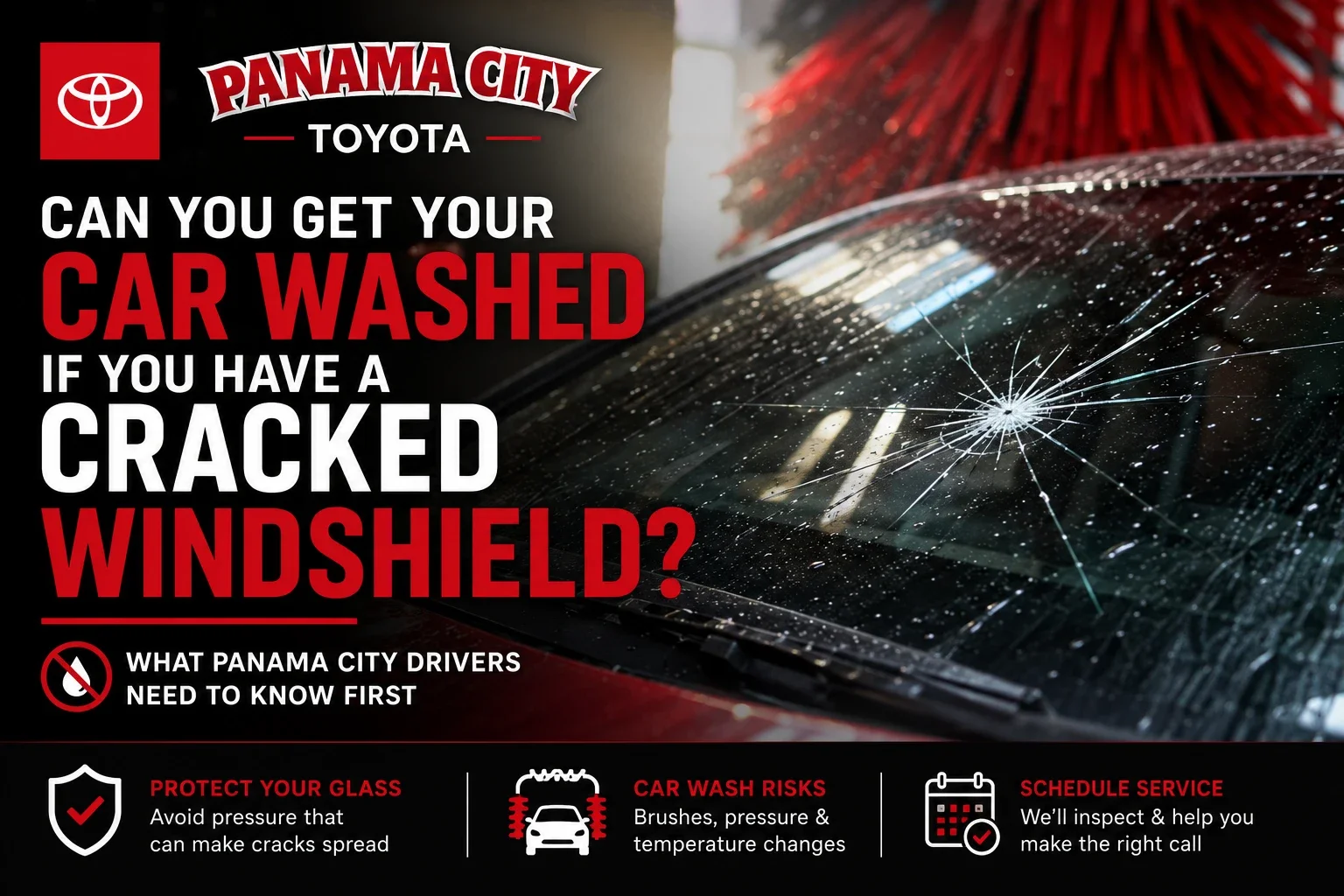
Can You Get Your Car Washed If You Have A Cracked Windshield?

Can You Get Your Car Washed If You Have A Cracked Windshield?

Quick Summary Can You Wash a Car With a Cracked Windshield? A cracked windshield does not always mean you can never wash your car, but it does mean you should be careful. Automatic car washes, high-pressure water, spinning brushes, strong dryers, and sudden temperature changes can make existing windshield damage spread. For very small chips, a gentle hand wash may be the safer short-term option. If the crack is long, spreading, near the edge of the windshield, or in your line of sight, skip the wash and schedule an inspection before putting more stress on the glass. Best Advice Avoid automatic washes until the crack is inspected. Main Risk Pressure, brushes, dryers, and temperature swings can spread cracks. Safer Option Use a gentle hand wash and avoid spraying directly into the crack. Table of Contents Use this guide to understand when a car wash is safe, when it is risky, and when Panama City Toyota recommends scheduling service first. 1 Quick Answer 2 Why Car Washes Can Be Risky 3 Touchless Car Washes 4 When to Avoid the Wash 5 Safer Hand Washing 6 Pressure Washer Risks 7 Florida Heat and Cracks 8 Schedule Toyota Service 9 FAQ A cracked windshield can make even simple maintenance decisions feel uncertain. Maybe your Toyota needs a wash after a week of rain, pollen, beach air, road dust, or bugs on the glass. But if there is already a chip, crack, or star-shaped break in the windshield, is it safe to run the vehicle through a car wash? The short answer is: it depends on the size, location, and severity of the crack, but it is usually smarter to avoid automatic or high-pressure car washes until the windshield is inspected or repaired. A small chip may not seem like a major issue at first, but water pressure, temperature changes, soap, brushes, air dryers, and vibration can sometimes make windshield damage spread. If the crack is already long, deep, near the edge of the glass, or in the driver’s line of sight, a car wash may create extra risk. At Panama City Toyota, our service team helps local drivers understand when a simple chip needs attention, when a windshield concern should be inspected, and when it may be better to delay washing the vehicle until the glass is repaired. Quick Answer: Should You Wash a Car With a Cracked Windshield? You can sometimes gently hand wash a vehicle with a very small windshield chip, but you should avoid automatic car washes, high-pressure spray, spinning brushes, and strong air dryers if the windshield has a crack. These can add pressure, vibration, and temperature stress to already damaged glass. If the crack is spreading, longer than a few inches, near the windshield edge, or blocking your view, do not run the vehicle through a car wash. Schedule an inspection or repair first. Why a Cracked Windshield Can Get Worse in a Car Wash Your windshield is designed to protect you, support visibility, and help maintain the structure of the cabin. When the glass is cracked, it is already under stress. A car wash can add more stress in several ways. Automatic car washes may use high-pressure water, rotating brushes, strong detergents, forced air dryers, and sudden changes in temperature. Even if each part of the process seems harmless, the combination can make an existing crack more likely to spread. Common car wash risks include: High-pressure water pushing into the crack Brushes adding vibration or direct pressure Hot or cold water creating temperature stress Air dryers forcing moisture deeper into damaged glass Existing cracks spreading toward the edge of the windshield Small chips becoming longer cracks after the wash That does not mean every cracked windshield will break during a car wash. But once the glass is damaged, the safer choice is to reduce pressure and avoid anything that could make the crack worse. Is a Touchless Car Wash Safer for a Cracked Windshield? A touchless car wash may be safer than a brush-style car wash because it does not physically scrub the windshield. However, touchless washes often rely on strong water pressure and chemical cleaners to remove dirt without contact. That means a touchless wash can still be risky if your windshield crack is already spreading or if the damage is close to the edge of the glass. If you must clean the vehicle before repair, a gentle hand wash is usually the safer option. Use low water pressure, avoid spraying directly into the crack, and do not scrub aggressively over the damaged area. When You Should Not Use a Car Wash With a Cracked Windshield You should avoid automatic car washes if the windshield damage looks serious or unstable. Some cracks are more likely to spread than others, especially when exposed to pressure, vibration, heat, or cold. Avoid the car wash if: The crack is longer than a few inches The crack is spreading The damage is near the edge of the windshield The crack is in the driver’s line of sight The glass has multiple chips or cracks You hear creaking or see movement near the damaged area Water has already entered the crack The crack appeared after an impact or road debris The windshield was recently damaged and has not been inspected If you are unsure, it is better to pause the wash and get the windshield checked first. Can Water Get Into a Windshield Crack? Yes, water can get into a windshield crack. That moisture may not seem like a problem right away, but it can make the damage harder to repair and may contribute to spreading if the glass is exposed to heat, cold, vibration, or pressure. In Panama City, drivers deal with heat, humidity, rain, salty air, sand, road debris, and sudden weather changes. Those conditions can make it even more important to address windshield damage early. A small chip that could have been repaired may become a larger crack if it is ignored for too long. What About Washing Around the Crack by Hand? If the crack is very small and you need to clean the vehicle, hand washing is usually the safest approach. The goal is to clean the car without putting extra pressure on the damaged glass. A safer hand-wash approach includes: Use low-pressure water Avoid spraying directly into the crack Use a soft microfiber towel Do not scrub the cracked area Avoid extreme hot or cold water Dry the windshield gently Do not use a pressure washer near the crack Schedule repair as soon as possible This is not a replacement for repair. It is simply a lower-risk way to clean the vehicle temporarily. Can a Pressure Washer Make a Windshield Crack Worse? Yes, a pressure washer can make a windshield crack worse. Direct high-pressure spray can push water into the damaged area and add stress to the glass. If the crack is already weak, the pressure may cause it to spread. Avoid using pressure washers directly on: Windshield cracks Stone chips Star-shaped impact damage Edge cracks Previously repaired glass Areas where the glass looks separated or unstable If your windshield has damage, keep high-pressure water away from it until the glass is inspected. Does Heat Make Windshield Cracks Spread? Heat can make windshield cracks worse, especially when the glass experiences sudden temperature changes. For example, a hot windshield hit with cold water may expand and contract quickly, increasing stress around the damaged area. This matters in Florida because your vehicle can sit in direct sun for hours. If the glass is already hot, running it through a car wash with cooler water or strong air drying may create extra stress. To reduce risk: Avoid washing the vehicle when the windshield is extremely hot Park in the shade before cleaning Avoid sudden temperature changes Do not blast the crack with cold water Repair chips and cracks early Should You Repair the Windshield Before Washing the Car? In many cases, yes. If the crack is visible, spreading, or more than a small chip, it is better to repair or replace the windshield before using an automatic car wash. Repairing the issue first can help protect your visibility, prevent the damage from spreading, and reduce the chance of turning a small problem into a larger one. If the windshield damage is minor, a technician can help determine whether repair is possible. If the damage is severe, replacement may be the safer option. Is It Safe to Drive With a Cracked Windshield? A small chip may not immediately make the vehicle unsafe to drive, but a larger crack can affect visibility and windshield strength. Any crack in the driver’s line of sight should be treated seriously. You should schedule service or inspection soon if: The crack blocks your view The damage reflects sunlight at night or during sunrise/sunset The crack is spreading The windshield has multiple damaged areas The crack reaches the edge of the glass You are planning a long drive You frequently drive on highways or rough roads Your windshield is part of your vehicle’s safety system. It is not just a piece of glass. What Should You Do Before Washing a Car With a Cracked Windshield? Before washing the vehicle, inspect the windshield carefully. Look at the size, location, shape, and direction of the crack. If it looks larger than before or reaches toward the edge of the glass, skip the car wash and schedule inspection. Use this quick checklist: Is the crack longer than a few inches? Is the crack in your direct line of sight? Is the damage close to the windshield edge? Has the crack grown recently? Are there multiple cracks or chips? Has water already entered the crack? Did the crack happen after a rock impact? Are you considering an automatic car wash? If you answer yes to any of these, avoid the car wash and get the windshield checked first. Why Local Drivers Should Take Windshield Cracks Seriously Panama City drivers face a mix of heat, rain, coastal air, highway driving, construction areas, and road debris. A small windshield chip can happen quickly, especially on busy roads or after a vehicle ahead kicks up a rock. Once damage appears, waiting too long can make the repair more difficult. Even regular driving can create vibration that causes the crack to grow. Add a car wash into the mix, and the risk can increase. Taking care of the issue early helps protect visibility, safety, and long-term repair costs. Schedule Toyota Service in Panama City, FL If your Toyota has a cracked windshield, a chip, or another visibility concern, Panama City Toyota can help you decide the right next step. Our service team can inspect your vehicle, explain what we see, and help you schedule the right repair or maintenance visit. Panama City Toyota serves drivers from Panama City, Panama City Beach, Callaway, Lynn Haven, Pretty Bayou, Springfield, and surrounding Florida communities. Schedule service online with Panama City Toyota or contact our service team before running your vehicle through an automatic wash with windshield damage. Suggested internal links to add in the editor: Schedule Service: /schedule-service Service Center: /service-center.html Service Specials: /service-parts-specials.html Parts Department: /parts/ Frequently Asked Questions Can I go through a car wash with a cracked windshield? It is usually better to avoid automatic car washes if your windshield is cracked. High-pressure water, brushes, dryers, vibration, and temperature changes can make the crack spread. A gentle hand wash is safer until the windshield is inspected or repaired. Is a touchless car wash safe with a cracked windshield? A touchless car wash may be safer than a brush-style wash, but it can still use high-pressure water and strong drying systems. If the crack is long, spreading, or near the edge of the windshield, avoid the wash and schedule inspection first. Can a car wash make a windshield crack worse? Yes. A car wash can make a windshield crack worse, especially if the wash uses high-pressure water, spinning brushes, strong air dryers, or sudden temperature changes. These can add stress to already damaged glass. Can water get inside a cracked windshield? Yes. Water can enter a windshield crack. Moisture inside the damaged area may make the crack harder to repair and can contribute to spreading over time, especially with heat, vibration, or pressure. Can I pressure wash a cracked windshield? No. You should avoid pressure washing a cracked windshield. Direct high-pressure spray can push water into the crack and may cause the damage to spread. Is it better to repair a windshield before washing the car? Yes. If the crack is visible, spreading, near the edge, or in the driver’s line of sight, repair or inspection should come before an automatic car wash. This helps reduce the risk of making the damage worse. Can I hand wash a car with a cracked windshield? You may be able to gently hand wash a vehicle with a small windshield chip or minor crack. Use low water pressure, avoid spraying directly into the crack, and dry the glass gently. Do not scrub or use a pressure washer on the damaged area. When should I stop driving with a cracked windshield? Stop driving or schedule immediate inspection if the crack blocks your view, spreads quickly, reaches the edge of the glass, or affects your ability to see clearly. Windshield damage can affect visibility and safety. Does Florida heat make windshield cracks worse? Florida heat can contribute to windshield crack growth, especially when hot glass is exposed to cooler water or sudden temperature changes. Parking in shade and repairing chips early can help reduce the risk of spreading. Where can I schedule Toyota service in Panama City, FL? You can schedule Toyota service with Panama City Toyota in Panama City, FL. The service team can help with maintenance, inspections, Toyota parts, and repair-related questions. Now that you have finished reading this guide, we at Panama City Toyota hope you've learned some of the risks associated with washing your vehicle if your windshield is cracked. If you have additional questions before you start washing your car, or if you are looking for a new or used Toyota vehicle, don't hesitate to reach out to us. You can also visit us for a quick cracked windshield repair.

Contact Us

Fill out this form below and we'll contact you shortly
*Required Fields